Madonna of Foligno
Madonna di Foligno
Take a moment to look closer.
Raphael · Vatican MuseumsRaphael · Madonna of Foligno · 1511 - 12
Guide
This huge altarpiece is a thank-you letter to the Virgin. It was ordered in 1511 by Sigismondo de' Conti, a humanist from the town of Foligno and a secretary of Pope Julius the second. Something had struck his house in Foligno, a lightning bolt according to the museum, and the house had survived. He believed the Virgin had saved it.
Look up first. The Virgin sits on clouds, holding the Child, inside a great golden disc of light. All around, the blue sky is full of small angel faces that seem to form out of the clouds.
Now look down, on earth. On the right the old donor kneels in a red, fur-lined cloak, his hands joined in prayer. Behind him Saint Jerome, with his long beard, lays a hand on his head and presents him to the Virgin. His lion peeks out at the right edge. On the left stand Saint John the Baptist, dressed in animal skins, and Saint Francis, kneeling. John looks out at us and points up to the vision.
In the centre, a small angel holds a tablet with no writing on it. Behind him lies a landscape with the town of Foligno under a rainbow. Look for the ball of fire falling towards the houses. That is the miracle, told in one tiny detail.
The painter is Raphael. He was working at the same time on the rooms of the pope's apartment, here in the Vatican. It was his first altarpiece painted in Rome, and it shows him at the height of his maturity.
The work
The painting is more than three metres high. Raphael painted it on wood, but today it is on canvas. The picture was transferred from panel to canvas in Paris, around 1800, because it was in poor condition. The museum describes the medium as tempera grassa, a rich, oily tempera, while other sources call it oil.
The picture is a sacra conversazione, a holy conversation. Saints and a living man share one space with the Virgin and seem to talk with one another. But Raphael changed the old formula. The Virgin does not sit on a throne under a canopy, as in earlier Umbrian and Florentine altarpieces. She appears in the sky, as a vision.
The picture is split into two worlds, heaven above and earth below, and Raphael binds them together with gestures and glances. John and the kneeling Francis direct our eye towards the Virgin. The little angel lifts his gaze to her. The Virgin turns towards the donor, and he looks back at her. Francis, meanwhile, stretches one hand towards us, as if to include us in the prayer.
The colours help too. The Virgin wears red, the colour of a mother, and blue, the colour of a queen. Around her disc of light, a crown of blue seraphim takes shape from the clouds. Below, the donor's purple cloak lined with ermine answers her red.
There is one surprise. Saint Jerome is often shown in cardinal's red, and the museum's text speaks of cardinal's vestments. Here, though, he wears an unusual blue robe. His lion lets us recognise him.
The painting was restored under the direction of Cesare Brandi in the late 1950s.
Context
The donor, Sigismondo de' Conti, was a distinguished humanist from Foligno, in Umbria, and served Pope Julius the second as a secretary. The sources agree that he ordered the painting as an ex voto, a gift to thank the Virgin for saving his house. They disagree about what happened. The museum speaks of lightning. Other sources mention a meteor, ball lightning, or a cannon shot that threw a burning ball, perhaps during a siege of the town.
The altarpiece was made for the high altar of Santa Maria in Aracoeli, the church on the Capitoline Hill in Rome, where the donor was buried. He died in 1512, at about eighty, probably before the work was finished.
In 1565 a descendant, the nun Anna Conti, had it moved to the church of Sant'Anna in Foligno, at the monastery of the Contesse. It stayed there for more than two centuries, and that is where its name comes from.
Then came Napoleon. Under the Treaty of Tolentino, the picture was taken to Paris, to the Louvre. The museum gives the year 1797. In Paris, restorers moved the paint layer from the old panel onto canvas. A commission recorded every step, and its report, published in 1802, is still an important source for the history of restoration.
After the fall of Napoleon, the sculptor Canova worked to recover the works taken from Italy. The painting came back in 1816, according to the museum. Pope Pius the seventh decided to keep it in Rome, in the Vatican Pinacoteca, rather than send it back to Foligno. It hangs in the same room as Raphael's Transfiguration.
Details
Take in the whole picture first. It is shaped like a tall arch. Heaven fills the upper half, earth the lower half, and the little angel stands exactly on the line between them, right in the middle.
Now look up at the Virgin and Child. They are gathered in an oval, under the Virgin's protective mantle. The Child is not a solemn little god giving a blessing. He is a real child, wriggling in his mother's arms and pulling at her veil. One of her fingers seems to tickle him under the arm, and he twists away. The Virgin recalls the one in the Adoration of the Magi by Leonardo, and the Child one by Michelangelo, as if Raphael were blending famous models.
Next, look into the landscape in the middle. The air is damp and trembling, with very original effects of light. Scholars see the influence of Venetian painting and of painters from Ferrara such as Dosso Dossi. Look closer: a rainbow arches over the small town, and inside it a burning ball seems to fall on the houses.
Come down to the little angel. He gazes up at the vision, dreamy and serious. He holds a tablet with two handles, in an ancient shape, but no words are written on it. It was probably meant to record the vow the Virgin had granted. Some scholars link it to the tablets on tombs, like a silent epitaph for the donor.
Finally, turn to the right. The portrait of the donor is often judged one of Raphael's finest. Look at the hollow cheeks, the sharp cheekbones, the deep-set eyes and the bony, wrinkled hands. Behind him, the lion of Jerome watches quietly.
Details up close
Legacy
The Madonna of Foligno marks a turning point in Raphael's career. It was his first altarpiece painted in Rome, and it shows his full maturity in composition, colour and form. It is also the closest forerunner of one of his most famous works, the Sistine Madonna.
The picture shows how Raphael could make ideal beauty feel familiar. The Virgin is a queen of heaven, yet she plays with her child like any mother. The saints are solemn, yet they turn, point and look at us. This lively naturalness is one reason why the work has been loved for five centuries.
Scholars have also read deeper layers into it. The church of Aracoeli once held a fresco by Pietro Cavallini, now destroyed. It showed the Virgin and Child appearing in a circle of light to the emperor Augustus, on the Capitoline Hill, on the day of the birth of Christ. The altarpiece stood beneath that fresco, and it may echo the same theme, turned into a funeral memorial for the donor. This would explain his sunken face, almost like a death mask.
The painting also has a place in the history of conservation. The report on its transfer to canvas in Paris is unique of its kind and is still studied today.
Finally, a modern curiosity. Some websites have claimed that the ball of fire shows a flying saucer crashing. The historian Massimo Polidoro rejects this idea. He points out that painters of the time used symbols that were anything but random, and that such readings look at another culture through twenty-first-century eyes.
- Date
- 1511 - 12
- Technique
- Tempera grassa su tavola trasportata su tela
- Size
- cm 308 x 198
- Inventory
- 40329
- Image
- Wikimedia Commons · CC BY-SA 4.0
- Official page
- www.museivaticani.va
Sources (5)
- Musei Vaticani – Raffaello Sanzio, Madonna di Foligno · official
- Vatican Museums – Raphael, Madonna of Foligno · official
- Wikipedia (en) – Madonna of Foligno · academic
- Wikipedia (it) – Madonna di Foligno · academic
- 维基百科(中文)– 弗利尼奥圣母 · academic
In the same area
 Image failed to load
 Image failed to load
 Image failed to load
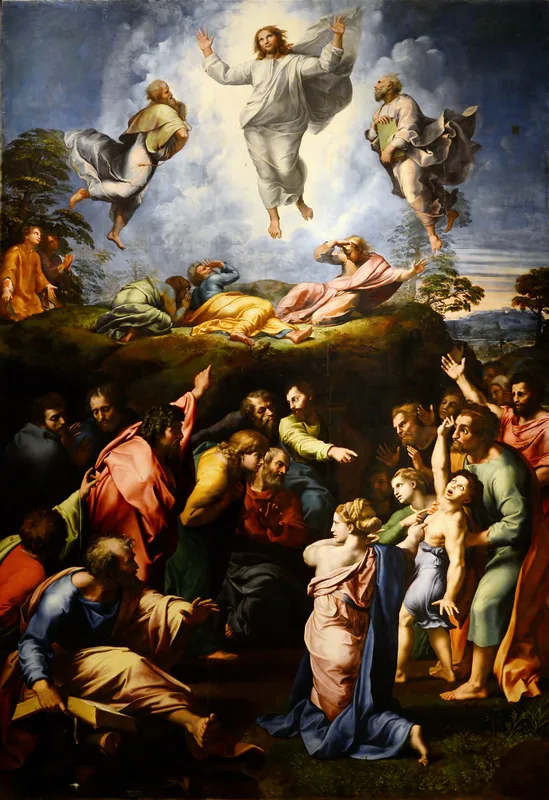 Image failed to load
 Image failed to load
 Image failed to load
 Image failed to load
By the same artist
 Image failed to load
 Image failed to load
 Image failed to load
 Image failed to load
 Image failed to load
 Image failed to load
 Image failed to load
 Image failed to load
Personal, non-commercial site. Image: Wikimedia Commons · CC BY-SA 4.0.
Pinch or scroll to zoom