The School of Athens
Scuola di Atene
Plato wears Leonardo's face; Raphael paints himself in a corner.
Raphael · Vatican MuseumsRaphael · The School of Athens
Guide
You are looking at one of the best-known paintings of the Renaissance, a fresco almost eight metres wide. Its famous name, the School of Athens, was not chosen by the artist. It was given centuries later. The real subject is philosophy, the search for truth through reason.
Look first at the centre, framed by the last arch. Two men walk towards you, deep in conversation. The old man with the white beard is Plato. He points up to the sky and holds his book, the Timaeus. Beside him walks his pupil Aristotle, holding his Ethics, with his hand stretched out flat above the ground. All the lines of the floor and the vaults lead your eye to the space between them.
Around them, more than fifty figures read, write, argue and teach. Only a few can be named with confidence. An old man sprawls on the steps: that is Diogenes. On the left, Pythagoras writes in a large book. On the right, a man bends over a slate with a pair of compasses, usually called Euclid. Many of the other names are guesses, and scholars still disagree about them.
The painter was the young Raphael, from Urbino. Pope Julius II had given him this room, which the pope used as his library and private study. Raphael gave some of the ancient thinkers the faces of men of his own time. Plato is traditionally said to have the features of Leonardo da Vinci. And at the far right edge, a young man in a dark cap looks straight out at you. That is the painter himself.
The work
The scene is set inside a vast, imaginary building. Its coffered vaults, its open dome and its huge piers recall the grand halls of ancient Rome. They also echo the design of the architect Bramante for the new basilica of St Peter, which was being built at the same time. The roof is left open, so a clear sky shines behind the philosophers.
In the niches stand two statues. On the left is Apollo, god of light and music, holding a lyre. On the right is Minerva, goddess of wisdom, with her helmet, her spear and a shield bearing the head of Medusa. The reliefs below them help to identify the two gods.
A broad flight of steps divides the crowd into two levels. Plato and Aristotle stand on the upper level, at the very top of the stairs. Plato is old, grey and barefoot. Aristotle is a man in his prime, in sandals and a robe edged with gold. To the left of Plato, a man in a green tunic counts off his arguments on his fingers. He is Socrates, recognised from his portraits in ancient marble busts. In the foreground, two groups gather around teachers: Pythagoras on the left, the geometer on the right.
The work is a fresco. The colours were brushed onto fresh, wet plaster, section by section, so they became part of the wall itself. The examination of the plaster has revealed that one figure, the brooding Heraclitus in front, was painted after all the others.
The painting has suffered. During the Sack of Rome in 1527, soldiers lit fires in the room, and the smoke damaged the frescoes. They also scratched graffiti into the lower band, later hidden by repainting. Centuries later, French plans to cut the frescoes from the walls and send them to France came to nothing.
Context
When Pope Julius II was elected, he chose not to live in the rooms of his predecessor. He moved to a set of rooms on the floor above and decided to have them painted anew. A team of artists was already at work when, in the last months of 1508, a young painter from Urbino joined them. He had probably been called to Rome by Bramante, who came from the same region.
The pope was so impressed that he entrusted him with the whole project. Older paintings were destroyed to make room for his, among them works by Piero della Francesca. According to the biographer Giorgio Vasari, Raphael was sorry to lose them.
This room was the first to be decorated. It served as the pope's library and private study, and the paintings follow that purpose. Each wall is devoted to one field of knowledge: theology, philosophy, poetry and justice. On the ceiling, above this fresco, a female figure represents Philosophy. The words beside her mean "knowledge of causes". Together, the walls celebrate the True, the Good and the Beautiful. Opposite this painting, the Disputation shows the truth revealed by faith. Here we see the truth reached by human reason.
Nobody knows exactly who designed this learned programme. The museum says it was certainly a theologian. Scholars point to a circle of humanists at the papal court, deeply influenced by the ideas of Plato.
The design changed a great deal on the way. An early drawing, now in Siena, shows one philosopher enthroned above a crowd of pupils. The full-size cartoon for the lower half survives in the Ambrosiana in Milan. It already contains almost every figure, but not the architecture, not Heraclitus and not the painter's self-portrait. The room later took its name from a papal court of justice, the Segnatura, which met here in the sixteenth century.
Details
Take in the whole wall first. The painted arch, the steps and the floor pattern all work like a stage set. The vanishing point of the perspective lies between the two central figures, and the sky behind them sets them apart.
Now look closer at Plato and Aristotle. The two gestures are the key to the picture. A popular reading says that Plato points to the world of ideas, and Aristotle to the world we can see and touch. Not everyone agrees. The philosopher Giovanni Reale noted that Aristotle does not point down at all: his palm hovers between earth and sky.
Next, the lower left. Pythagoras sits over a book, and a young man holds up a small tablet with signs of musical harmony. A man in a turban leans over his shoulder, usually named Averroes. Nearby, a young figure in white looks out at us. Many scholars see Francesco Maria Della Rovere, the pope's nephew. A popular modern idea makes this figure the woman mathematician Hypatia, but no source supports it.
Then look at the man alone on the steps, leaning on a block of marble. He is Heraclitus, and by tradition he has the face of Michelangelo, then painting the ceiling of the Sistine Chapel. He was added last, perhaps as a tribute. Legend has it that Raphael crept into the chapel at night to see his rival's work. Notice his heavy boots, which Michelangelo was known to wear.
Finally, the lower right. A bald man bends to draw with compasses, with the features of Bramante. Look at the decoration of his tunic: some read tiny letters there as Raphael's signature. Behind him, the crowned Ptolemy holds the earth, and a bearded man, perhaps Zoroaster, holds the heavens. At the edge, a young man in a dark cap looks out at us. This is Raphael.
Details up close
Legacy
The fresco was a success from the very start. Its beauty and its unity were admired at once, without the doubts that greeted some other great works of the time. It is often called the perfect embodiment of the classical spirit of the Renaissance.
Much of its power comes from the space. The painter built a deep, convincing architecture with accurate perspective, and filled it with people who seem to think with their whole bodies. The art historian Heinrich Wölfflin warned against reading the painting as a secret treatise. For him, what mattered was how each figure expresses a state of mind through movement.
Scholars have still offered many readings. Some see the seven liberal arts, the subjects of an educated mind, laid out group by group. Others see the ideas of Marsilio Ficino and other thinkers close to Plato, for whom love lifts us towards higher knowledge. As early as the sixteenth century, the pair at the centre was compared to the apostles Peter and Paul. None of these readings is accepted by everyone.
The portraits of living artists mattered too. By giving the likely faces of Leonardo, Michelangelo and Bramante to ancient sages, and by placing himself among them, the painter claimed a new dignity for his profession. Art, he seemed to say, belongs beside philosophy.
The fresco has been copied again and again. Anton Raphael Mengs painted a large copy in 1755, now in the Victoria and Albert Museum in London. A tapestry woven by the Gobelins workshop in 1689 for Louis XIV hangs in the French National Assembly. The Politecnico di Milano uses the group around the painter's self-portrait as its emblem. Two figures even appear on the covers of albums by the rock band Guns N' Roses.
- Image
- Wikimedia Commons · Public domain
- Official page
- www.museivaticani.va
Sources (10)
- Musei Vaticani – Scuola di Atene · official
- Vatican Museums – The School of Athens · official
- Vatican Museums – Room of the Segnatura · official
- Web Gallery of Art – The School of Athens · guide
- Wikipedia (en) – The School of Athens · academic
- Wikipedia (it) – Scuola di Atene · academic
- Wikipedia (en) – Stanza della Segnatura · academic
- 维基百科(中文)– 雅典学院 · academic
- Musei Vaticani – Stanza della Segnatura · guide
- Wikipedia (it) – Stanza della Segnatura · academic
In the same area
 Image failed to load
 Image failed to load
 Image failed to load
 Image failed to load
 Image failed to load
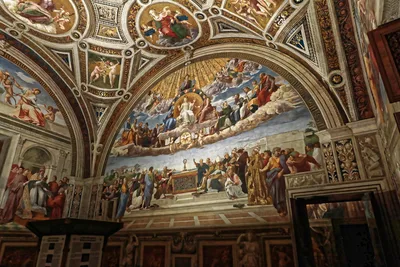 Image failed to load
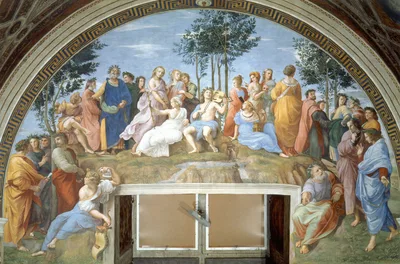 Image failed to load
 Image failed to load
By the same artist
Personal, non-commercial site. Image: Wikimedia Commons · Public domain.
Pinch or scroll to zoom