The Mass at Bolsena
Messa di Bolsena
Take a moment to look closer.
Raphael · Vatican MuseumsRaphael · The Mass at Bolsena
Guide
This fresco tells the story of a miracle. In 1263, a priest from Bohemia was saying Mass at Bolsena, a small town near Orvieto. He had doubts. He could not quite believe that the bread of the Mass truly became the body of Christ. At the moment of consecration, according to the story, blood trickled from the host and stained the white altar cloth. His doubts vanished.
Look first at the centre, high above the window. The priest in a blue and gold vestment holds up the host, and his face shows surprise. Behind him, young clerics kneel with tall candles.
Now look to the right of the altar. Kneeling calmly, with his hands joined in prayer, is a man who lived two and a half centuries later: Pope Julius II. He rests his elbows on a cushion with tassels, as if he were present at the miracle. Behind him stand cardinals from his court, and below them sit the men who carried his chair.
On the left, by contrast, the crowd reacts with excitement. People crane forward, point and gesture, while women sit on the steps with their children.
Raphael faced a real problem here. A window cuts into the wall, and it is not in the centre. He solved it brilliantly, raising the altar on a platform above the window and placing a group on each side.
The pope had a special devotion to the Eucharist, and he chose the scene. It is also a showcase of colour. Look at the red robes of the cardinals and the striped costumes of the chair-bearers, glowing against the white marble steps.
The work
The fresco fills an arched wall about five metres high and more than six and a half metres wide. Its lower part is broken by a window almost three metres wide, set off centre. This forced the composition. Raphael built a raised platform in the middle for the altar, reached by steps, and placed two groups of figures below it, one on each side. He varied the steps and the masses on either side, so the balance feels natural rather than rigid.
Behind the altar rises a dark wooden screen, curved like a choir stall of the painter's own day. Two curious men lean over it to see what is happening. Beyond, as in the School of Athens, a classical church opens to the sky.
The altar is covered with a cloth striped with gold, and a few liturgical objects stand on it, painted with restraint. The priest celebrates the Mass, and many clerics kneel behind him holding processional candles.
Opposite him kneels Julius II, in all the pomp of his office. His elbows rest on a large cushion with tassels at the corners, set on a folding stool carved with lions. Behind him is a group of cardinals, and lower down the papal chair-bearers wait, seated.
On the left, the onlookers stand or sit on the ground in surprise, repeating gestures of wonder like actors. The tension on the right is held inside, as if the witnesses were meditating on the event.
The colours are especially bold. The reds, greens and golds stand out sharply against the white marble of the steps. The left part of the fresco has been heavily restored, which has cost it some of its quality.
Context
This was the second scene painted in the room, after the Expulsion of Heliodorus. An inscription in the window recess gives the year: it names Julius II and the year 1512, the eighth of his pontificate. A few years earlier, another painter, Bramantino, had painted figures of military leaders on this same wall. They were covered over.
The subjects of the room were chosen by the pope at a hard moment. In 1511 he had lost Bologna to the French, and foreign armies threatened Italy. He vowed not to shave until the country was free of foreigners, which is why he has a beard here. The room's paintings show God protecting his Church. In this scene, it is the faith that is protected.
The subject was personal. Julius had a special devotion to the Eucharist. The scene also honoured his uncle Sixtus IV, himself a pope, who had promoted the cult of the body of Christ. And it celebrated the Church at a council held at the Lateran, which opened in May 1512. In that year the alliances were reversed and the pope enjoyed a moment of triumph. Compared with the preparatory sketches, he had himself shown more prominently in the finished fresco.
The miracle was an important one for the papacy. According to tradition, the stained cloth was taken to Orvieto, and a year later, in 1264, Pope Urban IV established the feast of Corpus Christi. The cathedral of Orvieto was built to honour the relic, which is still venerated there.
The pope is not alone. The museum names the cardinals behind him as his relatives Leonardo Grosso della Rovere, Raffaello Riario, Tommaso Riario and Agostino Spinola. Other scholars identify two of them differently, including Gabriele de' Gabrielli, with his arms crossed. So the identifications are not settled.
Details
Step back and see how the whole scene is built around the window. The altar sits on its platform like a stage, framed by the dark curve of the wooden screen and a patch of blue sky above. The two sides are different in mood: agitation on the left, stillness on the right. One scholar suggests that the contrast is also about time. The crowd on the left reacts to a miracle as it happens, while the pope's group seems to recall it in prayer.
Start at the altar. The priest wears a blue vestment embroidered with golden leaves. He holds the host above the chalice, and looks at it closely, as if he cannot believe his eyes. Candlesticks and sacred vessels stand on the altar, painted with quiet precision.
Now look across at Julius II. His white beard, red cape and joined hands make him the calmest figure in the picture. Notice the carved lions on the stool and the heavy tassels of the cushion. Rather than a miracle happening, it is a miracle repeated before the pope as a witness.
Look down to the lower right, at the chair-bearers. They sit in striped red, green and black costumes, one with a sword at his side. Their faces look like real portraits. Some scholars even think a Venetian painter, Lorenzo Lotto, inspired or painted them. Look at the young man who stares straight at us: one source sees him as a self-portrait of Raphael, shown as a member of the Swiss Guard, but that is not certain.
Finally, the left side. A woman in yellow twists round on the steps, and mothers with small children sit on the ground. According to one source, the woman in dark clothes, shown in profile at the bottom of the steps, is the pope's daughter, Felice della Rovere.
Details up close
Legacy
The Mass at Bolsena is often admired as one of Raphael's most balanced compositions. He turned an awkward wall, broken by an off-centre window, into a solution that looks effortless. The steps, the platform and the two groups fit together so naturally that most visitors never notice the problem.
It is also famous for its colour. The richness of the reds, greens and golds has long puzzled scholars. Many linked it to Venetian painting and to artists from the Venetian world who worked in Rome, such as Sebastiano del Piombo and Lorenzo Lotto. One early twentieth-century scholar even thought that Sebastiano had painted the group of cardinals. Later critics questioned this. They stressed that colour had always been central to Raphael's art, and that the influence between him and Sebastiano may have run both ways. The debate has not been settled.
The fresco shows a new way of treating history. The miracle happened long ago, but the witnesses are the pope and his court of 1512. The ancient architecture is only a backdrop. The event becomes a ritual repeated in the present, with the living pope as its guarantor.
For the papacy, the message was powerful. It showed the authority of the Church over the sacraments, and linked Julius II to the Eucharist, a devotion his family had long promoted. It also celebrated a moment of political triumph.
The miracle itself still shapes the life of the region. The feast of Corpus Christi is celebrated throughout the Catholic world, and the stained cloth is still venerated in the cathedral of Orvieto.
A study for one of the female figures survives in the collection of the dukes of Devonshire at Chatsworth.
Sources (8)
- Musei Vaticani – Messa di Bolsena · official
- Vatican Museums – The Mass at Bolsena · official
- Vatican Museums – Room of Heliodorus · official
- Web Gallery of Art – The Mass at Bolsena · guide
- Wikipedia (it) – Messa di Bolsena · academic
- Wikipedia (it) – Stanza di Eliodoro · academic
- Wikipedia (en) – The Mass at Bolsena · academic
- Musei Vaticani – Stanza di Eliodoro · guide
In the same area
 Image failed to load
 Image failed to load
 Image failed to load
 Image failed to load
 Image failed to load
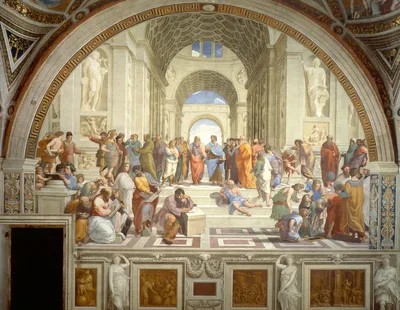 Image failed to load
 Image failed to load
 Image failed to load
By the same artist
Personal, non-commercial site. Image: Musei Vaticani · © Governatorato SCV – Direzione dei Musei.
Pinch or scroll to zoom