The Parnassus
Parnaso
Take a moment to look closer.
Raphael · Vatican MuseumsRaphael · The Parnassus
Guide
This fresco is a celebration of poetry. It decorates a room that was probably meant as the study and library of Pope Julius II, where each wall stands for one branch of knowledge: theology, philosophy, law and, here, poetry. The scene is Mount Parnassus, the home of the Muses in Greek myth.
Look first at the top of the hill, in the centre. The god Apollo sits by a spring, crowned with laurel. He is not playing an ancient lyre but a modern instrument of the painter's own day, a lira da braccio, played with a bow. Around him are the nine Muses, the goddesses who protect the arts.
Now let your eyes run down the slopes. Poets from antiquity and from more recent times gather there, talking, listening and pointing. On the left, the blind old man singing with his face lifted is Homer. Right beside him you can find Dante in profile, and Virgil. At the bottom left, a woman holds a scroll with her name written on it. She is Sappho, the only woman poet in the scene.
The painter had a difficult wall to work with, because a window cuts into the bottom of it. Instead of fighting the window, he wrapped the hill around it, so that the poets seem to sit and stand on its frame, almost in our own space.
The fresco was painted around 1510 and 1511, in the same years as the School of Athens in this room. It is a picture of harmony, where music, poetry and learned conversation meet in one calm and sunlit gathering.
The work
The fresco is about six and a half metres wide at the base. Its shape is unusual, because a window opens in the middle of the wall. The composition climbs over the window like a gentle hill, with Apollo and the Muses at the top and the poets on the slopes and at its foot.
Apollo sits at the summit, near the Castalian spring. His instrument has nine strings instead of the usual seven, perhaps a reference to the nine Muses. The two Muses closest to him are Calliope, the Muse of epic poetry, and Erato. The others are grouped behind them. Calliope, Erato and Sappho hold instruments copied with care from an ancient Roman sarcophagus decorated with the Muses.
There are eighteen poets in all. Some can be named with certainty, others only by guesswork. On the upper left are the epic poets: blind Homer, the young Ennius listening to him, then Dante, Virgil and Statius. On the lower left are lyric poets, among them Sappho and, further back, Petrarch. On the right, other ancient and modern poets come down the hill. One of them may be Boccaccio, and the man turning towards us may be Jacopo Sannazaro, but scholars disagree about many of these names.
Below, on either side of the window, are two scenes painted in shades of a single colour, like reliefs. In one, Alexander the Great has the poems of Homer placed in a precious casket. In the other, the emperor Augustus stops the Aeneid from being burned, against the wishes Virgil left in his will. These two scenes were probably painted by assistants from the master's design.
The figures are modelled strongly, almost like sculpture. The wall is seen against the light from the window, and the painter needed this strong relief to balance the real glare.
Context
Julius II decided in 1507 to move into these upper rooms of the palace. He did not want to live in the apartment below, decorated for his hated predecessor, Alexander VI. At first he hired a team of painters. A young artist from Urbino came from Florence in the summer of 1508, probably called by the architect Bramante. In 1509 the pope gave him the entire project and had the earlier paintings destroyed.
According to one early writer, the pope himself suggested the programme of the room, and theologians and humanists of his court worked it out. The four walls stand for theology, philosophy, law and poetry, each linked to a female figure on the ceiling. Above this wall, a round medallion shows Poetry, and a nearby panel shows Apollo and Marsyas.
The exact order of the walls is debated. One account places this fresco second, between the Disputation and the School of Athens. Others place it after the School of Athens, in 1510 and 1511. An inscription in the window recess names Julius II and the year 1511, the eighth of his reign. It may mark the end of this fresco or, more probably, of the whole room.
The place itself carried meaning. The window below frames the Vatican hill, which humanists of the time believed had been sacred to Apollo in antiquity.
An engraving by Marcantonio Raimondi records an earlier design. There, Apollo and the Muses sat in a shady laurel wood, cupids flew overhead with crowns for the poets, and Sappho did not yet appear. Preparatory drawings survive too, in Lille, Windsor and Oxford.
Soon after the work was finished, the room was used by the highest papal court, the Segnatura, which gave it the name it still has today.
Details
Start with the whole wall. The hill rises in a gentle arch above the real window, and the figures form a half-moon that opens towards us, as if to draw us into the audience. Slender laurel trees grow on the summit and stand out against the pale sky.
Now look at the centre. Apollo sits bare-chested on the rock, his face turned up towards the sky as he draws the bow across the strings. Just below his feet, a thin stream of water runs down the rocks: this is the Castalian spring. Two Muses sit on either side of him. On the left, in white, is Calliope. On the right, in pale blue with a lyre on her lap, is Erato. Behind them, one of the Muses holds a theatre mask.
Next, move to the upper left. The tall old man in the deep blue robe is Homer. His head is lifted and his eyes see nothing. The face is borrowed from the ancient Laocoön. Just beside him, in profile and crowned with laurel, is Dante, looking towards Virgil.
Then look down to the lower left, beside the window. A woman sits on the rock, twisting round, and raises a small sheet in her left hand. Look closer: it bears her name, Sappho. In her other hand she holds a lyre that rests on the ground.
Finally, look at the lower right. An old poet with a laurel wreath sits on the very edge of the window frame and gestures down towards us. The others around him talk, reflect with a hand on the chin, or turn to face the room. Here the painted hill and the real room seem to meet.
Details up close
Legacy
Critics have often found this fresco more eloquent than poetic. The poets strike the poses of orators, as if each were declaiming his own kind of verse, tragic, lyric or epic. Yet the whole scene flows naturally. The groups are linked by glances and gestures, and nothing feels stiff.
It is also full of borrowings, which learned visitors of the time would have enjoyed spotting. For the face of Homer, the painter used the head of the Laocoön, the ancient marble group found in 1506 and brought to the Vatican. Here, however, the expression speaks of blindness rather than pain. Two of the women, the Muse Euterpe and Sappho, have been said to recall figures of Michelangelo.
The fresco has also invited a long game of names. Scholars have proposed many identities for the poets, and some suspect that, as in the School of Athens, the ancient poets were given the faces of humanists of the day. The French historian Chastel doubted many of these names.
Another reading is cosmic. For some scholars, the nine Muses stand for the spheres of the universe, and Apollo is the principle that sets the cosmos in order through the sound of his instrument.
The fresco once risked leaving Rome. Under the Jacobin republic and in the Napoleonic period, the French made plans to detach the frescoes of these rooms and send them to France. The plan was never carried out, because of the technical difficulties and the disastrous attempts made in the church of San Luigi dei Francesi.
Today the Parnassus remains one of the clearest images of a Renaissance ideal: that the poets of pagan antiquity and of Christian Italy could meet as equals on the same sunlit hill.
- Image
- Wikimedia Commons · Public domain
- Official page
- www.museivaticani.va
Sources (7)
- Musei Vaticani – Parnaso · official
- Vatican Museums – The Parnassus · official
- Wikipedia (en) – The Parnassus · academic
- Wikipedia (it) – Parnaso (Raffaello) · academic
- 维基百科(中文)– 帕那苏斯山 · academic
- Wikipedia (en) – Stanza della Segnatura · academic
- Wikipedia (it) – Stanza della Segnatura · academic
In the same area
 Image failed to load
 Image failed to load
 Image failed to load
 Image failed to load
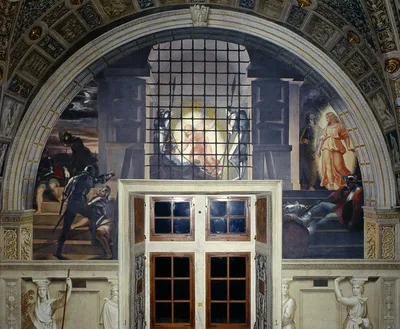 Image failed to load
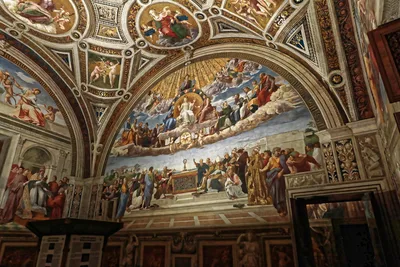 Image failed to load
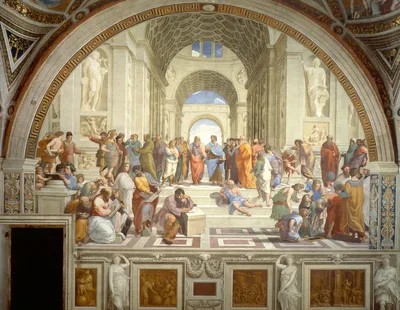 Image failed to load
 Image failed to load
By the same artist
Personal, non-commercial site. Image: Wikimedia Commons · Public domain.
Pinch or scroll to zoom