The Fire in the Borgo
Incendio di Borgo
Take a moment to look closer.
Raphael · Vatican MuseumsRaphael · The Fire in the Borgo
Guide
This scene shows a miracle in the district in front of Saint Peter's, known as the Borgo. According to the Book of the Popes, the Liber Pontificalis, a terrible fire broke out there in the year 847. Then the pope, Leo IV, gave his solemn blessing from the Loggia of the Blessings, and the flames died down. The church and its people were saved.
Look first into the far background, in the centre. There, small and calm, the pope stands on a balcony and raises his hand in blessing. Below him, a crowd kneels and stretches out its arms. The empty space in the middle of the picture leads your eye straight to him, even though he is tiny compared with the figures in front.
Then look at the foreground, which is full of panic. On the left, a building burns. A naked young man hangs from a wall, and a woman leans over to pass a baby to a man below. Further left, a young man carries an old man on his back, like the hero Aeneas escaping from burning Troy with his father. On the right, women hurry with jars of water on their heads and in their hands.
The fresco was designed by Raphael in 1514, for Pope Leo X. The new pope chose stories of earlier popes called Leo, so that their glory would shine on him too. Much of the painting was carried out by the workshop, probably including the young Giulio Romano.
Take a moment to compare the stillness of the pope with the storm of bodies in front. That contrast is the message of the picture: faith calming disaster.
The work
The fresco measures about six and a half metres by five. It is built like a stage set. Two groups of buildings stand at the sides like the wings of a theatre, and between them a deep view opens into the distance.
On the left rises a ruined temple with Corinthian columns, which recalls the ancient temple of the Dioscuri. Through an arch behind it, a building is in flames and its roof has already fallen in. On the right stands an Ionic temple, which recalls the ancient temple of Saturn.
In the background, the pope appears in a palace of rusticated stone, in the manner of Bramante. Further to the left, you can glimpse the façade of the old basilica of Saint Peter, decorated with mosaics. The empty space and all the gestures lead the eye towards the pope, although he is small.
The foreground is divided into separate episodes. On the left, a naked young man lowers himself down a wall, every muscle straining. A woman hands a baby in swaddling clothes to a man below. Nearby is the group of Aeneas, carrying his father Anchises on his shoulders, with his son Ascanius at his side. Behind them walks the old nurse Caieta. In the centre, women and children kneel and turn towards the pope. On the right, women struggle with vessels full of water to fight the fire in the temple.
The heroic nudes show the influence of Michelangelo. As for who painted what, opinions differ. A common view, going back to the scholar Cavalcaselle, gives the left side and part of the right to Giulio Romano, and the women in the centre to Penni or to Giovanni da Udine. To Raphael himself it gives the head of the girl carrying two vessels, and some figures in the background, including the pope.
Context
Leo X was elected pope in March 1513, after the death of Julius II. The painter, then just over thirty, was already the leading artist at the papal court, and he now took on even more work: the new basilica of Saint Peter, tapestries for the Sistine Chapel, and studies of the monuments of ancient Rome.
For this room, the pope chose a programme in praise of earlier popes with his own name, Leo III and Leo IV. The idea may have come from the Meeting of Leo the Great and Attila in an earlier room, where his own portrait had replaced that of Julius II. Here, too, the pope had his features given to the popes in each scene. So the Leo IV blessing the crowd is also a portrait of Leo X. The stories came largely from the Liber Pontificalis. A letter of 1514 from the painter to Baldassarre Castiglione suggests that the courtier helped to choose the subjects.
This was the first scene of the room to be finished, and it gave the room its name. Sources describe the room in different ways, as the pope's private dining room or as a music room. Its ceiling had been painted earlier by Perugino for Julius II, and it was kept. According to Vasari, the reason was the painter's affection for his old master.
The scene also carries a message. The fire recalls the burning of Troy in the Aeneid of Virgil, a way to celebrate the heroic history of Rome. And the pope who puts out the flames alludes to the role of Leo X as a peacemaker, at a time when wars kept flaring up among the Christian powers.
The later scenes in the room were painted more and more by assistants, among them Giulio Romano, Giovan Francesco Penni and Giovanni da Udine.
Details
Begin with the whole scene. Buildings frame it on both sides like the wings of a theatre, and a wide, empty square opens in the middle. Everything in front is movement and noise, while everything behind is calm.
Look first at the far left. A powerful young man carries an old man on his back, followed by a naked boy and an old woman in a white headscarf. This is Aeneas saving his father Anchises from burning Troy, with his son Ascanius and the old nurse Caieta. Some see in her a faint echo of the Libyan Sibyl that Michelangelo painted on the Sistine ceiling.
Next, look just to the right of them. A naked young man hangs from the top of a wall, stretching his body down before he lets go. Above him, a woman leans out and passes a baby in swaddling clothes to a man in a red cap, who reaches up to take it.
Now let your eyes travel deep into the background. On the balcony of a stone palace stands the pope, surrounded by his clergy, raising his hand in blessing. Look closer at the band of stone below the balcony: it carries an inscription with his name, Leo the Fourth. Just to the right, flames and smoke rise from the building next door.
Finally, turn to the right. A tall woman walks away from us with a great green jar balanced on her head. A girl in pale blue lifts a basin of water to a man who leans down to take it. Their clothes and hair are whipped by the wind, just as Vasari described them. One view gives the head of a girl turning towards us with two vessels to the master himself.
Details up close
Legacy
For a long time this fresco was widely praised. Vasari admired the women whose hair and clothes are whipped by the wind, and the young man who carries an old man as Aeneas carried Anchises. In the seventeenth century, Giovanni Pietro Bellori wrote that one could not imagine a more beautiful conception in the grand style. In the nineteenth, Jacob Burckhardt called it the most exalted genre picture that exists.
Its central scheme was also widely taken up by the classicist painters of the seventeenth century: a small, calm figure far away, towards whom all the gestures in the foreground converge.
In the twentieth century the tone changed. Several scholars criticised the fresco for its lack of unity and its rigid figures. One of them called it an unconnected sequence of isolated episodes, with a melodramatic parade of emotions. Others doubted that the master had painted it at all, and saw the hand of Giulio Romano. Frederick Hartt concluded that an idea born in the master's mind had been developed by a different personality.
More recent readings are more generous. In 2010 Patricia Reilly suggested that the disunity and the over-muscled bodies may be deliberate and humorous, a parody of the style of Michelangelo, meant for a small circle of learned courtiers in the pope's private rooms. Other scholars see the fresco as an experiment. It mixes the traditions of Urbino, Umbria, Florence and Venice, much as the writers of the court were then debating which language to write in.
Whatever one thinks of it, the painting marks a turning point. The harmonious calm of the Stanza della Segnatura gives way here to a bolder, more theatrical style. From these experiments grew the classicism that so deeply shaped the generations that followed.
- Image
- Wikimedia Commons · Public domain
- Official page
- www.museivaticani.va
Sources (7)
- Musei Vaticani – Incendio di Borgo · official
- Vatican Museums – The Fire in the Borgo · official
- Wikipedia (en) – The Fire in the Borgo · academic
- Wikipedia (it) – Incendio di Borgo · academic
- 维基百科(中文)– 梵蒂冈城门外的火灾 · academic
- Wikipedia (en) – Raphael Rooms · academic
- Wikipedia (it) – Stanza dell'Incendio di Borgo · academic
In the same area
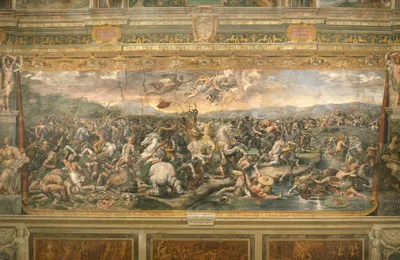 Image failed to load
 Image failed to load
 Image failed to load
 Image failed to load
 Image failed to load
 Image failed to load
 Image failed to load
 Image failed to load
By the same artist
Personal, non-commercial site. Image: Wikimedia Commons · Public domain.
Pinch or scroll to zoom