The Disputation of the Holy Sacrament
Disputa del Sacramento
Take a moment to look closer.
Raphael · Vatican MuseumsRaphael · The Disputation of the Holy Sacrament
Guide
This huge fresco is known as the Disputation of the Holy Sacrament, but the title is misleading. Nobody is really quarrelling here. The museum suggests a better name: the Triumph of Religion. It shows heaven and earth gathered around a single small object, the consecrated host of the Eucharist.
Find that object first. In the centre of the lower half, on an altar, stands a golden monstrance with the white host inside. All the lines of the perspective lead to it.
Now look up in a straight line above it. First comes the dove of the Holy Spirit, in a golden circle. Above the dove, Christ sits on the clouds, showing his wounds, between the Virgin Mary and John the Baptist. At the very top, God the Father blesses the scene from a sky of golden rays. On either side, saints and prophets sit on a curved bank of clouds. This is the Church in heaven.
Below, on the ground, is the Church on earth. Popes, bishops, theologians and ordinary believers crowd around the altar, arguing, reading, pointing and praying. Some of them have the faces of real people. Traditionally, the laurel-crowned man on the right is the poet Dante.
The fresco faces the School of Athens across the room. There, philosophers seek truth through reason. Here, the truth revealed by faith is shown. It was probably the first of the large wall paintings Raphael made in this room, around 1509, when he was in his mid-twenties.
Look closely at the lower edge. In raking light you may see faint scratched graffiti, left by soldiers during the Sack of Rome in 1527.
The work
The fresco fills a whole arched wall, about seven and a half metres wide. It is built in two tiers. Above is the Church Triumphant, the saints already in heaven. Below is the Church Militant, the Church still at work on earth.
Heaven is arranged along a central vertical axis. At the top, God the Father holds the globe and blesses, surrounded by golden rays. These rays are modelled in raised stucco, so they catch the light. Below him, Christ sits within a great halo of light full of little angels, with the Virgin on one side and John the Baptist on the other. Beneath Christ, the dove of the Holy Spirit points straight down at the host. Four small angels hold open the books of the four Gospels.
Around Christ, patriarchs and prophets of the Old Testament alternate with apostles and martyrs, seated on a semicircle of clouds. According to the museum, from left to right, they are Peter, Adam, John the Evangelist, David, Laurence, Judas Maccabeus, Stephen, Moses, James the Elder, Abraham and Paul. Other sources order a few of them differently.
On earth, the altar stands at the top of a few steps, in an open landscape. On the marble seats nearest to it sit the four Latin Doctors of the Church, whose names are written in their haloes. Around them crowd popes, bishops, theologians, poets and anonymous believers. Not all of them have been identified.
The whole design is based on circles. Concentric rings spread out from the host, which is also the vanishing point of the perspective. Circles also mark the central axis: the halo of the dove, the throne of Christ, the glory around God the Father.
In the background, on the left, a church is being built. On the right rises a great block of marble.
Context
The room was the first that Raphael decorated for Pope Julius II. The young painter from Urbino arrived in Rome in the last months of 1508. The pope was so impressed by his first work that he gave him the whole project, and earlier paintings were destroyed. Work began with the ceiling and continued on this wall. Sources date the fresco slightly differently, from 1509 to 1511, but it was probably the first of the great wall scenes.
The room served as the pope's library and private study. Each wall is devoted to a field of knowledge. This one is theology, and on the ceiling directly above it, a female figure of Theology presides. The museum describes the whole programme as a celebration of the True, the Good and the Beautiful. This wall shows supernatural truth, the truth revealed by God. The School of Athens opposite shows the truth reached by reason.
The ideas behind it are learned. Scholars link the programme to theologians and humanists at the papal court. Some think the fresco was inspired by a sermon of the Augustinian friar Egidio da Viterbo. How much came from the painter and how much from his advisers is not clear.
The title we use today goes back to an eighteenth-century misreading of the biographer Vasari. A disputation implies a quarrel, but Raphael wanted to show lively, eager discussion of the great Christian mystery of the Eucharist.
Raphael worked his way to the final design through many drawings. The first sketch, now in the Royal Library at Windsor, shows a simpler, less crowded scheme, without the altar and the host in the centre. Other studies are in Oxford, Chantilly, the British Museum, Lille and Montpellier.
The fresco was an immediate success at the papal court. Vasari wrote that no painter could create anything more graceful or more perfect.
Details
Step back and take in the whole wall. Notice how the curve of the heavenly clouds echoes the curve of the arch, and how the crowd on earth forms a second, wider curve around the altar. Everything turns around the small white host.
Look up first at the central axis in heaven. God the Father, the golden rays, Christ in his great halo, the dove: they are stacked one above the other, all pointing down to the altar. Beside Christ, the Virgin bows in adoration, while John the Baptist points to him. The calm, heavy figures on the clouds seem almost motionless.
Now come down to the altar. The monstrance stands against the open sky. The altar cloth bears the name of Julius II. Its knotted ornament recalls the designs by Leonardo in the Sala delle Asse in Milan. Around the altar, the Doctors of the Church sit on marble thrones. Saint Jerome, reading, has his lion beside him. Saint Gregory the Great, the museum tells us, has the features of Julius II. The saints on the right look up or dictate.
Then move to the right. The pope in the shining golden cope is identified as Sixtus IV, the uncle of Julius II, with his book at his feet. Behind him is a man in red with a laurel wreath, traditionally Dante. This face of the poet appears on the Italian two-euro coin. Further back, half hidden under a dark hood, some see the preacher Savonarola, a surprising presence. Further right, a man leans eagerly over a stone parapet.
Finally, look up at the ceiling directly above the fresco. A woman in a red robe sits among the clouds. She is Theology, and the little angels beside her hold tablets with an inscription that means knowledge of things divine.
Details up close
Legacy
The Disputation marks Raphael's arrival as a great painter in Rome. Earlier painters, such as Perugino and Pinturicchio, had shown rows of holy men as a simple gallery of portraits. Raphael turned the crowd of theologians into a real assembly, caught in a shared action. His drawings show how, step by step, he made their gestures more lively and their feelings warmer, while keeping them all focused on the host.
The fresco also shows his gift for clear, simple structure. Instead of obscure symbols, he created a scene that looks concrete, eloquent and familiar. Heaven is serene and still. Earth is animated. The living still search and question, while the saints in heaven are at peace in the presence of God.
Its portraits have fascinated visitors ever since. Some are certain, others traditional. The museum names Julius II as Saint Gregory, Sixtus IV, Dante and Fra Angelico. Other sources add Bramante leaning on the balustrade on the far left and the young Francesco Maria Della Rovere, the pope's nephew. The presence of Savonarola, condemned by Pope Alexander VI, is the most debated. One explanation is that Julius II, an enemy of the Borgia pope, had revoked that condemnation.
The building site in the background has often been read as a reference to the new basilica of St Peter, which Julius II had just begun. The great block of marble on the right may allude to the cornerstone of the Church.
The fresco has survived hard times. During the Sack of Rome in 1527, soldiers scratched insults to the pope into the painted surface, and some can still be seen near the bottom. Later, French plans to detach the frescoes of these rooms and send them to France came to nothing.
Today it remains the counterpart to the School of Athens: faith and reason, facing each other across the same room.
- Image
- Wikimedia Commons · CC BY-SA 4.0
- Official page
- www.museivaticani.va
Sources (9)
- Musei Vaticani – Disputa del SS. Sacramento · official
- Vatican Museums – The Disputation of the Most Holy Sacrament · official
- Vatican Museums – Room of the Segnatura · official
- Web Gallery of Art – Disputation of the Holy Sacrament · guide
- Wikipedia (it) – Disputa del Sacramento · academic
- Wikipedia (en) – Disputation of the Holy Sacrament · academic
- Wikipedia (en) – Stanza della Segnatura · academic
- 维基百科(中文)– 圣礼之议 · academic
- Musei Vaticani – Stanza della Segnatura · guide
In the same area
 Image failed to load
 Image failed to load
 Image failed to load
 Image failed to load
 Image failed to load
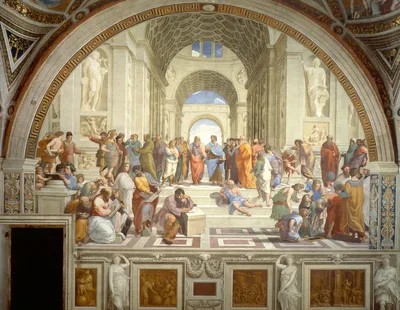 Image failed to load
 Image failed to load
 Image failed to load
By the same artist
Personal, non-commercial site. Image: Wikimedia Commons · CC BY-SA 4.0.
Pinch or scroll to zoom