The Battle of the Milvian Bridge
Battaglia di Ponte Milvio
Take a moment to look closer.
Giulio Romano (Raphael's workshop) · Vatican MuseumsGiulio Romano (Raphael's workshop) · The Battle of the Milvian Bridge
Guide
This huge battle scene is almost eight and a half metres wide. It shows the clash at the Milvian Bridge, just north of Rome, on 28 October 312. Two rival Roman emperors fought here. Constantine won, and his rival Maxentius drowned in the Tiber. For the Church, this was the moment when Christianity triumphed over the pagan world.
Find Constantine first. He rides a white horse in the very centre, wearing a gold crown and golden armour, and his horse tramples the enemy. Above him, three angels with swords swoop down from the clouds, a sign that heaven is on his side. Now look to the right. The bridge is packed with soldiers, and below it Maxentius, still wearing his crown, is swept away by the river with his horse.
Look also at the edges of the scene. It is painted to look like a gigantic tapestry, hanging from the cornice and curling at the corners.
The idea came from Raphael, who planned this hall for Pope Leo X. But Raphael died suddenly in April 1520, and the painting was carried out by his workshop, above all by his pupil Giulio Romano. It was finished within four years.
The painters took great care with the setting. The green hill on the left is Monte Mario, and a building there is probably Villa Madama, a villa that Raphael himself was designing at the time. A battlefield of the fourth century is placed in the landscape of the sixteenth.
The work
The fresco is enormous, almost four metres high and more than eight metres wide. It is a crowded, violent scene, full of bodies in every pose: soldiers falling, horses rearing, men grappling on the ground.
The painters looked closely at ancient Rome. The tangled fighting is inspired by the battle reliefs carved on Roman sarcophagi and other monuments. The figure of the emperor himself is modelled on the emperor in an ancient frieze on the Arch of Constantine.
In the centre, Constantine advances in triumph. The enemy troops stand in his way, but they bend before his unstoppable charge. On the right, the Milvian Bridge is crammed with men. In the river, archers shoot at the boats of the army of Maxentius and overturn them, while other soldiers are pushed into the water by the press of the fighting. Among them is Maxentius himself, on horseback and recognisable by his crown, now doomed.
The setting is surprisingly precise. The battle takes place north of Rome. On the left rise Monte Mario and the building site of Villa Madama. In the background, the painters included the cliffs of Saxa Rubra.
The scene is framed as a woven hanging. All four main paintings in this hall pretend to be tapestries hung on the walls. Look for the painted fringe along the top and the curled lower corners. On either side stand figures of popes and virtues. Below the battle, smaller scenes painted in one colour tell what happened next, among them the finding of the body of Maxentius.
Raphael had planned to paint this hall in oil on the wall. After his death, his pupils found the method disappointing and returned to traditional fresco, which was quicker and more reliable.
Context
This is the largest of the Raphael Rooms, about ten metres by fifteen. Pope Leo X commissioned its decoration in 1517. The theme is the life of the emperor Constantine and the victory of the Church over paganism. The pope attached great importance to it. According to a famous document, later shown to be a forgery, Constantine had given Rome to the popes, so his story supported the Church's claim to worldly power.
Raphael, busy with countless projects, only had time to prepare the designs. He died suddenly on 6 April 1520. The museum states that the first idea of this composition is certainly his, but that the painting was executed by Giulio Romano, who completed it after his master's death. The biographer Vasari also gave the cartoon, now in the Louvre, to Giulio Romano. Some scholars prefer another pupil, Giovan Francesco Penni.
The work did not go smoothly. Six days after Raphael died, the Venetian painter Sebastiano del Piombo wrote to his friend Michelangelo, asking for help to win the commission for himself. He obtained part of the job for a short time, but he clashed with Raphael's assistants, who refused to let him use their master's drawings.
Opinions of the first results were mixed. A letter of December 1520 reports that the pope found the paintings poor. A year later, the writer Baldassarre Castiglione wrote that he admired the work, then about half done.
The decoration was finished by 1524, under Pope Clement VII, when Giulio Romano left Rome for Mantua. Much later, in the Napoleonic period, French officials made plans to detach the frescoes and take them to France. The technical difficulties were too great, and the paintings stayed where they are.
Details
Step back and take in the whole wall. The painted tapestry is packed with movement from edge to edge. Yet the composition has a clear axis. The eye is drawn to the centre, where the only calm figure in the chaos rides forward, and then to the right, towards the bridge and the river, where the battle is decided.
Start with Constantine. He is crowned and dressed in gilded armour, holding a spear, on a rearing white horse. Around him, standards rise into the sky. Look at the men beneath the hooves: they are twisted and falling, while the emperor looks straight ahead. His calm is the message. Victory, the painting says, comes from God, not from the fury of the fight.
Now look up. Three angels in fluttering robes fly across the sky with drawn swords, pointing the way. They confirm that the outcome of the battle is divine. Notice how they sweep in the same direction as the charge below.
Then turn to the lower right. The bridge arches across the river, crowded with soldiers. Beneath it, a small boat tips over as archers aim at the men inside. And in the water, a bearded man with a crown clings to his struggling horse. This is Maxentius, about to drown in the Tiber. Soldiers around him clutch at the current, and a shield floats away.
Before you leave, glance along the bottom of the painted tapestry. Helmets, shields and fallen weapons lie scattered on the ground, as in the carved battles of ancient sarcophagi that inspired the painters.
Details up close
Legacy
Because it is not by the master's own hand, this fresco is less famous than the paintings in the neighbouring rooms. Yet it is a key work for understanding what happened to Raphael's art after his death. His workshop carried on without him, using his designs, and his pupils brought the great project to an end.
The fresco also shows how the popes used history. The victory of Constantine was presented as the victory of Christianity over the pagan world, and the whole hall exalts the Church and its settlement in Rome. The painters echoed the monuments of ancient Rome to give that message the weight of the empire itself.
Scholars still debate who did what. The museum and Vasari name Giulio Romano as the painter. Others see the hand of Giovan Francesco Penni in the cartoon. The general design, all agree, goes back to Raphael.
A recent discovery changed the story of the hall. It had long been thought that Raphael never painted here at all. But in 2020, after a five-year restoration, experts concluded that two allegorical figures in this hall, a gentle woman with a lamb and a figure of justice holding a pair of scales, were painted by Raphael himself, in oil. They were done before all the other paintings in the room. That makes them his very last works, later even than the Transfiguration.
Legend has it that on the eve of the battle, Constantine saw a cross in the sky and was told that he would win under that sign. The painting next to this one tells that story.
The Milvian Bridge still stands in Rome today. For a long time cars crossed it, but now it is open only to people on foot.
- Image
- Wikimedia Commons · Public domain
- Official page
- www.museivaticani.va
Sources (8)
- Musei Vaticani – Battaglia di Costantino contro Massenzio · official
- Vatican Museums – The Battle of Constantine against Maxentius · official
- Web Gallery of Art – The Battle at Pons Milvius · guide
- Wikipedia (it) – Battaglia di Costantino contro Massenzio · academic
- Wikipedia (it) – Sala di Costantino · academic
- Wikipedia (en) – The Battle of the Milvian Bridge (Giulio Romano) · academic
- Wikipedia (en) – Raphael Rooms · academic
- Web Gallery of Art – Sala di Costantino, view · guide
In the same area
 Image failed to load
 Image failed to load
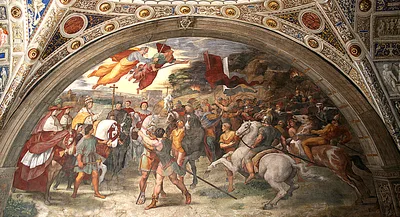 Image failed to load
 Image failed to load
 Image failed to load
 Image failed to load
 Image failed to load
 Image failed to load
Personal, non-commercial site. Image: Wikimedia Commons · Public domain.
Pinch or scroll to zoom