The Expulsion of Heliodorus from the Temple
Cacciata di Eliodoro dal Tempio
Take a moment to look closer.
Raphael · Vatican MuseumsRaphael · The Expulsion of Heliodorus from the Temple
Guide
This is the painting that gave the room its name. It tells a story from the Bible, from the second book of Maccabees. Heliodorus, a minister of the king of Syria, has come to the Temple of Jerusalem to seize its treasure. The high priest prays for help, and God answers.
Look first at the right. A horseman in golden armour charges in on a white horse, with two young men flying beside him, their hair streaming. Heliodorus lies on the ground under the hooves, and a vessel full of coins spills across the floor. His men flee in terror.
Now look at the far end of the hall. In the calm, empty centre, the high priest kneels at the altar, praying, beside a great lampstand. The whole miracle comes from his prayer.
Finally, look to the left. There, carried on a chair above the crowd, sits a man who does not belong to the ancient story at all. He is Pope Julius II, the patron of these rooms, watching calmly as the thief is punished. The message was clear to anyone who saw it: God protects the property of the Church, and the pope is its guardian. Among the men carrying the chair, the museum identifies the engraver Marcantonio Raimondi and the painter himself.
Raphael painted this scene around 1511 and 1512, with help from his workshop. Compare it with the calm, balanced frescoes he had just finished next door. Here the action is pushed to the sides, the light is dramatic and the figures rush and twist.
The work
The fresco fills a large arched wall, about five metres high and seven and a half wide. The story comes from the Bible, in the third chapter of the second book of Maccabees. King Seleucus of Syria sent his minister Heliodorus to take the treasure kept in the Temple of Jerusalem. The money had been set aside for widows and orphans. The high priest Onias prayed, and God sent a horseman with two youths, who beat Heliodorus and drove him out.
The painter follows the text closely. The rider wears golden armour. The two youths seem to fly rather than run, their feet barely touching the floor. Heliodorus is pinned against the lower right edge of the picture, with his soldiers and the stolen goods.
The setting is a grand classical building. A long nave, seen in steep perspective, opens to the sky at the far end, and its vaults are richly gilded. Light falls across the architecture and makes the space glow.
The composition is new for Raphael. In the School of Athens, everything radiated harmoniously from the centre. Here the centre is almost empty and still, full of deep shadow and flashes of light. The drama is packed into the two sides, where the figures crowd together.
The colours changed too. The tones are denser and warmer, perhaps under the influence of painters from Venice working in Rome, such as Sebastiano del Piombo and Lorenzo Lotto. The group of the pope on the left is warmer still, which suggests it was painted a little later.
The fresco has suffered. During the Sack of Rome in 1527, soldiers camping in these rooms are said to have lit a fire in the fireplace right below this scene. Later restorations were not always careful.
Context
While the first room was still being finished, in the summer of 1511, Raphael began designing this one. It was meant for the pope's private audiences. The subjects were chosen at a dark moment. Julius II had just returned to Rome after a disastrous war against the French, which had cost him the city of Bologna. Foreign armies threatened the whole peninsula.
So the pope chose a programme of miracles. Each wall shows a moment when God protected his Church. Its faith was threatened in the Mass at Bolsena, its head in the Liberation of Saint Peter, its seat in the meeting of Leo the Great and Attila, and its property here, in the story of Heliodorus. The museum links these scenes to the pope's own politics: to free Italy from the French and to defend the worldly power of the papacy.
History soon changed the painting. Julius had vowed not to shave until Italy was free of foreigners, which is why he appears with a beard in all the new scenes. Then, in 1512, alliances were reversed and the pope enjoyed a moment of triumph. It seems he then had himself added to the fresco as a witness, more visibly than planned. The story may also allude to his victory over the cardinals who had plotted against him and sided with the French.
Raphael relied more and more on assistants in this room. How much each of them painted is still debated. The nineteenth-century scholar Cavalcaselle gave the right side to Giulio Romano and the women on the left to Giovanni da Udine.
Preparatory work survives. The cartoon is in the Louvre, and a study of female figures is in the Ashmolean Museum in Oxford. A second version in tempera, probably a preparatory sketch, is kept in Civitavecchia, in Palazzo Manzi.
Details
Take in the whole scene first. The long nave pulls your eye deep into the distance, towards the patch of sky at the end. But the action happens at the edges, in two tight groups on either side of an empty floor. Your eye has to jump from one to the other, and that is part of the drama.
Start on the left with Julius II. He is carried high on a chair, dressed in red, bearded and unmoved, as if watching a play. The men carrying him wear the clothes of Raphael's own time. According to the museum, one of them is the engraver Marcantonio Raimondi, and the other is Raphael himself. The figure in profile beside them is thought to be the painter and architect Baldassarre Peruzzi.
Just above, look at the two figures climbing a column to get a better view. A man in green hugs the shaft while a boy hangs on below him. This lively detail was copied many times, even in the later frescoes of these rooms.
Now look closer at the centre. The high priest Onias kneels in prayer before the altar, in blue and gold, with a lit seven-branched lampstand beside him. He is small and far away, yet the perspective links him directly with the pope in the foreground.
Finally, the right side. The golden horseman rears over Heliodorus, who sprawls on the floor in armour. The two youths sweep in with raised arms. Behind them, soldiers flee with the loot on their shoulders, and a toppled vessel pours out gold coins. The horse has been compared to Leonardo's studies of horses. The crush of bodies against the frame recalls scenes on the Sistine ceiling by Michelangelo.
Details up close
Legacy
This fresco marks a turning point in Raphael's art. After the calm, balanced compositions of the first room, he broke the symmetry. The focus moves off centre, the light becomes dramatic, and the figures move with a new, restless energy. From this fresco onward, this dynamic formula appears again and again in his work.
Scholars see several influences at work. The powerful bodies and twisting poses owe much to Michelangelo, who was painting the Sistine ceiling nearby. The richer colour suggests the Venetian painters then active in Rome. The horse recalls Leonardo, whether his designs for the Battle of Anghiari or his studies for an equestrian monument; the sources suggest both.
Yet the painter keeps his own voice. The passion recalls Michelangelo, but Raphael holds a certain distance, an objective calm. One scholar put the contrast this way: for Michelangelo, history was a tragedy in progress. For Raphael, it was an example, a lesson to be shown. That is why the pope can sit so calmly at the edge of the scene, like a spectator at a theatre.
The exaggerated gestures and twisting bodies have also been seen as a first sign of Mannerism, the style that followed the High Renaissance.
The picture is also a striking piece of political art. A pope painted into an ancient Bible story, watching his enemies being driven out, turned a religious scene into a statement about the present.
Later artists returned to the subject. The Italian painter Francesco Solimena treated it in 1725, and the French painter Eugène Delacroix in 1850. The fresco itself survived both the Sack of Rome and, much later, Napoleonic plans to cut it from the wall and carry it off to France.
Sources (9)
- Musei Vaticani – Cacciata di Eliodoro dal tempio · official
- Vatican Museums – The Expulsion of Heliodorus from the Temple · official
- Vatican Museums – Room of Heliodorus · official
- Web Gallery of Art – The Expulsion of Heliodorus from the Temple · guide
- Wikipedia (it) – Cacciata di Eliodoro dal tempio · academic
- Wikipedia (it) – Stanza di Eliodoro · academic
- Wikipedia (en) – The Expulsion of Heliodorus from the Temple · academic
- 维基百科(中文)– 将赫略多洛赶出圣殿 · academic
- Musei Vaticani – Stanza di Eliodoro · guide
In the same area
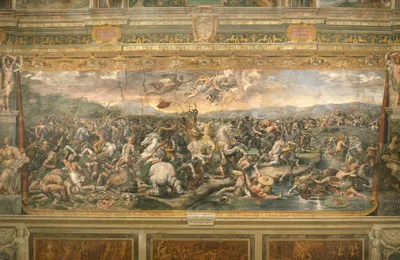 Image failed to load
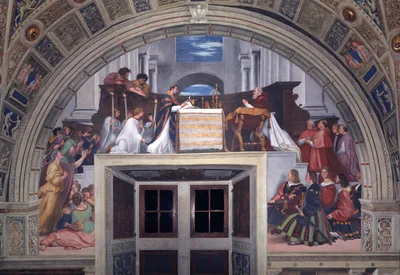 Image failed to load
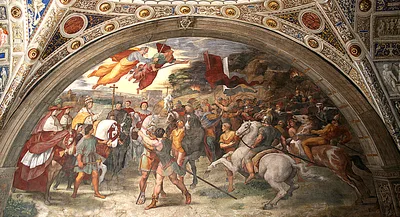 Image failed to load
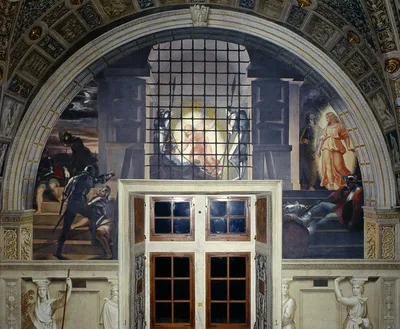 Image failed to load
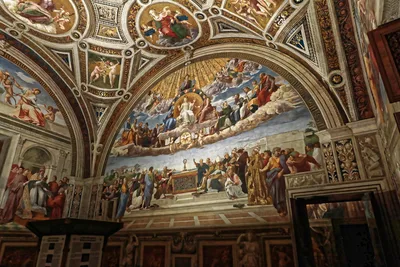 Image failed to load
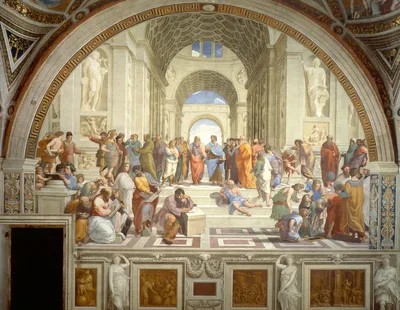 Image failed to load
 Image failed to load
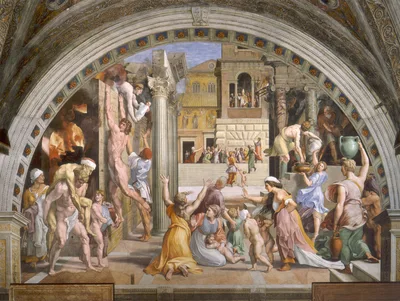 Image failed to load
By the same artist
Personal, non-commercial site. Image: Musei Vaticani · © Governatorato SCV – Direzione dei Musei.
Pinch or scroll to zoom