The Liberation of Saint Peter
Liberazione di San Pietro
Take a moment to look closer.
Raphael · Vatican MuseumsRaphael · The Liberation of Saint Peter
Guide
This is one of the earliest great night scenes in painting. It tells a story from the Acts of the Apostles. King Herod had thrown the apostle Peter into prison, chained between two soldiers, and planned to put him to death. During the night an angel came and set him free.
The wall is broken by a real window, so Raphael painted the story above and around it in three parts. Look first at the centre. Behind heavy iron bars, in a dark cell, an angel bursts in with a blaze of light and wakes Peter, who still sleeps in chains. The guards lean on their spears, fast asleep.
Now look to the right. The angel, glowing golden, leads Peter by the hand down the steps and out of the prison. Peter seems dazed, as if he were still dreaming. Below them, more guards sleep.
Then turn to the left. Here the alarm is raised. Under a crescent moon, a soldier points up at the cell, and his companions stir. A torch flickers, and its glow shines on their armour.
Light is the real subject of this fresco. The museum counts the divine light of the angel, the light of dawn, the moon, the torches, their reflections on the armour, and even the daylight that comes in through the window below.
The story had a personal meaning. Before he became pope, Julius II had been cardinal of the church of St Peter in Chains in Rome. The fresco was finished in 1514, under his successor Leo X.
The work
The fresco fills an arched wall more than six and a half metres wide at the base. A real window opens in the middle of its lower part. Rather than hide it, Raphael built his composition around it. The cell sits above the window, on an upper level, reached by flights of steps on the left and the right, much like the altar in the Mass at Bolsena on the opposite side of the room.
The story comes from the twelfth chapter of the Acts of the Apostles, and the painter tells it in three episodes. In the centre, the angel appears in the cell. On the right, he leads Peter out. On the left, the soldiers discover that the prisoner has gone. Although the story is split, the scene feels strongly unified.
The cell is the most striking part. It is seen through a grid of black bars, set between massive dark walls. The glow of the angel behind the bars creates a surprising sense of depth. The light reaches everything in the scene, even the prison walls, where reddish reflections linger.
Peter looks old and tired. Two guards in shining armour stand on either side of him, asleep on their feet. On the right, another guard slumps on the steps, his shield beside him.
On the left, the soldiers move about in a confused, half-lit crowd. The moon shines through the clouds, and a torch sends flickering light across the armour. There is also a faint light of dawn on the horizon.
The painting shows some later repairs in the background. Raphael's assistants took a larger part in this room than before, and the hand of his pupil Giulio Romano has been seen in this scene.
Context
The subjects of this room were chosen by Julius II at a difficult time. The French had taken Bologna, and foreign armies threatened Italy. Each wall shows God protecting his Church. In this scene, it is the person of the pope that is saved: Peter, the first pope, is rescued by divine help at the worst moment of his trials.
The subject was also personal. Before his election, Julius II had been the cardinal of the Roman church of St Peter in Chains. The story of Peter freed from his chains was, in a sense, his own story.
Scholars have suggested other meanings too. Peter's weary old face may allude to the death of Julius II in 1513, freed at last from his earthly prison. Or it may refer to the new pope, Leo X, who as a cardinal had been taken prisoner after the battle of Ravenna and was later freed. Both readings remain hypotheses.
To paint this fresco, Raphael had to destroy an earlier work by Piero della Francesca on this wall. It is a striking coincidence. Piero's Dream of Constantine, in Arezzo, is the only known earlier example of a night scene lit in this way.
An early drawing for the fresco is kept in the Uffizi. It shows several differences, above all a stricter symmetry. On two painted tablets in the window recess, an inscription records that the work was completed in 1514, in the second year of the pontificate of Leo X.
The theme of the dream also links the fresco to the ceiling above it, where the corresponding biblical scene shows the ladder of Jacob, seen in a dream.
Details
Step back and take in the whole wall. The window cuts into the middle, and the painting wraps around it like a stage with three scenes. Your eye goes first to the blaze of light at the top, then to the right, then to the left. The darkness of the night holds everything together.
Now look closer at the cell. Through the black grid of bars you can see the angel, surrounded by rays of light, bending over Peter. The old man is still asleep, his wrists chained to the two guards who stand on either side. Notice how the bars stand out against the light, like a window frame against the sun. The guards' armour catches the glow, and so do the dark stones of the walls.
Then move to the left side. Here is the most daring part of the painting. Look up to find the thin crescent moon among the clouds. Below it, a soldier in dark armour points up towards the cell, while another turns, startled, and a third shields his eyes. A torch burns in the middle of the group. The light of the moon and the flame glint on helmets and breastplates in quick, bright touches.
Finally, look at the right side. The angel, whose body shines as if made of light, takes Peter by the hand and leads him down the steps. Peter follows, bewildered, not sure whether he is awake or dreaming. At their feet, a guard sleeps slumped against the wall, his head resting on his arm. The whole scene has a strange, unreal calm, halfway between dream and reality.
Before you go, look at the real window below. When its shutters are open, daylight joins the painted lights above.
Details up close
Legacy
This fresco is celebrated above all for its light. Here, for the first time, Raphael attempted a true night effect, combining the natural light of the moon with the supernatural light of the angel. Light becomes the protagonist of the whole scene. Its only known precedent is the night scene by Piero della Francesca in Arezzo.
The painting also shows Raphael's gift for storytelling. He turned an awkward wall, broken by a window, into a sequence of three moments that we read in a single glance, like a play in three acts. The dreamlike calm of the right side contrasts with the agitation on the left, and both frame the burst of light in the centre.
It holds a special place in his career. According to one source, it is the last fresco in these rooms that can be attributed to Raphael with any certainty. The large cycles that followed, apart from the Sibyls in the church of Santa Maria della Pace, were entrusted mainly to his assistants. Other scholars see the hand of Giulio Romano even here, so the question of who painted what remains open.
The fresco also shows how the popes used the stories of the past. Peter, the first pope, saved from prison by God, stood for the papacy itself, rescued from its enemies in the troubled years of the wars in Italy. Julius II, the former cardinal of St Peter in Chains, could see himself in the story. Leo X, who had himself been freed from captivity, could too.
Like the other frescoes of the rooms, it survived the Napoleonic period, when French officials made plans to detach the paintings of Raphael and carry them off to France. The technical difficulties proved too great.
Sources (8)
- Musei Vaticani – Liberazione di San Pietro · official
- Vatican Museums – The Liberation of St Peter · official
- Vatican Museums – Room of Heliodorus · official
- Web Gallery of Art – The Liberation of St Peter · guide
- Wikipedia (it) – Liberazione di san Pietro · academic
- Wikipedia (it) – Stanza di Eliodoro · academic
- Wikipedia (en) – The Liberation of Saint Peter · academic
- Musei Vaticani – Stanza di Eliodoro · guide
In the same area
 Image failed to load
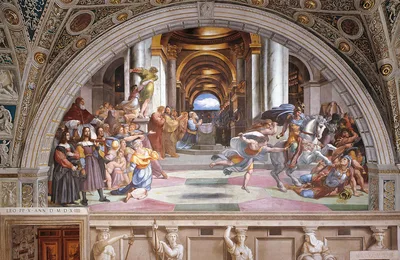 Image failed to load
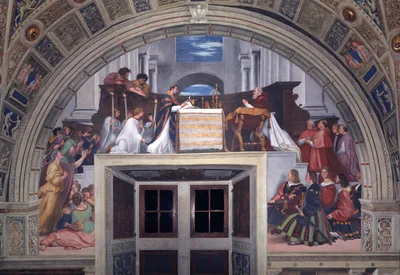 Image failed to load
 Image failed to load
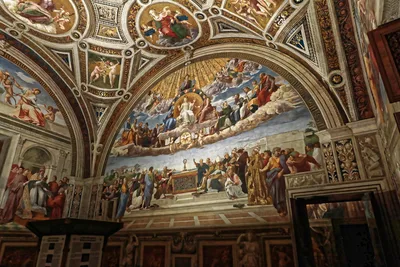 Image failed to load
 Image failed to load
 Image failed to load
 Image failed to load
By the same artist
Personal, non-commercial site. Image: Musei Vaticani · © Governatorato SCV – Direzione dei Musei.
Pinch or scroll to zoom