Musician Angels
Angeli musicanti
Take a moment to look closer.
Melozzo da Forlì · Vatican MuseumsMelozzo da Forlì · Musician Angels · 1480 ca.
Guide
This young angel with golden curls is one of the best-loved images in the whole Pinacoteca. He is a fragment of a much larger fresco, a wall painting that once covered the vault of the apse in the church of the Holy Apostles in Rome. The painter was Melozzo da Forlì, and he painted it around 1480.
The subject of the whole fresco was the Ascension of Christ. In the centre Christ rose into heaven, surrounded by apostles and by a crowd of angels playing music. The angel before you is one of those musicians. Look at how he turns his face in profile, bends his head over the lute and plucks the strings with care, as if he were listening to the sound. His wing, his red sleeves and his green cloak stand out against a deep blue sky.
The painting was meant to be seen from far below, high up in a vault. This is why the figures are so solid and so boldly foreshortened. The painter was a master of perspective, and a follower of the great Piero della Francesca.
The fresco survived for more than two centuries. Then, in 1711, the apse was destroyed to modernise the church. The painting was cut from the wall and divided into pieces, and large parts were lost. The figure of Christ went to the Quirinal Palace. The heads of apostles and the musician angels came to the Vatican, and one angel is now in the Prado in Madrid.
So what you see is a survivor. It is only a piece of a great lost ceiling, but even alone it still sings.
The work
The piece is a detached fresco, just over a metre tall. Fresco means painting on fresh, wet plaster, so the colours become part of the wall itself. When the church was rebuilt, the painted plaster had to be taken off the wall. You can still see the scars of that operation. Cracks run across the blue sky, and the edges are broken and uneven.
The official text of the museum speaks of fourteen fragments with apostles and musician angels, all shown together here in the Pinacoteca. They include four heads of apostles and two groups of small angels. The others are single angels, each with an instrument. There is an angel with a viol, one with a drum and a flute, one with a tambourine, one with a triangle and one with a rebec, a small bowed instrument. Three of them play the lute, like the angel on this page.
Look at how the figure is built. The body turns in space, the head in profile, the shoulders at an angle, the lute pressed against the chest. The large pear-shaped lute is seen from the side, and its round sound hole is carefully decorated. The drapery falls in broad, simple folds of green and red, which give the figure weight.
The light is clear and bright. It soaks the colours and softens the shadows. This comes from the example of Piero della Francesca, whom the painter knew at the court of Urbino. But the faces are gentler and more natural than in the older master, and this tenderness is typical of the painter from Forlì.
Each angel was once part of a single, huge vision. Today each one hangs alone, like a musician who has lost his orchestra.
Context
The church of the Holy Apostles stands in the centre of Rome. In the 1470s it was renewed on a grand scale. Pope Sixtus the fourth and his nephew, Cardinal Giuliano della Rovere, restored it. That nephew later became Pope Julius the second, the patron of Michelangelo and Raphael.
Who exactly ordered the fresco is not certain. The museum links it to the works of renewal carried out for Giuliano della Rovere, and dates it around 1480. Other sources say that it was commissioned by another nephew of the pope, Cardinal Pietro Riario, and date it to the early 1470s. Scholars still disagree about the date.
In those years the painter was at the peak of his career. Born in Forlì, he had spent time at the court of Urbino, where he came into contact with Piero della Francesca. From there he learned monumental figures and a rigorous use of perspective. In Rome he became the official painter of Sixtus the fourth. He also painted another famous work in this Pinacoteca, the fresco of the pope appointing the humanist Platina as head of the Vatican Library.
The fresco stayed in the apse until 1711. That year the apse was destroyed, as the church was being modernised. The painting was detached and divided into sixteen parts. Much was lost in the process. The blessing Christ was placed on the grand staircase of the Quirinal Palace, then a papal palace, where he still is today. A Latin inscription there praises the painter as the one who first invented, or brought to light, the art of painting vaults by the wonderful laws of optics. Fourteen fragments with apostles and angels came to the Vatican, and one more angel is in the Prado.
Details
Before looking at the details, try to imagine the angel where he once was. He was not at eye level, as he is now, but high above your head, in the curve of a vault. The painter calculated every form to be seen from below. Up close, the figure looks broad and heavy. From far beneath, it would have seemed to float.
Start with the face. The angel is shown in pure profile, with a straight nose, a faint smile and a calm, attentive eye. His golden hair falls in thick, springy curls, each one picked out with a light touch of the brush. Around the head, look closer, and you will see small dark dots scattered on the blue. They seem to form a soft halo of light around him.
Now follow his arms down to the lute. One hand reaches up to the neck of the instrument, pressing the strings. The other plucks over the round sound hole, with its fine pattern. The fingers are long and delicate, and the white cuffs peep out from the red sleeves. The whole gesture is quiet and concentrated. You can almost hear the note.
Finally, look at the wing on the left. Its long, grey-blue feathers are laid in overlapping rows against the sky, and the blue behind them is intense. Near the edges of the fragment you can make out traces of other forms, perhaps the wings and robes of neighbouring figures. They remind us that this angel was never alone.
A description of the lost ceiling by Giorgio Vasari may help you to picture it. He wrote that the angels were seen sweeping through the air in two opposite directions.
Details up close
Legacy
The fresco of the Holy Apostles was famous from the start. Its bold and at the same time rigorous perspective struck the painter's contemporaries. According to Giorgio Vasari, the figure of Christ was so admirably foreshortened that it seemed to pierce the vault. It is one of the earliest known examples of perspective applied to human figures on a ceiling.
This way of painting has a name in Italian. It is called sotto in su, which means from below upwards. The figures are drawn as they would really appear to someone looking up. Italian sources call it the most difficult and the most rigorous art. The painter was the first to practise it with great success, and this kind of perspective is sometimes called Melozzian.
Its influence was huge. A few years later, Filippino Lippi paid homage to it in the Carafa Chapel in Rome. Michelangelo himself kept the cycle in mind when he painted the ceiling of the Sistine Chapel. Sources also say that parts of the fresco influenced Raphael. Later, in Loreto, the painter went further, decorating a whole dome with figures foreshortened for the eye from below.
Few of his works survive, and this is one reason why these fragments are so precious. They are among the most important remains of Roman painting in the age of Sixtus the fourth.
Today the musician angels have a life of their own. Cut off from the great scene they belonged to, they have become independent images, loved for their grace and their music, far from the vault they were painted for.
- Date
- 1480 ca.
- Technique
- Frammento di affresco staccato
- Size
- cm 93,5 x 117
- Inventory
- 40269.14.10
- Image
- Musei Vaticani · © Governatorato SCV – Direzione dei Musei
- Official page
- www.museivaticani.va
Sources (6)
- Musei Vaticani – Melozzo da Forlì, Un angelo che suona il liuto · official
- Vatican Museums – Melozzo da Forlì, An angel playing the lute · official
- Wikipedia (it) – Angeli musicanti · academic
- Wikipedia (it) – Melozzo da Forlì · academic
- Wikipedia (en) – Melozzo da Forlì · academic
- Wikipedia (en) – Santi Apostoli, Rome · academic
In the same area
 Image failed to load
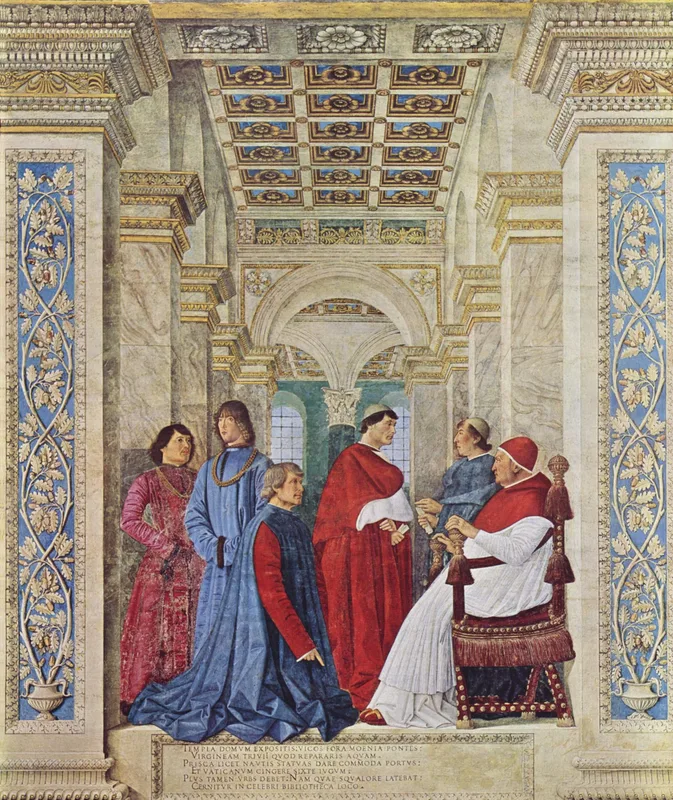 Image failed to load
 Image failed to load
 Image failed to load
 Image failed to load
 Image failed to load
 Image failed to load
Personal, non-commercial site. Image: Musei Vaticani · © Governatorato SCV – Direzione dei Musei.
Pinch or scroll to zoom