Sarcophagus of Saint Helena
Sarcofago di Sant'Elena
Take a moment to look closer.
Roman art · Vatican MuseumsRoman art · Sarcophagus of Saint Helena
Guide
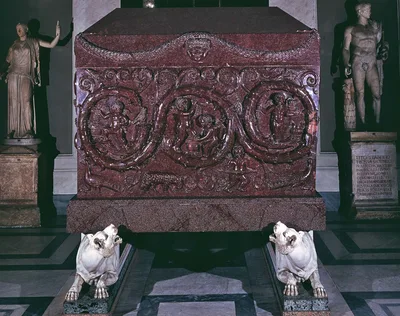
This huge block of red stone is one of the most important tombs of the ancient world. It is carved from porphyry, a very hard purple rock that in Roman times was used for the finest imperial monuments. It stands about two and a half metres high, and tradition has always linked it to Helena, the mother of the emperor Constantine the Great.
Look first at the sides of the chest. Roman horsemen, in helmets and short tunics, charge with their spears. Beneath the hooves, barbarian enemies flee, fall or kneel as prisoners. On the lid above, winged Victories and little cupids hold garlands, and two lions rest on the top.
Now think about that decoration. Helena was a devout Christian, honoured today as a saint. Yet there is not a single Christian or female symbol here. The scenes celebrate a military triumph. For this reason scholars believe the tomb was first meant for a man of the imperial family: perhaps her husband Constantius Chlorus, or more probably Constantine himself. The emperor later moved his capital to Constantinople and chose to be buried there. The great coffin in Rome then went to his mother.
Helena died around 330. Her tomb stood in a round mausoleum on the edge of Rome, between the via Prenestina and the via Labicana. The sarcophagus survived thanks to its enormous weight and to its later reuse by the popes. In 1777 it was brought to the Vatican.
As you look, remember how hard this stone is. Every horse, every face and every fold was cut from a material that was reserved for emperors.
The work
The sarcophagus is colossal. It is about two and a half metres high and more than two and a half metres long. Its size suggests that it may have been planned for a family group rather than for one person. Like the coffin next to it, it is made of red porphyry from Egypt.
The lid has four sloping sides, like a roof. At the corners sit figures carved in the round: winged Victories and young spirits. Heavy garlands hang between them, held up in the middle by a flying cupid. On the long sides of the roof, two lions lie framed by the garlands. The official museum text says that one is sleeping and the other crouching.
The chest itself is smooth, and the figures stand out from it in medium and high relief. Along the top runs a band with small two-handled tablets. They were never inscribed, so we do not know what text was planned. There are also two busts on the long sides. The man wears a victor's wreath of leaves and is probably Constantius Chlorus. The woman looks a little like the portraits of Helena known from coins.
The main zone is filled with Roman horsemen. There are three on each long side and two on each short side. They wear short tunics and helmets, and carry spears and sometimes shields. They charge at fleeing barbarians or lead them away as prisoners. Below them, captives are carved in high relief.
The coffin was heavily restored in the eighteenth century. A fire in the fourteenth century had damaged it, and missing parts were remade, especially at the base. The restorers were Gaspare Sibilla and Giovanni Pierantoni. Even so, scholars agree that the overall composition and style are original.
Context
Helena was the mother of Constantine the Great. The sources disagree slightly about her death. The official museum text says around 335, while other sources give 329 or 330.
She was buried outside Rome, on the ancient via Labicana, in a large round mausoleum. According to one source, Constantine had built it between 326 and 330, originally as a tomb for himself. Its vault was lightened with clay jars built into the masonry. From these jars comes the medieval name of the place, Torpignattara, the tower of the pots, which is still the name of a district of Rome today.
Why did the emperor give up his own tomb? In 324 he made the city of Byzantium his residence and renamed it Constantinople. He decided to be buried there. The plan for a family mausoleum in Rome was abandoned, and his mother, who went on living in Rome, received the great sarcophagus. Later her remains too were taken to Constantinople, to rest near her son.
Porphyry was extremely hard to carve. The work was usually done near the quarries in Egypt, or by artists from that region. So this coffin was probably made by craftsmen from the East. Its style is more classical than earlier works of the age of the Tetrarchs, such as the famous group in Venice. The bodies are full and the drapery falls naturally. This return to classical forms is typical of the art of Constantine, once the civil wars were over. For this reason most scholars now date the sarcophagus to around 320.
The rhythm of the horsemen has often been compared to the cavalry procession on the base of the Antonine Column in Rome, with the same play of light and shadow between the high relief and the smooth ground.
Details
Start by walking slowly around the whole sarcophagus, if the space allows. Notice how the scene continues on every side, so that the horsemen seem to ride all the way around the coffin. The polished red stone gives the figures a deep, shining colour.
Now look up at the lid. At the corners sit winged Victories, the messengers of triumph. Between them hang thick garlands, and in the middle a small cupid flies, holding them up. Look closer at the top of the roof. There you can see one of the two lions, lying stretched out among the garlands.
Next, look at the upper band of the chest. Two busts look out at us, a woman on one side and a man on the other. The man wears a wreath of leaves, a sign of victory. He is probably Constantius Chlorus, the husband of Helena. The woman may be Helena herself. Between them you can see the smooth tablets with two small handles. They were meant for inscriptions, but they were never filled.
Then take in the great battle in the middle. Three horsemen gallop across the long side. Their horses rear up, and their spears are raised high. Below them the enemies are crushed. One barbarian falls forward, others kneel with their hands tied. The contrast between the deep relief and the smooth background creates strong light and shadow.
Finally, look down at the four lions that hold up the whole mass. They are not ancient. They were carved in the eighteenth century by Francesco Antonio Franzoni, when the sarcophagus was brought into the papal museum. Their open mouths and wild manes add a last touch of drama to an imperial tomb.
Details up close
Legacy
Few objects bring us so close to the family of Constantine. The sarcophagus is one of two great porphyry coffins from the age of Constantine that stand together in this hall, and it is a key work for understanding the art of that time.
Its long life is a story in itself. The coffin stayed in the mausoleum on the via Labicana for centuries. Its contents were lost long ago. In the twelfth century it was moved to the basilica of Saint John Lateran, where it was reused for the burial of Pope Anastasius IV. In the seventeenth century it was placed in the portico of that church and dedicated once again to Helena. The sources differ a little on the dates: one says the move to the Lateran happened as early as the eleventh century.
At the end of the eighteenth century Pope Pius VI brought it into the Vatican. The official museum text gives 1777, another source 1778. After its restoration it was set on four new lions, and it has been one of the showpieces of the museum ever since.
Scholars still discuss who it was really made for. The official text and many scholars think of a man, probably Constantine. One encyclopedia entry argues the opposite: as the mother of the emperor, Helena would have been important enough to receive a coffin made especially for her. The question remains open.
What is certain is its message. The purple stone of emperors, the charging cavalry and the kneeling prisoners all speak of power and victory. Placed over the grave of a woman remembered as a saint, it shows how the old imperial language of triumph and the new Christian world met in the fourth century.
- Inventory
- 238
- Image
- Wikimedia Commons · CC BY-SA 4.0
- Official page
- www.museivaticani.va
Sources (5)
- Musei Vaticani – Sarcofago di S. Elena · official
- Vatican Museums – Sarcophagus of St Helena · official
- Wikipedia (it) – Sarcofago di Elena · academic
- Wikipedia (en) – Sarcophagi of Helena and Constantina · academic
- Wikipedia (en) – Mausoleum of Helena · academic
In the same area
 Image failed to load
 Image failed to load
 Image failed to load
 Image failed to load
 Image failed to load
 Image failed to load
 Image failed to load
 Image failed to load
By the same artist
Personal, non-commercial site. Image: Wikimedia Commons · CC BY-SA 4.0.
Pinch or scroll to zoom