Perseus Triumphant
Perseo trionfante
Take a moment to look closer.
Antonio Canova · Vatican MuseumsAntonio Canova · Perseus Triumphant
Guide
This proud young nude looks like an ancient statue, but it is not. It was carved by the sculptor Antonio Canova in just a few months, between the end of 1800 and the beginning of 1801. It shows Perseus, the hero of Greek myth, a moment after his greatest deed. He has just cut off the head of Medusa, the monster whose gaze turned people to stone.
Look first at his raised left hand. It holds the severed head, with snakes for hair, and the hero's eyes are fixed on it. His lowered right hand grips the curved blade he used. On his head is a winged cap, and on his feet the winged sandals of the god Mercury.
Why does a modern statue stand among the great antiquities of the Vatican? The answer is a story of war and loss. After the Treaty of Tolentino, the French carried off the famous Apollo Belvedere to Paris. Pope Pius VII then bought this Perseus and set it on the empty pedestal of the Apollo. It was soon nicknamed the Consoler.
The choice was no accident. Canova had modelled his hero on the Apollo, borrowing its balance, its proportions and its expressive force. When the ancient statue came home, the Perseus was so admired that it was allowed to stay, and the two were shown side by side. For a living sculptor, there could hardly be a greater honour.
So as you look, think of it as a conversation across two thousand years: a modern artist answering one of the most celebrated statues of antiquity, and daring to stand next to it.
The work
The statue is larger than life. In a letter of May 1801, Canova himself described it as perhaps larger than the Apollo Belvedere. It is carved from white marble and stands on a high base.
The subject comes from Greek mythology. Perseus was sent to kill Medusa, one of the three Gorgons. To help him he received magic gifts: a winged cap, winged sandals and a blade. The sources tell this part differently. The museum's own text says the sandals and the curved blade came from Mercury. Another description speaks of a sword given by Vulcan and a helmet of invisibility from Pluto.
Canova chose the moment after the action, not the fight itself. The hero stands facing us, in a calm and majestic pose. His left arm lifts the head high like a trophy, and his gaze goes to the face of the monster. An early admirer of the work, the writer Isabella Teotochi Albrizzi, saw two opposite feelings in this pause: anger fading away and pleasure just beginning.
The head of Medusa has a model of its own. Canova based it on a famous ancient marble, the Medusa Rondanini. For the body he looked to the Apollo Belvedere, and he kept a plaster cast of it in his studio.
The surface is the heart of his art. Canova did not take pupils, but hired workers to rough out the block. Using a system of measuring points, they copied his plaster model into marble and left a thin layer of stone over the whole figure. The master then concentrated on the final surface himself.
The statue is in generally good condition. A recent restoration, supported by the museum's patrons, removed dust and grime, secured the base, which had cracks, and returned the head of Medusa to its original position.
Context
The sculptor was born in 1757 in Possagno, a village of the Republic of Venice, into a family of stone-cutters. In 1780 he moved to Rome to study the relics of antiquity. By 1800 he was the most celebrated artist in Europe.
The Perseus was born in troubled times. At the end of his Italian campaign, Napoleon ordered the Apollo Belvedere to be taken from the Vatican to Paris. It was part of a vast removal of works of art from Italy, which followed the Treaty of Tolentino. The Vatican had lost its most famous statue.
The idea for the Perseus goes back to 1797, or even earlier, and the marble was carved in a few months around 1800 and 1801. Its early story is tangled, and the sources disagree. Some call it a commission from a French tribune, Onorato Duveyriez. Others say nobody had ordered it, and that Duveyriez was only the first buyer to show interest. Next came the government of the Cisalpine Republic in Milan. Through Giuseppe Bossi, secretary of the Brera Academy and a friend of the sculptor, it wanted the statue for the new Foro Bonaparte, and it had already begun to pay.
Then a letter arrived from Cardinal Doria. Pope Pius VII wished to buy the Perseus for three thousand gold coins. In 1802 the statue entered the Vatican and was placed on the very pedestal of the lost Apollo.
The pope also rewarded the artist. He named him Inspector General of Fine Arts, the office Raphael had once held under Pope Leo X. He also made him a Knight of the Golden Spur. It was the only honour that Canova, who disliked official ceremonies, received in person. It is said that the pope broke with protocol and pinned the cross of the order on his chest with his own hands.
Details
Start by taking in the whole figure from the front, the way Canova intended it to be seen. The pose is open and frontal, with a long line running from the raised left hand down to the lowered right one. A heavy cloak falls from his left arm to the ground and helps to hold up the marble. Then walk slowly around it. The stone is worked with care on every side.
Look closer at the head of Medusa, held up at arm's length by the hair. Snakes and small wings twist among her curls. Her eyes are half closed and her mouth hangs open, yet the face is sorrowful rather than horrible, almost beautiful. That softness comes from the ancient Medusa Rondanini, which Canova used as his model. During the recent restoration, this head was returned to its original position.
Now turn to the face of Perseus, under the winged cap. His profile is serene, with hardly a trace of the struggle. Critics of the time found the whole figure too graceful, too much like a god and not enough like a warrior. Look at the smooth features and judge for yourself.
Next, follow his right arm down to the hand. It holds a strange weapon: a straight blade with a hook near the tip, which the Italian text of the museum calls a falcetto, a small sickle. Behind it you can see the empty scabbard. The blade points away, low and relaxed, as if the effort were over.
Finally, look down at his feet and the sandals of Mercury, the gift that let him fly. The weight rests on one straight leg, while the other is relaxed, the same balance that Canova admired in the Apollo Belvedere. On the front of the round plinth, an inscription carries the name of Pope Pius VII, who brought the statue here.
Details up close
Legacy
Few modern works have been given such a place. The courtyard of the Belvedere was normally reserved for the great statues of classical antiquity. By putting the Perseus there, the pope treated a living sculptor as an equal of the ancient masters. Contemporaries began to call Canova a new Phidias.
The story took a new turn in 1815. After the fall of Napoleon, the pope sent Canova himself to Paris, to recover works of art that had been taken there. That same year, the Apollo Belvedere came back to the Vatican. Yet the Perseus was not removed. The decision to keep both statues on show sealed the sculptor's reputation for good.
The work was also debated. The critic Carl Ludwig Fernow admired its beautiful surface, but felt that the mind was left without a high and pure pleasure. Others found it too Apollonian, fit for a god rather than a hero. The historian Leopoldo Cicognara, a friend of the sculptor, replied with irony: unable to fault the carving, the critics attacked the idea behind it.
Today the Perseus is seen as one of Canova's finest heroic works. It sums up the Neoclassical belief, shaped by Winckelmann, that artists become great by following ancient models. Yet the writer Stendhal saw more in it. Canova, he said, imitated the Greeks, but like them, his genius invented a new beauty.
The statue also had a second life. In 1804 a Polish countess, Waleria Tarnowska, ordered a version from Canova, meant to resemble the Vatican one with small variations. Since 1967 it has been in the Metropolitan Museum of Art in New York. The plaster model is kept in the sculptor's home town, Possagno.
- Inventory
- 969
- Image
- Musei Vaticani · © Governatorato SCV – Direzione dei Musei
- Official page
- www.museivaticani.va
Sources (5)
In the same area
 Image failed to load
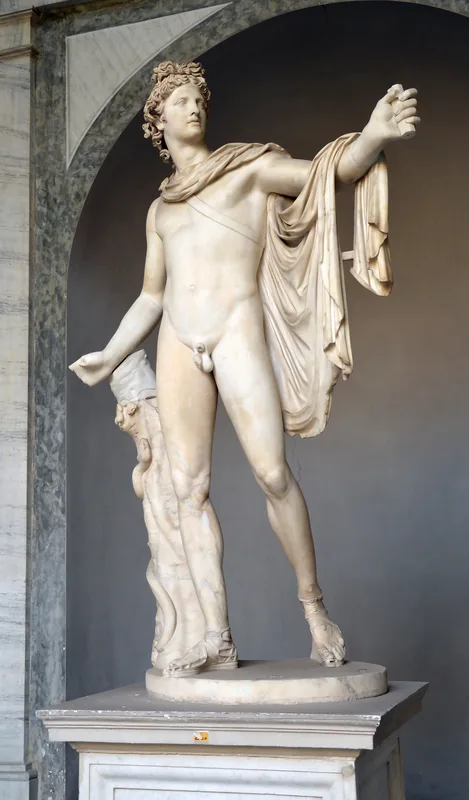 Image failed to load
 Image failed to load
 Image failed to load
 Image failed to load
 Image failed to load
 Image failed to load
 Image failed to load
Personal, non-commercial site. Image: Musei Vaticani · © Governatorato SCV – Direzione dei Musei.
Pinch or scroll to zoom