Sleeping Ariadne
Arianna dormiente
Take a moment to look closer.
Roman art · Vatican MuseumsRoman art · Sleeping Ariadne
Guide
A young woman lies asleep, one arm flung over her head. This is Ariadne, a princess of Crete and the daughter of King Minos. In the ancient myth she helped the hero Theseus defeat the Minotaur and escape from the Labyrinth. The ungrateful hero then abandoned her while she slept on the island of Naxos. Later the god Dionysus arrived, woke her and took her as his bride. The statue shows the moment in between: she is alone, and not yet rescued.
Look first at the pose. She half lies and half sits. Her head rests on her left arm, her right arm is thrown over her head, and her legs are crossed at the calves. Her sleep does not look peaceful. Many viewers have felt a restlessness in her body, as if she were caught between sleep and waking.
Now find the bracelet on her upper left arm. It is shaped like a snake, and for almost three centuries this small detail misled everyone. People took it for the asp that killed Cleopatra, the queen of Egypt, and so the statue was called Cleopatra. Only at the end of the 1700s did the scholar Ennio Quirino Visconti recognise her as Ariadne.
The marble is a Roman copy, made in the age of the emperor Hadrian. It repeats a lost original created in the second century BC by the school of Pergamon. Pope Julius II bought it in 1512, and it soon became one of the most admired statues of antiquity. For later artists, her pose became the classic image of sleep.
The work
The statue shows a young woman stretched out in sleep. She is propped up at an angle, half lying and half sitting, with her long legs extended and crossed at the calves. Her head is pillowed on her left arm, and her right arm is thrown back over her head. This elbow, bent above the head, was a conventional sign of sleep in ancient art.
She wears a chiton, a long, light tunic, tied with a band under her breasts. The fabric slips and gathers in deep folds. Around her legs it bunches up so tightly that one scholar, Sheila McNally, wrote that it seems to imprison her.
The mood is the real subject. The sleeping Ariadne was an old theme, long known from painted vases. What was new in the Hellenistic period was the uneasy pose, halfway between sleep and waking. The classical scholar Webster thought it might reflect a new literary source that has not survived. McNally saw a sluggish effort to throw off some inner discomfort, held back by a slumber more oppressive than relaxing. When she wakes, she may curse Theseus, as she does in a poem by the Roman writer Catullus.
On her upper left arm is a bracelet in the shape of a snake. It is simply a piece of jewellery, but it gave the statue a false identity for almost three hundred years.
The marble is a Roman copy from the reign of Hadrian. The lost original was made in the second century BC by the school of Pergamon. Other Roman copies of the same model survive. One, at Wilton House, is largely unrestored. Another, the Medici Ariadne now in the Uffizi, was heavily reworked in modern times. Two small statuettes suggest that reduced copies of this famous figure were sold in Roman times.
Context
Nobody knows where or when the statue was found. Toward the end of the fifteenth century it belonged to the Maffei, a Roman family of humanists and collectors. The sources disagree on which member of the family owned it. A drawing by the painter Amico Aspertini, made between 1496 and 1503, records it in their collection.
In 1512 Pope Julius II bought the statue. It was installed at once in the Belvedere Courtyard, next to two recent discoveries, the Laocoön and the Apollo. Everyone then called it Cleopatra. It was set on an ancient Roman sarcophagus and turned into a fountain, in a niche at one end of the upper terrace. On the fountain ran a Latin epigram that begins with the words Huius nympha loci, the nymph of this place. For centuries it passed for an ancient poem. In fact it was written in the fifteenth century by a humanist, Giovanni Antonio Campani. The verses came with a story of a sleeping nymph supposedly found by the distant Danube.
In the 1530s the niche appeared as a grotto in a drawing by Francisco de Holanda. In the 1550s, under the direction of Giorgio Vasari, the statue moved indoors, still as a fountain, to the end of a long gallery. Daniele da Volterra designed the setting, which became known as the room of Cleopatra.
After several more moves, it reached the place where you see it now in 1779. The painter Cristoforo Unterperger decorated the back of the niche with Egyptian motifs, which are now covered by a red wash. The statue rests on a sarcophagus carved with the battle of the gods against the Titans.
Soon afterwards, the agents of Napoleon chose the statue for the new museum in Paris. After his fall, it returned to Rome.
Details
Start by taking in the whole figure. The body forms a long diagonal, rising from the crossed feet to the raised elbow. The red niche frames her like a stage set. For more than two centuries she lay above a fountain, and water once flowed below her.
Now look closer at the head and the right arm. The arm is thrown over the head, the elbow bent high. This is the gesture that carried the idea of sleep from antiquity into Renaissance art. Her face is turned slightly down, with the eyes closed. Is she deeply asleep, or about to wake? Scholars have read the pose both ways, and that doubt is part of its power.
Next, find her upper left arm, just below the shoulder. There is the famous bracelet, a coiled snake. The scholar Winckelmann was among the first to see that it is only jewellery, not a deadly asp. He thought the figure might be a nymph or a Venus. The final answer, Ariadne, came from Visconti, who compared the statue with similar images on carved gems and on reliefs from ancient sarcophagi.
Finally, follow the drapery down to her legs. Over the chest, the thin chiton clings to the body in fine folds, tied under the breasts. Lower down the cloth becomes heavier. It twists around the hips and legs in deep, crowded ridges, full of shadow. The contrast between the relaxed upper body and the tangled fabric below gives the figure its restless energy. Step a little to one side, and see how the folds change with the light.
Last, look down at the sarcophagus under her rocky bed. Its frieze shows the battle of the gods against the Titans, a crowd of twisting, muscular bodies. It is a violent world beneath a sleeping figure.
Details up close
Legacy
Few ancient statues shaped the art of later centuries as much as this one. Known then as Cleopatra, it became the main model through which the pose of sleep, one elbow bent above the head, passed from antiquity to the High Renaissance and beyond.
Michelangelo studied the way her arms wrap around the head. He drew on it for his figures of Night and Dawn, carved for the Medici tombs in San Lorenzo in Florence. Poets wrote verses to the statue, sometimes in her own voice. Baldassare Castiglione composed one as a dramatic monologue, which Alexander Pope later translated into English.
Kings wanted her too. The artist Primaticcio chose her as one of a dozen statues to be cast in bronze for King Francis I at Fontainebleau. In the process her limbs were gently lengthened, to suit French ideas of female beauty. Many copies were then made from that bronze. Louis XIV ordered copies in marble, and in Rome the painter Nicolas Poussin kept a small wax copy of his own, now in the Louvre.
The fashion reached gardens, and even America. At Stourhead, a lakeside temple held a lead copy made in 1766, with the same Latin verses. In America, Thomas Jefferson received a small marble copy in 1805 as a gift from James Bowdoin. It still stands in the hall of his house at Monticello. By 1816 he was calling his Cleopatra by her true name, Ariadne.
The statue's own fame showed when Napoleon's agents picked it for Paris. Today it is often counted among the most renowned sculptures of antiquity, and its dreamy, uneasy pose still echoes wherever artists show a figure lost in sleep.
- Inventory
- 548
- Image
- Wikimedia Commons · CC BY-SA 3.0
- Official page
- www.museivaticani.va
Sources (4)
- Musei Vaticani – Arianna addormentata · official
- Vatican Museums – Sleeping Ariadne · official
- Wikipedia (en) – Sleeping Ariadne · academic
- Wikipedia (it) – Arianna addormentata · academic
In the same area
 Image failed to load
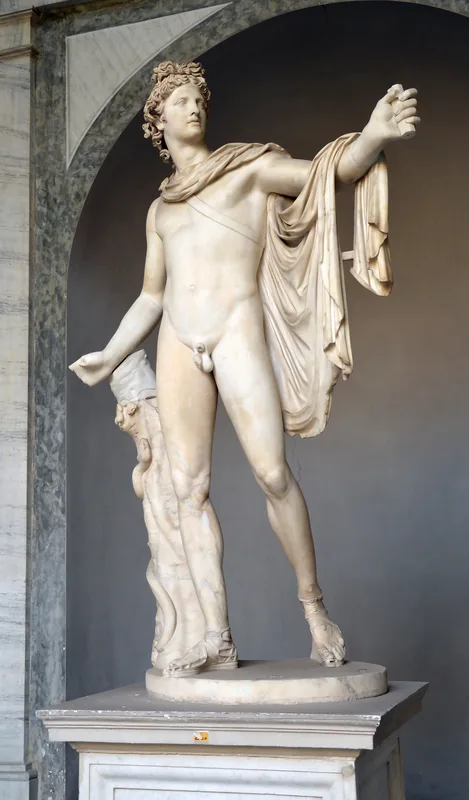 Image failed to load
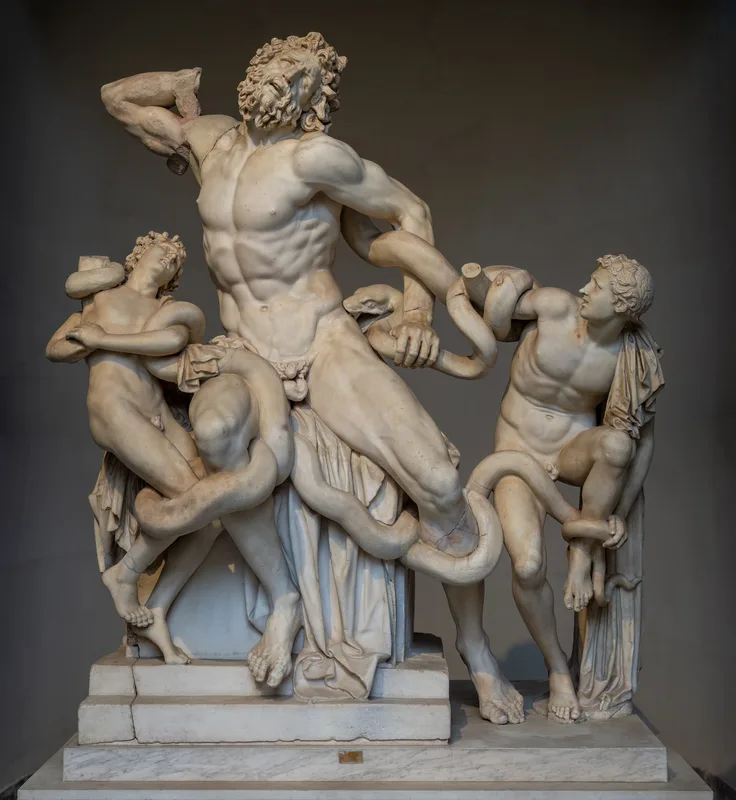 Image failed to load
 Image failed to load
 Image failed to load
 Image failed to load
 Image failed to load
 Image failed to load
By the same artist
Personal, non-commercial site. Image: Wikimedia Commons · CC BY-SA 3.0.
Pinch or scroll to zoom