Apollo Belvedere
Apollo del Belvedere
Take a moment to look closer.
after Leochares · Vatican Museumsafter Leochares · Apollo Belvedere
Guide
This is the Greek god Apollo, the divine archer, caught a moment after he has let an arrow fly. For four hundred years after its discovery, many people thought it the finest statue in the world.
Look first at the pose. The god strides forward with his left arm stretched out. That hand once held a bow. His head turns sharply the same way, as if he were following the arrow. The body seems to face us and to turn away at the same time. A short cloak is fastened at his shoulder and thrown over the outstretched arm, and a strap across his chest carries his quiver. Apart from the cloak and his sandals, he is naked.
The marble you see was carved in Rome in the second century AD. It copies a lost bronze made in Greece around 330 BC, probably by the Athenian sculptor Leochares. The statue was found in 1489 and bought at once by a cardinal, Giuliano della Rovere. When he became Pope Julius II, he brought it to the Vatican. It has stood in the Belvedere since at least 1508, and that is where its name comes from.
Why does it matter so much? In the eighteenth century the German scholar Johann Joachim Winckelmann praised it as the highest ideal of ancient art. Artists, poets and collectors across Europe followed him, and Napoleon even carried it off to Paris. Today you can judge for yourself. Take a step back and follow the long line from the outstretched arm to the turning head.
The work
The statue is carved in white marble and stands two and a quarter metres high, larger than life. It shows Apollo as a standing archer who has just shot an arrow. The effort of the shot still seems to linger in his muscles.
What exactly has he just hit? Scholars do not agree. The traditional answer is the serpent Python, the monster that guarded Delphi, and for this reason the statue is also called the Pythian Apollo. Other suggestions are the giant Tityos, who threatened the god's mother Leto, or the episode of the Niobids.
The pose is a complex contrapposto. The figure seems to be seen from the front and in profile at the same time. His hair falls in light ringlets onto the neck and is gathered elegantly on top of the head. There it is encircled by a band called the strophium, a sign of gods and kings. He wears only sandals and a short cloak, the chlamys, clasped at the right shoulder and thrown over the left arm. His quiver hangs from a strap over his right shoulder.
The statue also has a long history of repairs. The museum says that when it reached the Vatican only the left hand and the fingers of the right hand were missing. Other accounts speak of the lower right arm. Between 1532 and 1533 the sculptor Giovanni Angelo Montorsoli, a pupil of Michelangelo, completed the left arm, replaced the right forearm and rebuilt the top of the tree trunk on which it rests.
In December 2019 serious structural problems emerged. The restoration that followed, completed in 2024, added a carbon-fibre support at the back, anchored to the base. It also replaced the left hand with a cast of the hand of Baia, a fragment of an ancient plaster copy of the Greek original.
Context
The story begins in Greece. Around 330 BC a bronze statue of Apollo was made there, probably by the Athenian Leochares, one of the most celebrated artists of his time. He also worked on the Mausoleum of Halicarnassus, a sumptuous tomb counted among the seven wonders of the ancient world. The bronze Apollo is lost.
What stands here is a marble copy. According to the museum, it was made by a copyist workshop active in Rome in the first decades of the second century AD. Other scholars place it around the middle of that century.
The rediscovery is less clear than you might expect. The museum says that the statue was found in Rome in 1489, among the ruins of an ancient house on the Viminal Hill. Other accounts suggest Anzio, on the coast, or Grottaferrata, where Giuliano della Rovere was abbot. What is certain is that this powerful cardinal acquired it straight away. During the reign of Pope Alexander VI he stayed away from Rome, and the statue stood in his garden at Santi Apostoli. At first artists paid it little attention, although a pupil of Ghirlandaio drew it twice.
Things changed when the cardinal became Pope Julius II. He moved the statue to the Vatican, where the museum records it in the Belvedere from 1508. Other sources give 1511. It was placed in the small sculpture court of the Belvedere, which was linked to the papal palace by Bramante's great courtyard. From then on it was famous.
Its later journey was dramatic. After the Italian campaign of 1796 Napoleon took it to Paris, where it went on show in the Louvre. It came back to its old place in 1816, with the help of Antonio Canova.
Details
Start by walking slowly around the statue. From the front, the god seems to stride straight towards you. From the side, you see that he is also turning, so that the body faces one way and the head another. This double view is the complex contrapposto that visitors have admired for centuries.
Now look up at the head. The hair falls in soft ringlets onto the neck and is gathered into a knot on top. Around it runs a thin band, the strophium, a mark of gods and kings. The eyes look far away, towards the flight of the arrow. The philosopher Arthur Schopenhauer wrote that this head stands so freely on the shoulders that it seems wholly delivered from the body.
Next, follow the outstretched left arm. The cloak is draped over it and falls in deep folds. The hand at the end is the newest part of the statue. In the recent restoration, the hand made by Montorsoli was replaced by a cast of the hand of Baia. That fragment comes from a plaster copy made in Roman times from the Greek bronze itself, so this is as close as we can get to the original gesture. Originally, this hand held the bow.
Then look at the right side. The lower right arm is not ancient. Montorsoli carved it in the 1530s, together with the top of the tree trunk on which it rests. Look closer and try to see where the old marble meets the new. For centuries, these additions were part of what people admired.
Finally, look down at the feet. Apart from the cloak, the god wears only sandals, carved with fine straps. At the back, a support in carbon fibre, anchored to the base, now helps to hold the figure steady. Canova had already used a similar support when the statue returned from Paris.
Details up close
Legacy
For four hundred years after its discovery, this was one of the most admired sculptures in the world. Once it stood in the Belvedere, artists wanted copies. The Mantuan sculptor known as L'Antico made a careful wax model and cast it in bronze for the Gonzaga collection. Albrecht Dürer reversed its pose for his Adam in an engraving of Adam and Eve dated 1504, which suggests that he had seen it in Rome. Michelangelo sketched it too. In the 1530s Marcantonio Raimondi engraved it, and his print spread the famous pose all over Europe.
Its greatest moment came in the eighteenth century. From 1755 the German scholar Winckelmann championed it as the perfect expression of the Greek ideal. His words about noble simplicity and quiet grandeur became a motto of neoclassicism. Goethe, Schiller and Byron all admired it. Its fame even became political. During the French Revolution, a bishop declared that carrying off the Apollo would be the most brilliant of conquests. While it was in Paris, the pope commissioned Antonio Canova to carve a Perseus in a similar pose, to fill the empty place.
Then taste changed. Romantic critics were far less kind. William Hazlitt called it positively bad, and John Ruskin was disappointed. Some later writers explained its long fame by its homoerotic appeal, a view that was not widely accepted. By 1969 the art historian Kenneth Clark could write that it was now forgotten, except by the guides of coach parties.
Yet the statue never lost its public. Plaster casts filled schools and public places in Europe and America throughout the nineteenth century. Painters from Millet to de Chirico quoted it. And the recent restoration, with its new hand taken from an ancient cast, shows that the search for its original appearance is still going on.
- Inventory
- 1015
- Image
- Wikimedia Commons · CC BY-SA 4.0
- Official page
- www.museivaticani.va
Sources (5)
- Musei Vaticani – Apollo del Belvedere · official
- Vatican Museums – Apollo Belvedere · official
- Wikipedia (en) – Apollo Belvedere · academic
- Wikipedia (it) – Apollo del Belvedere · academic
- 维基百科(中文)– 观景殿的阿波罗 · academic
In the same area
 Image failed to load
 Image failed to load
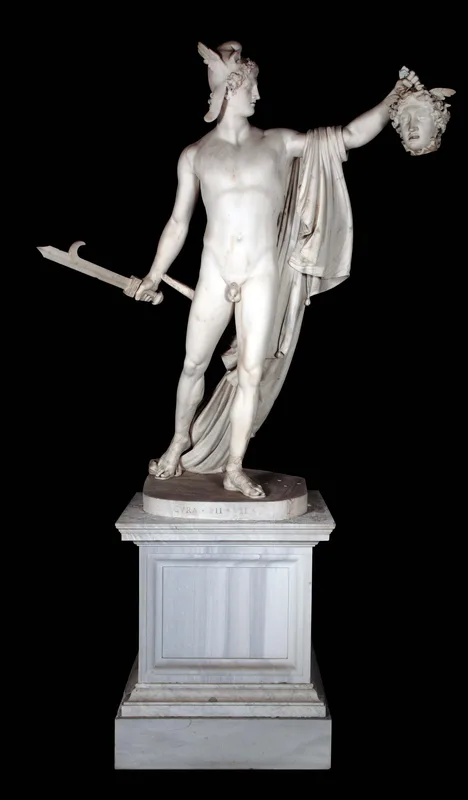 Image failed to load
 Image failed to load
 Image failed to load
 Image failed to load
 Image failed to load
 Image failed to load
Personal, non-commercial site. Image: Wikimedia Commons · CC BY-SA 4.0.
Pinch or scroll to zoom