Belvedere Torso
Torso del Belvedere
A headless, armless fragment that Michelangelo revered.
Apollonios of Athens · Vatican MuseumsApollonios of Athens · Belvedere Torso
Guide
At first sight this is only a broken block of marble. It has no head, no arms and no lower legs. Yet for five hundred years artists have called it one of the greatest sculptures that survive from the ancient world.
Look at the body. A powerful man sits on an animal skin thrown over a rock. His chest twists sharply to one side and bends forward. Every muscle of the stomach and back is tense, even though he is not moving. That contrast between stillness and strain is the secret of the piece.
Who is he? Nobody knows for sure. For centuries he was taken for Hercules resting on the skin of a lion. Today the museum favours another idea. He may be Ajax, a Greek hero of the Trojan War, sitting alone and thinking about taking his own life. His head once leaned sadly on his right hand, which held the sword.
The statue carries a signature in Greek on the front of the rock: Apollonios, son of Nestor, an Athenian. The museum dates the marble to the first century before Christ, probably inspired by an older bronze.
Above all, this fragment was loved by Michelangelo. His admiration was so well known that the torso was nicknamed the School of Michelangelo, and its twisting bodies echo through his figures on the Sistine Chapel ceiling. Walk slowly around it, as he did, and watch how the muscles change with every step.
The work
The fragment is about one metre sixty high. What survives is the trunk of a muscular male nude, with the thighs and the upper part of the seat. The head, the arms and the legs below the knees are lost.
The man is seated, but he is not relaxed. His upper body turns and leans forward, and his thighs swing the other way. The result is a spiral of muscle. A curator at the Vatican Museums calls this static tension: a body that does not move, yet is strained to the limit. In ancient art, he explains, such a pose was used for people contemplating death.
The seat is a rock covered with an animal skin. Traditionally it was read as the skin of the Nemean lion, the beast killed by Hercules, and that is why the figure was long called a Hercules. Recent studies see a panther skin instead. That opened the way to other names, among them the one-eyed giant Polyphemus, the satyr Marsyas and the wounded archer Philoctetes.
The museum's favoured answer is Ajax, son of Telamon. After the death of Achilles, the hero's armour was given to Odysseus and not to him. Ajax went mad with rage, killed a flock of sheep believing they were his enemies, and then took his own life. The statue would show him just before, sitting in silence. His head rested on his right hand, which held the sword, while his left hand probably gripped the scabbard. Holes in the marble show where limbs, a shield and perhaps other figures were once attached.
On the front of the rock is the signature in Greek letters: Apollonios, son of Nestor, Athenian. The sculptor is not mentioned by any ancient writer.
Context
Almost everything about the origin of the torso is uncertain. Neither the place nor the date of its discovery is known. The museum dates the marble to the first century before Christ and suggests that the sculptor, an artist of the so-called neo-Attic school, drew on a bronze from the first half of the second century before Christ. Some scholars once thought it was an original; today it is usually seen as a copy, made in the first century before or after Christ.
Its later history is better known, though the sources do not fully agree. The first record comes from the 1430s. The antiquarian Ciriaco d'Ancona noted its inscription in the palace of Cardinal Prospero Colonna, on the Quirinal Hill in Rome. He was interested in the lettering, not in the beauty of the body. Around 1500 it belonged to the sculptor Andrea Bregno. During the sack of Rome in 1527 it was still in the Colonna palace, where it suffered some damage.
The museum and the encyclopaedias say that it entered the papal collection between 1530 and 1536. A Vatican News feature instead links it to Cardinal Giuliano della Rovere, the future Julius II, and to the Octagonal Court from about 1503. By the middle of the century, in any case, it stood in the Belvedere courtyard beside the Apollo and the Laocoön. The long stay in those gardens gave it its name. The scholar Leonard Barkan put it neatly: the Laocoön took two months to become famous; the torso took a hundred years.
In 1798 it was taken to Paris by Napoleon and shown at the Louvre. It came back to the Vatican in 1815, under the care of the sculptor Antonio Canova.
Details
Start by taking in the whole fragment from a little distance. Many visitors first meet it from behind, and the back alone is enough to show its power. Then walk round to the front. Notice how the figure seems to rise from the rock in a single turning movement, even though so much of it is missing.
Now look closely at the chest and shoulders. The upper body twists to one side and folds forward, so the muscles of the stomach bunch into deep ridges. Where the neck and arms broke away you can see rough surfaces, and in one of them a round hole. Holes like this held the missing parts. Imagine the head resting on the right hand, low and heavy with thought.
Next, follow the thighs. They are huge and swing away from the chest, broken off just above the knees. Their mass balances the twist of the upper body and anchors the whole figure.
Then look at the seat. The man sits on an animal skin spread over a rock, its folds hanging down the front. For centuries people saw the lion skin of Hercules here. Recent studies prefer a panther.
Finally, come close to the front of the rock, just below the skin. There are a few lines of small Greek letters. They give the name of the sculptor, Apollonios, son of Nestor, and call him Athenian. It was this inscription that caught the eye of the first scholar to record the statue, in the fifteenth century.
Details up close
Legacy
Few ancient works have taught so many artists. Renaissance, Mannerist and Baroque painters and sculptors came to draw it, and it helped to spark the revival of classical art. Drawings survive by Amico Aspertini, Martin van Heemskerck and Hendrick Goltzius, and an engraving of about 1515 carried its image to people who could never travel to Rome. Small bronze copies often completed it as a seated Hercules.
Its greatest admirer was Michelangelo. He is said to have spent hours with it, even touching the marble. A popular legend claims that Julius II asked him to add the missing head and limbs, and that he refused, saying it was too beautiful to change. Whatever the truth, the torso lives on in his work. The muscular nudes of the Sistine Chapel ceiling, the Sibyls and Prophets, the risen Christ and Saint Bartholomew in the Last Judgement, and his Moses all show its influence. Two of the nudes flanking the scene of the sacrifice of Noah seem almost like copies of it.
Later artists were just as fascinated. Raphael, Rubens and Turner studied it. The engraver William Hogarth included it in his ideas about beauty. According to the painter himself, Eugène Delacroix modelled a figure in his painting of the boat of Dante on it, and Rodin drew on it for his famous Thinker.
Unlike many statues admired in the seventeenth and eighteenth centuries, the torso has never lost its reputation. In 2015 it travelled to the British Museum for an exhibition on the human body in Greek art. Today, a curator notes, many visitors hurry past on their way to the Sistine Chapel. It deserves a slower look.
- Inventory
- 1192
- Image
- Musei Vaticani · © Governatorato SCV – Direzione dei Musei
- Official page
- www.museivaticani.va
Sources (5)
- Musei Vaticani – Torso del Belvedere · official
- Vatican Museums – The Belvedere Torso · official
- Vatican News – Michelangelo's "Teacher" · guide
- Wikipedia (en) – Belvedere Torso · academic
- Wikipedia (it) – Torso del Belvedere · academic
In the same area
 Image failed to load
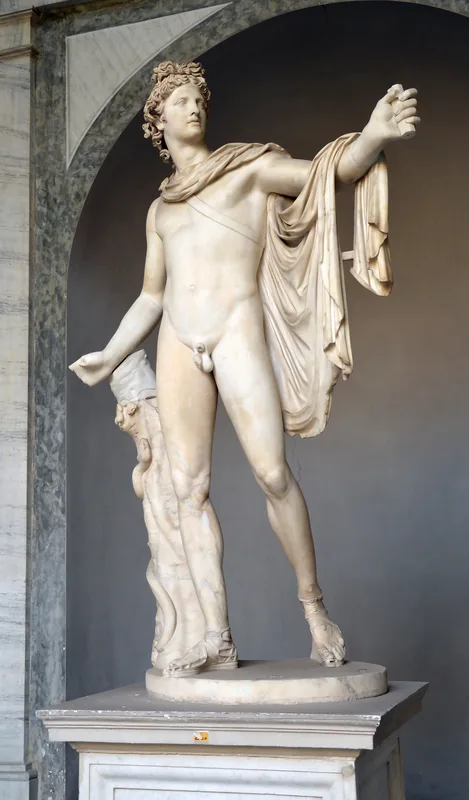 Image failed to load
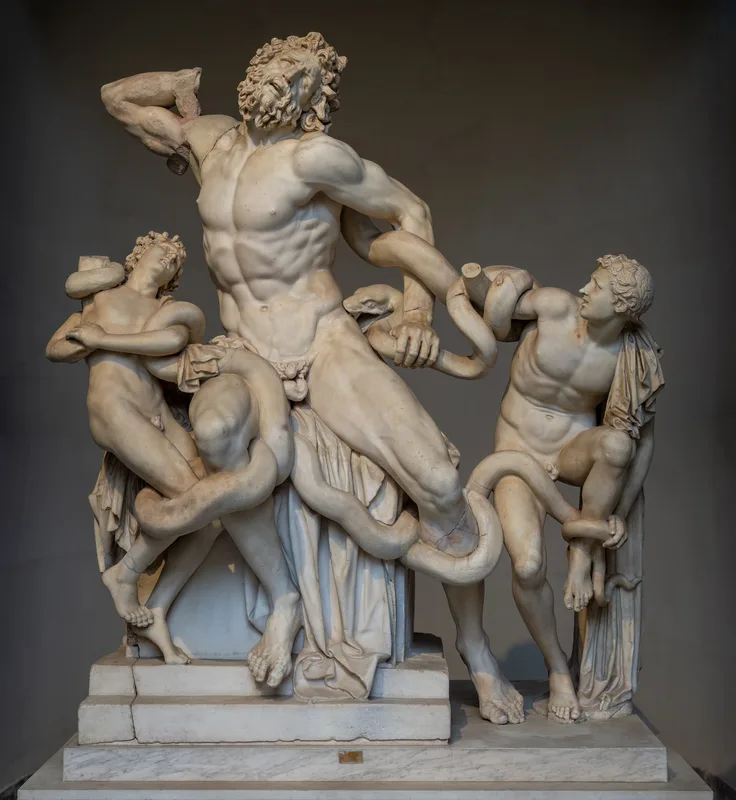 Image failed to load
 Image failed to load
 Image failed to load
 Image failed to load
 Image failed to load
 Image failed to load
Personal, non-commercial site. Image: Musei Vaticani · © Governatorato SCV – Direzione dei Musei.
Pinch or scroll to zoom