Hercules Mastai (gilded bronze)
Ercole Mastai
Take a moment to look closer.
Roman art · Vatican MuseumsRoman art · Hercules Mastai (gilded bronze)
Guide
Take a step back, because this statue is colossal. It is made of bronze covered with gold, and it stands almost four metres high. It shows the hero Hercules as a young man, calm and at rest, leaning on his club.
Look first at his left side. The skin of the Nemean lion, the beast he defeated, hangs over his arm. His left hand is open. It held the golden apples of the Hesperides, another of his famous prizes. Much of the surface still glows with its ancient gilding.
Now for the strangest part: the story of how this statue survived. In 1864 workers were digging new foundations in the courtyard of a palace near Campo de' Fiori, in the area of the ancient Theatre of Pompey. First a bronze finger appeared in the earth, then a hand. Deeper down lay the whole figure, placed horizontally in a trench. Over it was a slab of travertine cut with three letters, F C S. They are the initials of a Roman formula for something struck by lightning and buried.
So this is what happened. In antiquity lightning hit the statue. Following their custom, the Romans did not throw it away. They gave it a ritual burial, together with the remains of a lamb, and there it lay for many centuries.
Soon after the discovery the statue was acquired by Pope Pius IX. His family name was Mastai, and that is why we call it the Hercules Mastai. Before you move on, imagine it as the Romans saw it, shining in the sun, before the lightning struck.
The work
The statue shows the hero as a youth, not as the bearded strongman of many later images. His weight rests on one leg, while the other is relaxed. This creates the gentle opposition of the body that goes back to the Greek sculptor Lysippus. The same stance appears in another bronze in Rome, the Hercules of the Forum Boarium. Both figures have powerful muscles, yet they look very different from the heavy, bearded Farnese Hercules.
The attributes tell us who he is. The club is his weapon. The lion skin recalls his first great victory, and the apples of the Hesperides a later one. A description written by the archaeologist Pietro Ercole Visconti in 1864 records that pieces of the club were found in the pit. The lion skin turned up under the back of the statue, but it originally hung from the left arm to just below the knee. He also noted that the apples were missing, and indeed the open hand is empty today.
The figure was cast in bronze and then heavily gilded, probably with gold leaf. When it came out of the ground it was badly damaged. The feet had come away from the legs, and one foot and the base were lost. At the top of the head there was a flaw from the casting.
The sculptor Pietro Tenerani restored it in the nineteenth century, using mainly plaster. Many gaps were then covered with gilded stucco so skilfully that they are hard to tell apart from the bronze. Today the statue is held in place by iron brackets fixed to the walls of its niche. A recent study with vibration sensors showed that it is stable.
Context
The statue came to light by chance. In 1864 the owner of the Palazzo Pio Righetti ordered excavations in his courtyard to lay new foundations. The site lies in the area of the Theatre of Pompey, inaugurated in 55 BC.
The finds came in stages. On the eighth of August a bronze finger emerged from the earth, and then a hand. On the thirty-first of August, at a depth of eight or nine metres, the entire statue was brought to light. The works were led by the architect Luigi Gabet. In September the statue was freed and raised with a wooden scaffold. The historian Gregorovius watched the scene. He wrote that he saw the statue resurrected from its tomb, lifted with ropes, screws and winches, surrounded by cheerful workers. For him it was a true Roman scene.
The way it had been buried explained its survival. It lay flat in a pit, under travertine slabs marked F C S. According to the Roman custom, an object struck by lightning received a ritual burial on the spot. The remains of a lamb were found with it.
In October 1864 the statue was examined by the archaeologist Pietro Ercole Visconti and the sculptor Pietro Tenerani. In January 1865 Pope Pius IX came to see it, and his visit sealed its transfer to the papal museums. The owner received fifty thousand scudi and other gifts. A few days later Visconti announced the discovery at the Pontifical Academy and proposed the name it still bears, after the family name of the pope.
At the end of January the statue reached the Vatican, where Tenerani restored it. In April 1866 it was placed in this round hall, among the great sculptures of the papal collection.
Details
Start with the whole figure. Notice how calm it is. The hero is not fighting. He simply stands, leaning lightly to one side, with his weight on one leg. The gold catches the light from above and makes the body glow against the shadow of the niche.
Now look up at the head. The face is young and beardless, framed by short curls. In 1864 Visconti noticed that the top of the skull was missing, as if cut away to receive a crown, and that there was a casting flaw there. It is possible that another piece was once inserted on top of the head. Look closer at the surface and you will see where the gold is brightest. During the recent cleaning, restorers found that the old protective layers hid a much more brilliant gilding.
Next, follow the left arm. The lion skin hangs from it in heavy folds. It was found under the back of the statue and returned to its place. Look at the open hand: it is empty, because the apples were already lost in 1864.
Then look at the right hand and the club. Visconti observed something odd. Judging from the position of the hand, the club could not have touched the ground, but seemed to hang in the air. Today the restored club reaches down to the base. Look closer and you will also see an iron bar behind it, one of the brackets that hold the statue to the wall.
Finally, look down at the ankles and feet. This is where the statue broke. X-ray images taken during the restoration showed fractures in the bronze at the ankles. For more than a century they were hidden under plaster added in the nineteenth century. The restorers plan to replace these old additions with removable copies and to keep the originals in storage.
Details up close
Legacy
Scholars still disagree about the age of this statue. Everyone agrees it was made in Roman times. The model behind it may have come from a Greek workshop in Attica, active between 390 and 370 BC. The bronze itself has been dated anywhere from the end of the first century AD to the beginning of the third. The Patrons of the Arts, who support its restoration, give different ranges on different pages, and one encyclopedia entry even places it in the second century BC. So it is fair to say that the date remains open.
Its fame rests on two things. First, it is colossal and gilded: almost four metres of bronze covered in gold, and still largely intact after its long burial. Second, the way it was found gives us a vivid glimpse of Roman religion. The letters F C S and the remains of the lamb show a ritual in action. An object touched by lightning could not simply be thrown away.
The discovery also made a strong impression in its own time. It happened in the heart of papal Rome, in front of crowds, and a famous historian wrote it down. The pope bought the statue and gave it his own family name, and it was given a place of honour in this hall.
In recent years the statue has been studied again with modern science. In 2020 the Vatican laboratories checked its stability. Restorers then began to clean the gilding and to review the nineteenth-century repairs. Their aim is simple: to let visitors see the ancient bronze and gold more clearly than at any time since it came out of the ground.
- Inventory
- 252
- Image
- Wikimedia Commons · Public domain
- Official page
- www.museivaticani.va
Sources (6)
- Musei Vaticani – Eracle (Ercole Mastai) · official
- Vatican Museums – Hercules Mastai · official
- Patrons of the Arts in the Vatican Museums – Hercules Mastai · guide
- PAVM – Preliminary studies for the restoration of the Hercules Mastai · guide
- Wikipedia (it) – Ercole del Teatro di Pompeo · academic
- APAVM – The Colossal Bronze Hercules Mastai · guide
In the same area
 Image failed to load
 Image failed to load
 Image failed to load
 Image failed to load
 Image failed to load
 Image failed to load
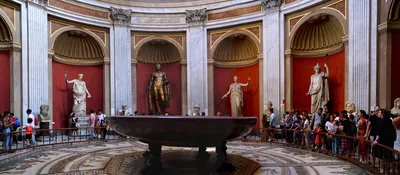 Image failed to load
 Image failed to load
By the same artist
Personal, non-commercial site. Image: Wikimedia Commons · Public domain.
Pinch or scroll to zoom