Sarcophagus of Constantina
Sarcofago di Costantina
Take a moment to look closer.
Roman art · Vatican MuseumsRoman art · Sarcophagus of Constantina
Guide
This red porphyry coffin was made for a princess. According to the official museum text, it held the remains of one of the daughters of the emperor Constantine the Great, most probably Constantina, also called Costanza, who died in 354. She was buried in a round mausoleum on the via Nomentana, beside the basilica of Saint Agnes, just outside Rome.
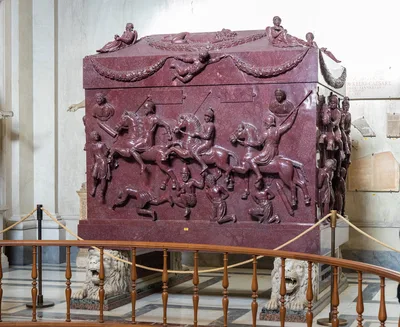
Look at the sides of the chest. Instead of battles, you see a harvest. Great vine stems curl into circles, and inside them little winged cupids gather bunches of grapes. Lower down there are two peacocks, a ram, and a cupid carrying a garland. On the lid, garlands of leaves are tied to masks. It is a cheerful, abundant world, very different from the coffin of Helena with its charging horsemen.
Why grapes on a tomb? The grape harvest was an old theme of funerary art, linked to Dionysus, the god of wine. Just as the grape dies to become something better, wine, so the dead could hope for a new life. Christians could read the same images in their own way, thinking of the wine of the Eucharist. The peacock, whose flesh was believed never to decay, became a symbol of immortality. Pagan and Christian meanings live side by side here.
The same vintage scenes were also set in mosaic on the vault of the mausoleum, where some still survive today.
The coffin had a long journey. In the fifteenth century it was moved into the centre of Rome, to Piazza San Marco. In 1790 it came to the Vatican, pulled on a cart by forty oxen. Take a moment to imagine that slow procession through the streets.
The work
The sarcophagus is massive. It stands about two and a quarter metres high, and its structure is similar to the coffin of Helena nearby, who was the grandmother of Constantina. Both are carved from red porphyry, the hard stone of the imperial court.
The lid has four sloping sides and a tall border. Along it run garlands, held by heads and masks. One encyclopedia entry describes four portrait heads on the lid, one of which may show Constantina herself.
The chest is covered on all four sides with rich reliefs. Vine stems wind into complex scrolls. They fill the upper band, frame the edges of the short sides, and on the long sides enclose small scenes with cupids. In the centre of each long side, cupids pick grapes inside rings of leaves. Along the lower edge are animals: two peacocks, a ram and a cupid with a garland. One source calls the animals sheep rather than a ram.
The short sides show the next step of the vintage. Three cupids tread the grapes in a vat. The juice pours out through a spout shaped like a lion's head and fills one of three jars lined up to receive it.
Compared with the coffin of Helena, made some twenty years earlier, the style has changed. The composition still follows classical models, but the figures are stockier and their volumes simpler. The plants, instead, are rendered with rich, almost calligraphic detail. Scholars see in this the passage from late antique art towards the new, less classical forms that would lead to the Middle Ages.
The four lionesses that support the coffin are not ancient. They were carved in white marble by Francesco Antonio Franzoni, the same sculptor who made the lions under the sarcophagus of Helena.
Context
Constantina was a daughter of the emperor Constantine. She died in 354, and according to the historian Ammianus Marcellinus her body was brought back to Rome from Bithynia.
She was buried on the via Nomentana, in an estate outside the walls. Here Constantine had built a large funerary basilica beside the catacombs of the martyr Saint Agnes. Next to it rose the round mausoleum that later became the church of Santa Costanza. It is one of the best preserved buildings of late antiquity in Rome. The sarcophagus stood in a niche opposite the entrance.
The coffin was probably made at the same time as the building. One encyclopedia entry suggests between 337 and 354, most likely around 340. Excavations in 1992 suggested instead that the mausoleum itself dates from around 350. The sarcophagus is mentioned in the Liber Pontificalis, the ancient book of the lives of the popes, and by Ammianus.
Porphyry came only from quarries in Egypt, and since the third century it had been reserved for the imperial court. Carving it was a specialist craft of workshops in the East. Very similar pieces survive in Istanbul and in Alexandria, which supports this view.
The mosaics of the mausoleum repeat the themes of the coffin: vine scrolls, cupids picking grapes and making wine. Because of these images, in the Renaissance the building was even thought to be a pagan temple of Bacchus.
In 1254 the mausoleum was consecrated as a church, and remains believed to be those of Constantina were placed under the altar. Between 1467 and 1471 the sarcophagus was moved to Piazza San Marco in the centre of Rome, and in 1790 it finally reached the Vatican.
Details
Start with the whole long side. Notice the rhythm of the three great circles formed by the vine. They link together like the links of a chain, and every empty space around them is filled with smaller tendrils, leaves and grapes. There is almost no smooth stone left.
Now look up at the lid. A heavy garland of leaves swings across the front, and in the middle it is tied to a mask, a round face with puffed cheeks. Look at how finely the leaves are cut, even in this very hard stone.
Next, come closer to the central circle. Two cupids are busy with the harvest. One reaches up for a bunch of grapes, while the other bends over a basket already full of fruit. In the side circles other cupids carry baskets on their shoulders. Their small bodies are round and a little heavy. This is the simpler, sturdier style that scholars see as a step away from classical art.
Then look down at the lower band. At each end stands a peacock, its long tail spread along the ground. The peacock renews its feathers each spring, and its flesh was believed not to decay, so it spoke of resurrection. Between them walks a woolly ram, an animal linked to the idea of sacrifice, and a cupid carries a garland. Pagan and Christian ideas meet in these few animals.
Finally, look at the four white lionesses that hold the coffin up. They were carved by Francesco Antonio Franzoni. Their heads are raised and their mouths open, as if roaring at the visitors. Their pale marble makes the deep red of the porphyry look even richer.
Details up close
Legacy
This sarcophagus is one of the most important objects for the study of the art of late antiquity. It stands at a turning point, when Rome was becoming Christian but still spoke the old visual language of the pagan world.
Its images show that turning point clearly. The grape harvest and the cupids come from the cult of Dionysus. Yet the same images could also speak of the Eucharist, the Christian rite of bread and wine. The peacock of Juno, a symbol of empresses, became a Christian sign of eternal life. This mixing of meanings, not yet fully settled, is typical of the fourth century. One source adds that sarcophagi of this style ceased to be used in Rome by the end of that century, which makes this one a prime example.
There is also an open question about whose coffin it really is. Tradition and the official museum text link it to Constantina. But her mausoleum held two porphyry sarcophagi. The smaller one was moved to Saint Peter's in 1606. Some scholars now suggest that the larger coffin, this one, may have held her sister Helena, and that the less spectacular one was really Constantina's. Their roles, they argue, were reversed in popular memory as the fame of Constantina as a saintly figure grew in the Middle Ages. The question is still debated.
The sarcophagus has also had a long life as a model. Casts of it stand in the mausoleum of Santa Costanza and in the Museum of Roman Civilization. And its great porphyry mass, carried to the Vatican by forty oxen, still gives us a sense of the splendour of the family of Constantine.
- Inventory
- 237
- Image
- Musei Vaticani · © Governatorato SCV – Direzione dei Musei
- Official page
- www.museivaticani.va
Sources (5)
- Musei Vaticani – Sarcofago di Costanza · official
- Vatican Museums – Sarcophagus of Constantia · official
- Wikipedia (it) – Sarcofago di Costantina · academic
- Wikipedia (en) – Sarcophagi of Helena and Constantina · academic
- Wikipedia (en) – Santa Costanza · academic
In the same area
 Image failed to load
 Image failed to load
 Image failed to load
 Image failed to load
 Image failed to load
 Image failed to load
 Image failed to load
 Image failed to load
By the same artist
Personal, non-commercial site. Image: Musei Vaticani · © Governatorato SCV – Direzione dei Musei.
Pinch or scroll to zoom