Antinous as Osiris
Statua di Osiri-Antinoo
Take a moment to look closer.
Roman art · Vatican MuseumsRoman art · Antinous as Osiris · Regno di Adriano (117-138 d.C.)
Guide
At first sight this looks like an Egyptian pharaoh. Look again. The young man is Antinous, a Greek youth who was the favourite of the Roman emperor Hadrian. He is dressed here as Osiris, the Egyptian god of death and rebirth.
The story behind the statue is a sad one. In the year 130, during a journey up the Nile, Antinous drowned in the river. How it happened is still unclear. The emperor was devastated. Near the place of the tragedy he founded a new city in the young man's honour, and he declared Antinous a god. For the Egyptians, anyone who drowned in the Nile was reborn like Osiris, who had been thrown into that same river. So Antinous became Osiris-Antinous.
Start with the head. He wears the striped headcloth of the pharaohs, the nemes, which falls in two flaps in front of his shoulders. Then look at the stiff, frontal pose, the clenched fists and the pleated kilt around his hips. All this is Egyptian. But the face, the soft modelling of the chest and the relaxed knees are Greek and Roman. The statue is carved from fine white Parian marble and stands more than two metres tall.
It was found in 1740 at Hadrian's great villa at Tivoli, near Rome. It may have stood in a shrine to Antinous there, alongside other Egyptian gods. Why does it matter? Very rarely has a private person been turned into a god so openly, and this statue shows how an emperor's grief became a religion.
The work
The statue is carved from white Parian marble and is about two metres and forty centimetres high. It dates from the reign of Hadrian, who ruled from 117 to 138. The surface is very well preserved and highly polished, so it still catches the light.
The young man stands upright and faces straight ahead. His arms hang close to his sides, and his fists are closed. His left leg steps forward. This rigid, frontal stance recalls Egyptian sculpture, the art of the pharaohs and their gods.
His clothing is Egyptian too. On his head he wears the nemes, the striped royal headcloth. It covers the hair, passes behind the ears and then folds down in front of both shoulders. Around his hips he wears a shendyt, a short pleated kilt held by a belt, with a triangular panel at the front.
Yet the body and the face still follow a Greek way of seeing. The chest, the belly and the knees are modelled softly and naturally. The face has the features found in almost every portrait of Antinous: a broad face, full, pouting lips, almond-shaped eyes and finely lined eyebrows. The chest is unusually full. Thanks to these fixed features, archaeologists can recognise him at once.
Scholars divide the portraits of Antinous into groups. This one belongs to the Egyptianising type. Only four statues of this kind survive. Several were found at the emperor's villa at Tivoli and are now spread across the museums of Europe. The Vatican statue is the most famous of them. The model was meant to express both the royal and the divine nature of the young man: a pharaoh's costume for a new god.
Context
The young man was born around the year 110 into a Greek family in Bithynia, a Roman province on the southern shore of the Black Sea, in what is now northwest Turkey. His home town was Claudiopolis, today Bolu. He probably met the emperor in 123, when Hadrian toured the region, and he became part of his court.
In the autumn of 130, the emperor and his entourage sailed up the Nile. During that journey Antinous fell into the river and drowned. Ancient and modern writers have suggested an accident, suicide, murder, or even a voluntary sacrifice for the sick emperor. Nobody knows. His death came around the time of the festivals of the Nile and of Osiris. In the myth, Osiris was killed by his brother Seth and thrown into the Nile, then brought back to life. The Egyptian priests soon identified the drowned youth with the god.
Hadrian then did something without precedent. He made Antinous a god, with an official cult, and he did so without asking the Roman Senate. He founded the city of Antinoopolis near the place of death. The cult spread through the provinces of the empire, above all between 133 and 138, the year the emperor died.
This statue belongs to that cult. It was unearthed in 1740 at the Casino Michili, in the grounds of Hadrian's Villa at Tivoli. Excavations there have recently identified a sacred area called the Antinoeion, with two small temples. It was a special place of worship for the young man, perhaps even his tomb. The statue may have come from there. The pope Benedict XIV received it as a gift and placed it in the Capitoline Museum in 1742. In 1838 Gregory XVI moved it to the Vatican, for his new Egyptian Museum.
Details
Begin by standing back and taking in the whole figure. Notice how straight it is: the head, the shoulders and the hips are all square to you. Now walk a little to one side. From an angle, the statue still keeps this strict, front-facing design, as if it were meant to be seen from the front, in a shrine.
Look closer at the head. The nemes is carved in fine horizontal stripes. Its two flaps fall in front of the shoulders, framing the neck. Above the brow, a smooth band holds the cloth in place. Under this pharaoh's headdress, the face is not Egyptian at all. It is the face of Antinous as Roman sculptors knew it, broad, with full lips and almond-shaped eyes. In many portraits his head turns aside and looks down in melancholy. Here, as a god, he looks straight ahead.
Now lower your eyes to the middle of the body. Both fists are tightly closed, and each one grips a short rod-like object. Around the hips runs a flat belt. Below it, the kilt is carved in dozens of narrow vertical pleats, and a triangular panel hangs at the front. Compare these crisp, regular lines with the soft skin of the belly just above. The sculptor enjoyed that contrast.
Finally, look at the legs. The left leg strides forward, but the weight does not really shift. The knees and calves are modelled with Greek naturalism. Beside his right leg rises a support carved like a tree trunk, which helps the slender marble ankles carry the weight of the figure. It is a Roman sculptor's device, hidden behind an Egyptian god. Last of all, notice the polish of the marble, still smooth and bright after almost two thousand years.
Details up close
Legacy
The cult of Antinous was unique in the history of the Roman Empire. Formal deification was normally reserved for emperors and their families. Yet here a young man from a provincial Greek family received temples, priests, games and a whole city. The historian Cassius Dio wrote that his portraits were set up practically all over the world. Apart from Augustus and Hadrian himself, no figure of classical antiquity has left us more images.
Scholars still debate what the emperor intended. It is unclear whether he truly believed that the youth had become a god. There were also political motives. The cult tied loyalty directly to the emperor, and a Greek god helped his efforts to unite the Greek world.
This statue also shows the Egyptian side of the cult. In the sacred area of the villa, archaeologists found fifteen more marble statues of gods and priests in 2002, together with a pair of red granite figures that once supported a building. The Osiris-Antinous is the finest of these Egyptianising works. It blends two artistic languages in a single body.
Later centuries were fascinated by the face of Antinous. It came to embody the ideals of neoclassical and romantic taste. The German scholar Johann Joachim Winckelmann praised one of his portraits in extravagant terms. By then the Osiris-Antinous was already on show in Rome, first at the Capitoline Museum and then at the Vatican.
Since the eighteenth century Antinous has also become a symbol of love between men. He appears in works by Oscar Wilde and Fernando Pessoa. In 1951 the French novelist Marguerite Yourcenar made his story one of the main themes of her celebrated Memoirs of Hadrian.
- Date
- Regno di Adriano (117-138 d.C.)
- Technique
- Marmo pario
- Size
- alt. cm 241; larg. cm 77; prof. cm 79
- Inventory
- 22795
- Image
- Wikimedia Commons · CC BY 2.5
- Official page
- www.museivaticani.va
Sources (5)
- Musei Vaticani – Statua di Osiri-Antinoo · official
- Vatican Museums – Statue of Osiris-Antinous · official
- Antigone – Carole Raddato, Looking for Antinous (2022) · academic
- Wikipedia (en) – Antinous · academic
- Wikipedia (it) – Antinoo · academic
In the same area
By the same artist
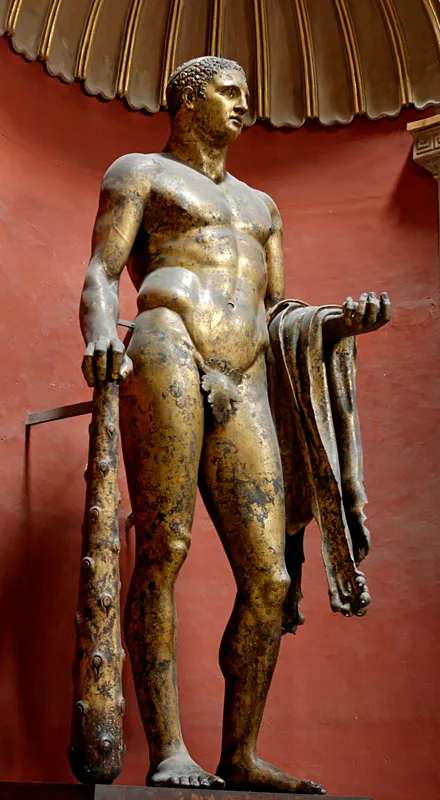
Personal, non-commercial site. Image: Wikimedia Commons · CC BY 2.5.
Pinch or scroll to zoom