Sphere Within Sphere
Sfera con sfera
Take a moment to look closer.
Arnaldo Pomodoro · Vatican MuseumsArnaldo Pomodoro · Sphere Within Sphere
Guide
In the middle of this great courtyard stands a huge bronze ball, four metres across. Its title is Sphere Within Sphere, and it is the work of the Italian sculptor Arnaldo Pomodoro. The artist gave it to the Vatican in 1990. After so many ancient statues and old paintings, it can come as a surprise.
Look first at the outer shell. From a distance it seems a perfect globe, smooth and shining like a planet. Then your eye catches the great tear across its face. Through the gap you see a second sphere inside, and it is broken too. Its edges are full of teeth, ridges and notches, like the gears of a machine or the inside of a living body.
That contrast is the whole idea. The sculptor compared the polished outside to the surface perfection of our world, and the broken inside to the troubled complexity hidden beneath it. He also saw a sphere inside a sphere as a hope: the rebirth of a less tormented and destructive world.
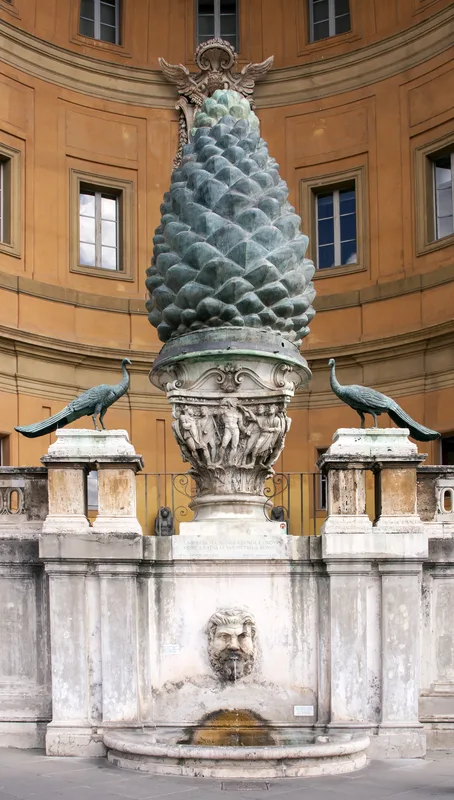
Now look around you. The courtyard is named after a giant ancient bronze pine cone, which sits in the great niche behind the sphere. Here are two bronzes and two round forms, separated by many centuries. On the other side rises the dome of St Peter's. Several accounts say that the Vatican sphere has a mechanism that responds to the wind, so that the Roman breeze at sunset can slowly turn it. Stay a moment and watch how the light moves across the metal.
The work
Sphere Within Sphere is a bronze sculpture four metres in diameter. The Vatican catalogue dates it to 1990 and records it as a gift from the artist. That places it at the very top of the series, whose spheres range from half a metre to four metres across.
The form is easy to describe. An outer sphere has been torn open, as if something had split it from within. In the opening sits a second, smaller sphere, and it too is cracked and gashed. The sculptor described his aim as breaking these perfect, magic forms in order to reveal their internal ferment, mysterious and alive, monstrous and yet pure.
The outside is smooth and polished. The inside is rough and crowded with shapes that look like teeth, ribs and cogs. According to the artist, these forms can be read in two ways. They may seem organic, and so human, or they may look technological, like the parts of a gear. The series is often described as an image of an ideal city, where living shapes and mechanical ones meet.
The contrast between shine and roughness is deliberate. In his own words, he wanted to create a discordant tension, a conflict with the polished shine, a unity composed of incompleteness. As a young man he had trained as a goldsmith, and his early works were made like jewels, with overlays of silver and gold. The same attention to surface returns here on a monumental scale.
The Vatican sphere is unusual in one respect. It is said to have a mechanism that responds to the wind, so the sculpture is not meant to stand quite still. One account even calls it a sphere that rotates over time. Seen in the open air, its metallic reflections change with every hour of the day.
Context
The sculptor was born in 1926 in Morciano di Romagna, not far from Rimini. He trained as a surveyor and as a goldsmith, and in the mid-1950s moved to Milan, which remained his home for the rest of his life. An exhibition of Picasso there, and later a visit to New York where he saw the sculptures of Brancusi, made a deep impression on him.
Spheres became his signature in the 1960s. In 1966 he was asked to make a large sphere, three and a half metres across, for the Italian pavilion at Expo 67 in Montreal. That sculpture now stands in front of the Farnesina palace in Rome. Its success opened the way to commissions around the world. Over his career he made about forty-five spheres of this kind.
The Vatican sphere arrived in 1990, a year of honours for the artist. That same year he received the Praemium Imperiale for sculpture from the Japan Art Association. According to the museum's catalogue, the sphere was a gift of the artist and entered the collection on 6 March 1990. One writer suggests that he saw the gift as a kind of consecration of his work.
There is one uncertainty about the date. Some accounts say the Vatican sphere was created between 1979 and 1980. The artist's foundation does list a Sphere Within Sphere from those years, but that one is in fibreglass and two and a half metres wide. The Vatican catalogue gives 1990 for the bronze. The sources do not explain how the two are related.
The setting suits the work. The courtyard is framed on one side by the dome of St Peter's and on the other by the curved niche of the palace facade. Here a modern sphere faces an ancient one.
Details
Start by taking in the whole courtyard. The lawns, the paths and the long facades all lead the eye to the centre, where the sphere stands on its low base. If you can, walk slowly around it. From every side the tear looks different, and from some angles the inner sphere almost disappears behind the shell.
Now look at the great opening in the outer shell. Its edges are not clean cuts. They are ragged, like torn metal or cracked earth, and the break spreads across the face of the globe in jagged branches. Through the gap you glimpse the inner sphere, which carries its own wound.
Come closer and study the inner forms. Rows of small blocks and teeth line the break, like the cogs of a gear. The artist said these shapes could be read as human or as technological, and you can decide for yourself. Then compare them with the outer skin. Outside, the bronze is smooth, and its metallic reflections catch the sky, the buildings and the people passing by. Inside, the surface is darker, rougher and busier. That is the tension he wanted: perfection on the outside, a troubled world within. As he once put it, in his work he saw the cracks, the eroded parts, and the destructive potential of a time of disillusion.
Finally, raise your eyes to the great niche in the palace facade behind the sphere. In it sits the ancient bronze pine cone that gives the courtyard its name, almost four metres high. From the right spot, the two line up, one modern bronze in front of an ancient one. The first is classical, symbolic and stable. The second is modern, dynamic and restless.
Details up close
Legacy
Spheres of this kind became the artist's signature, and they now stand in public places around the world. There is one at the United Nations in New York, another at Trinity College in Dublin, others at the University of California in Berkeley, at the Hirshhorn Museum in Washington and at the Tehran Museum of Contemporary Art. They differ in size, from half a metre to four metres.
The meaning of the series has grown over time. When Italy gave a sphere to the United Nations in 1996, it was offered as a reference to the new millennium. Its shell seems to break open as if the inner sphere were hatching. The artist called it a promise for the rebirth of a less troubled and destructive world. The same hope can be read here.
Others see the spheres more darkly, and the artist allowed for this too. He spoke of the cracks and eroded parts that emerge from our time of disillusion. So the sphere can be seen as a wounded world, or as a world being born. Both readings are possible, and the work does not choose between them.
In the Vatican, the sphere has become one of the symbols of the courtyard. It shows that the museums welcome art of every period, and that past and present can meet here and question each other. Next to the ancient pine cone, it turns a place of passage into a stage where old and new face each other.
The artist died at his home in Milan on 22 June 2025, the day before his 99th birthday. He once said that sculpture must be projected into space, to remove as far as possible the weight of the material and the fixed base. A great bronze globe that the wind can turn is a fitting example of that idea.
Sources (7)
- Musei Vaticani – Catalogo online: Sfera con sfera [MV.24850.0.0] · academic
- Fondazione Arnaldo Pomodoro – Sfera con sfera, 1979-1980 · academic
- Vativision – La sfera di Pomodoro nel Cortile della Pigna · guide
- L'archivio della scultura – Sfera con sfera · guide
- Wikipedia (en) – Sphere Within Sphere · academic
- Wikipedia (it) – Sfera con sfera · academic
- Wikipedia (en) – Arnaldo Pomodoro · academic
In the same area
Personal, non-commercial site. Image: Wikimedia Commons · CC BY-SA 3.0.
Pinch or scroll to zoom