The Pine Cone (Pigna)
Pigna
Take a moment to look closer.
Publius Cincius Salvius · Vatican MuseumsPublius Cincius Salvius · The Pine Cone (Pigna)
Guide
You are looking at one of the oldest and strangest landmarks of the Vatican. Inside the great niche at the end of this courtyard sits a giant pine cone of bronze, almost four metres tall. It even gave the courtyard its name: the Cortile della Pigna, the Courtyard of the Pine Cone.
The pine cone is ancient Roman. It was made around the second century AD as part of a fountain, and water once flowed from it. It carries the name of the man who cast it, Publius Cincius Salvius. Look first at the surface. Row upon row of overlapping scales spiral upwards, each one modelled in metal, so the fruit looks almost real.
Then look at its companions. On either side stands a bronze peacock. These are copies of ancient birds that probably came from the tomb of the emperor Hadrian. Below, beside the fountain in the courtyard, lie two Egyptian lions made for a pharaoh called Nectanebo.
This object has travelled a long way. It was found in the Campus Martius, the old district around the Pantheon, and it probably decorated a sanctuary of the goddess Isis. In the Middle Ages it stood in the courtyard in front of the old basilica of Saint Peter. In 1608 it was brought here.
The poet Dante mentions it in the Divine Comedy. He compares the face of a giant to the pine cone of Saint Peter's, and his lines are carved just below it. So when you stand here, you are looking at a fountain that Roman citizens, medieval pilgrims and Renaissance popes all knew.
The work
The sculpture shows a pine cone, the fruit of the pine tree, enlarged to a colossal size. It is cast in bronze and stands almost four metres high. From below it looks solid and heavy, yet its surface is full of rhythm. The scales run upwards in slanting rows, each one slightly raised and ending in a point, so light and shadow play over the whole form.
It was made as a fountain. The sources differ a little on how the water came out. One says that it spouted from the top. Another says that it ran from the tips of the scales. Either way, the cone was once wet with running water, unlike the dry green bronze we see today. Water still flows at the foot of the monument, and you can hear it across the courtyard.
The bronze carries the name of the man who made it, Publius Cincius Salvius. Beyond this name, the sources say nothing about him.
The pine cone does not stand on the ground. It rests on a large ancient capital, the carved top of a column, which comes from the Baths of Nero. The capital dates from the third century and shows the crowning of a victorious athlete. So the monument you see is an assembly. Roman pieces of different dates and origins were brought together much later.
The two bronze peacocks on either side complete the group. They are copies. The originals date from the age of Hadrian and are kept inside the Vatican Museums. They probably came from the emperor's great tomb, which is now the Castel Sant'Angelo.
Everything is framed by the huge niche behind, a Renaissance addition. In front of it, a double flight of steps designed by Michelangelo leads up to the pine cone.
Context
The story begins in the Campus Martius, a district of ancient Rome. The pine cone was found there, near the Pantheon and the Baths of Agrippa. It probably decorated the nearby temple of Isis, an Egyptian goddess who also had followers in Rome. Its discovery left a lasting mark. A whole district of the city is still called Pigna after it.
Why a pine cone? In ancient Rome the fruit had a religious meaning. It was linked with the cult of Cybele, the mother goddess of Phrygia, and of her young companion Attis. According to the myth, Attis wounded himself beneath a pine tree, and new trees grew from his blood. The cone, full of seeds, came to stand for life that survives death. A Roman festival on the twenty-second of March celebrated the moment when a sacred tree was carried into the goddess's sanctuary.
Later the pine cone moved into a church setting. It was placed at the centre of the porticoed courtyard in front of the old basilica of Saint Peter, the church that stood before the present one. It remained there for centuries.
In 1608 it was moved to this courtyard. The courtyard itself was once the upper end of the vast Belvedere Courtyard, designed by Bramante to link the palace of Pope Innocent VIII with the Sistine Chapel. The building of the Vatican Library later cut that long space in two, and this upper part took its name from the pine cone.
The great niche behind it is the work of Pirro Ligorio. He built it in 1562, under Pope Pius IV, and modelled it on the apses of the Roman Forum. It replaced a lower and more elegant exedra by Bramante, which did not rise above the height of the façade. The architecture was already here, waiting, when the pine cone arrived.
Details
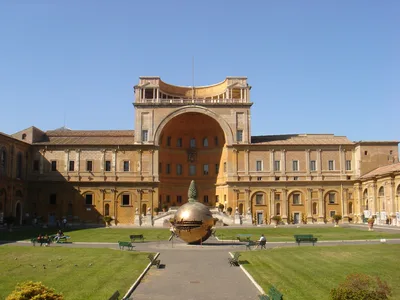
Start with the whole view. The scene is built like a stage. The huge curved niche frames it, with its ochre walls and rows of windows. The pine cone sits on the central axis, raised on its tall base, between two birds. Below, a stone wall with a small fountain completes the picture. Take it all in, then come closer.
Look first at the pine cone itself. Follow the scales with your eyes. They run in slanting rows around the whole cone, and each one swells out and ends in a blunt point. The bronze has turned green and blue over the centuries, darker in the hollows and paler on the raised edges. According to one source, water once ran from these tips.
Now look at the base just under the cone. This is the ancient capital from the Baths of Nero. Around it stands a crowd of carved figures, and at the centre a nude young man. The sources link the scene with the crowning of a victorious athlete. Below the figures you can see the curling leaves of the capital. A piece of a Roman bath building has become a pedestal.
Then turn to the peacocks, one on each side, perched on stone pillars. Their long tails stretch out behind them, and their slender necks rise high. Remember that they are copies. The originals, from the age of Hadrian, probably stood at the emperor's tomb.
Finally, find the small plaque just below the base. It carries Dante's words from the Inferno: his face seemed to me as long and as broad as the pine cone of Saint Peter's in Rome. The poet is speaking of the giant Nimrod. Under it, water still pours into the basin, so the old fountain is not completely silent.
Details up close
Legacy
The pine cone is one of the few ancient monuments of Rome that has stayed in view, in one place or another, for most of its long life. Found in the Middle Ages, it stood first at Saint Peter's and then here. It is said to be about eighteen hundred years old.
Its most famous witness is Dante. In the Inferno, part of the Divine Comedy, he meets the giant Nimrod and measures his face against the pine cone of Saint Peter's. The comparison suggests that many readers knew the object, at least by reputation. Whether the poet saw it himself is uncertain. A popular story says that he came to Rome as a pilgrim for the Jubilee of 1300 and saw it then. This is possible, but there is no proof, and it remains a legend.
The pine cone has also given names. The district of Rome where it was found is still called Pigna. The courtyard began to be called after it soon after its arrival in 1608.
Its meaning has shifted with its setting. In ancient Rome it was tied to the cult of Attis and to the idea of life after death. Modern writers often call it a symbol of immortality and rebirth. Some popular accounts go further and link its shape with the pineal gland in the brain and with spiritual enlightenment. That is a modern reading, not something the ancient sources tell us.
There is a second pine cone fountain, in Rimini, but its pine cone was only installed in 1807. The Vatican bronze is the ancient original of its kind.
Today visitors often pause here after hours inside the Vatican Museums. They listen to the water, look up at the green scales, and share a sight that the people of ancient Rome, pilgrims and popes saw before them.
- Image
- Wikimedia Commons · CC0
- Official page
- www.museivaticani.va
Sources (7)
- Musei Vaticani – Terrazza del Nicchione · official
- Vatican Museums – Terrace of the Niche · official
- Walks in Rome – The Courtyard of the Pinecone · guide
- Aleteia – The story behind the Vatican's 13-foot pine cone sculpture · guide
- Wikipedia (en) – Fontana della Pigna · academic
- Wikipedia (it) – Pignone (scultura) · academic
- 维基百科(中文)– 松果喷泉 · academic
In the same area
Personal, non-commercial site. Image: Wikimedia Commons · CC0.
Pinch or scroll to zoom