Round Hall and Porphyry Basin
Sala Rotonda e vasca di porfido
Take a moment to look closer.
Michelangelo Simonetti (hall) · Vatican MuseumsMichelangelo Simonetti (hall) · Round Hall and Porphyry Basin
Guide
Welcome to the Round Hall, one of the grandest rooms in the Vatican. Look up first. The great dome above you imitates the Pantheon, the famous domed temple of ancient Rome. The hall was completed in 1779 to a design by the architect Michelangelo Simonetti, as part of the new museum of ancient sculpture that the popes were building at the time.
Now look at the centre of the room. That enormous dark red bowl is a single basin of red porphyry, an extremely rare stone often called imperial porphyry. It is almost five metres across, and the museum's catalogue estimates its weight at around fifteen tonnes. In antiquity it must have decorated one of the great public spaces of imperial Rome. The three feet it stands on are modern, made of gilded bronze.
Then lower your eyes to the floor. It is a patchwork of ancient mosaics from the third century AD, found at Otricoli and at Sacrofano and pieced together here in the eighteenth century. You can make out sea creatures, centaurs and fighting figures.
Finally, look around the walls. Colossal statues of gods, heroes and emperors stand in the niches, and huge busts rise on pedestals between them. The bronze giant covered in gold is a Hercules, a work with its own remarkable story.
This hall was designed like a small temple for the masterpieces of antiquity. Take a moment in the middle of it, and enjoy the feeling of standing inside a Roman building.
The work
The hall is a round, domed space almost eighteen metres across. Its wall is divided into ten bays. Large niches for colossal statues alternate with fluted pilasters, and in front of them stand outsize busts. Light enters from a ring of windows high in the drum, of a type used in Roman baths, so the statues are lit softly from above.
The basin at the centre is the star of the room. It is carved from red porphyry, a deep purple stone speckled with pale crystals. According to one guide, in antiquity this stone came from a single quarry in Roman Egypt. The museum's catalogue gives its diameter as four metres and seventy-six centimetres. The walls of the bowl are twenty-five centimetres thick. The centre of the bowl has a round eye, and the small boss at its heart is a restoration. The basin rests on three modern feet in gilded bronze.
The floor tells its own story. The central part is a large colour mosaic from the baths of Otricoli, a Roman town in Umbria, about eighty kilometres from Rome. It was found in a large octagonal room of the bath complex. It shows battles between Greeks and centaurs, together with sea and river gods. It is not entirely original, because pieces were completed when it was laid here. Around it runs a band of black and white mosaic from Otricoli and Sacrofano.
The niches hold famous statues. Among them are a gilded bronze Hercules and the colossal Antinous from Palestrina. The busts include the head of Zeus from Otricoli, found in 1775. It is thought to be a Roman copy of a Greek original. Everything here was chosen and arranged to create one harmonious, ancient-looking whole.
Context
The Round Hall belongs to the Pio-Clementino Museum, named after two popes. Clement XIV founded the museum in 1771. His successor, Pius VI, enlarged it, and for him the architect Michelangelo Simonetti designed a sequence of three new halls. This round room was one of them. The Vatican dates its completion to 1779, while other sources give about 1780 or 1782.
Its model is also debated. The Vatican says the vault imitates the Pantheon. A modern architectural study instead links the plan to the so-called Temple of Minerva Medica, a fourth-century building in Rome. Either way, the aim was the same: to show ancient sculpture inside a space that itself looked ancient. Simonetti had learned this taste for accuracy from Winckelmann, the great scholar of Greek art.
Many of the works came from new excavations. The mosaics were dug up at Otricoli, in Umbria, and the head of Zeus was found there in 1775, during a campaign paid for by Pius VI.
The basin has a longer and more tangled history. A popular story says it came from the Golden House of the emperor Nero, but the museum's own catalogue calls this tradition less reliable. The sixteenth-century antiquarian Pirro Ligorio said it was found near the Curia in the Roman Forum under Pope Julius II. Another scholar has suggested excavations in the garden of the Colonna family. What is certain is that it stood in that garden, and that in 1552 Ascanio Colonna gave it to Pope Julius III, who moved it to his Villa Giulia. It reached the Vatican in the eighteenth century. Even its size is given differently: the museum's web page speaks of thirteen metres around, the catalogue of more than fourteen.
Details
Start by standing near the railing and taking in the whole hall. Everything is arranged around one centre. The ring of niches, the circle of the floor and the round bowl of the basin all echo the shape of the dome. It is a room made to be seen from the middle.
Now look closely at the basin. Notice the colour of the stone, a dark wine red with tiny pale flecks. Run your eye along the smooth curve of the rim, carved from a single block of this rare stone. Look at the feet too. They are modern additions in gilded bronze, made to lift the bowl like a precious object. The museum's catalogue estimates that the whole basin weighs about fifteen tonnes.
Next, lower your eyes to the floor near the railing. The mosaic comes from the baths of Otricoli. Look for the figures between the bands of ornament: centaurs, sea creatures and fighting men. Some parts are original, others were completed in the eighteenth century when the floor was laid here, so try to spot where the colours and the tesserae change.
Then lift your gaze to one of the niches. Each is crowned with a large shell and framed by fluted pilasters, all in the language of ancient architecture. The central niche here holds the gilded bronze Hercules, which has its own remarkable story.
Finally, look at the tall figure with a crown on its head. It is probably the colossal Antinous found at Palestrina. Antinous was the favourite of the emperor Hadrian, and he drowned in the Nile. Here he appears as Osiris and Dionysus. The ornament on his crown looks like a pine cone. It is a modern replacement for the original, which may have been a snake or a lotus flower.
Details up close
Legacy
The Round Hall is more than a room full of treasures. It is an early example of a museum designed with a purpose. Its architect wanted the whole suite of classical rooms to lift the visitor's mood gently but powerfully, and this is exactly what happens as you step inside. The approach looked ahead to the great themed museums of the Romantic era.
The hall also tells us how the eighteenth century looked at antiquity. The restorers of the time did not hesitate to complete ancient works. Busts were given new bases, missing parts were added, and heads were reworked. The floor mosaic was filled in where it was missing. Today we would treat these objects differently, but the result is a unique picture of the taste of that age.
The basin shows another side of this story. Its stone is known as imperial porphyry, and it is extremely rare. The bowl once adorned a great public space of imperial Rome. It passed through the hands of Roman noble families and popes before it found its place here. The legend of the bath of Nero has grown around it, and some modern writers even call it the largest single piece of porphyry in existence. The first claim is doubtful, and the second is hard to check, yet both show how strongly it impresses.
Some works in the hall had a long life beyond Rome. The head of Zeus from Otricoli, for example, was used by the Baroque sculptor Stephan Schwaner as a model for God the Father in a church in Warsaw.
Above all, the Round Hall preserves the dream of its builders: to let visitors walk into a Roman interior and meet the ancient world face to face.
- Image
- Wikimedia Commons · CC BY-SA 2.0
- Official page
- www.museivaticani.va
Sources (10)
- Musei Vaticani – Sala Rotonda · official
- Vatican Museums – Round Hall · official
- Musei Vaticani – Catalogo online: Grande tazza circolare (labrum) · official
- Wikipedia (en) – Michelangelo Simonetti · academic
- Wikipedia (en) – Museo Pio-Clementino · academic
- Wikipedia (it) – Museo Pio-Clementino · academic
- Wikipedia (en) – Ocriculum · academic
- Wikipedia (it) – Giove di Otricoli · academic
- Romapedia – Round Room · guide
- Gerard Sauer – The Pantheon-like Sala Rotunda · guide
In the same area
 Image failed to load
 Image failed to load
 Image failed to load
 Image failed to load
 Image failed to load
 Image failed to load
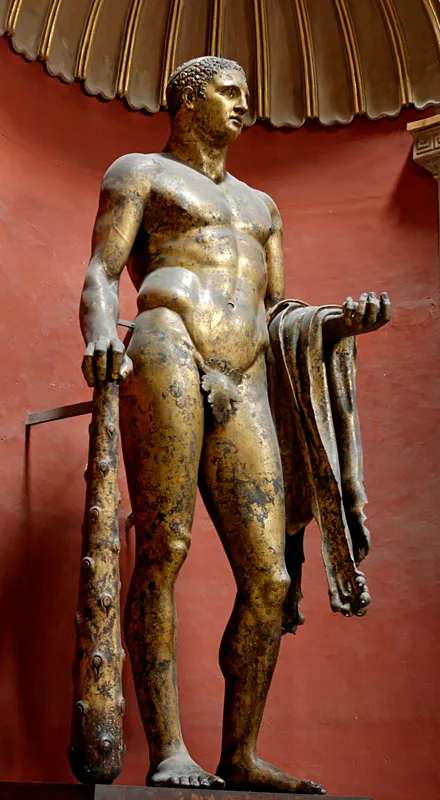 Image failed to load
 Image failed to load
Personal, non-commercial site. Image: Wikimedia Commons · CC BY-SA 2.0.
Pinch or scroll to zoom