The Temptations of Christ
Tentazioni di Cristo
Take a moment to look closer.
Sandro Botticelli · Vatican MuseumsSandro Botticelli · The Temptations of Christ
Guide
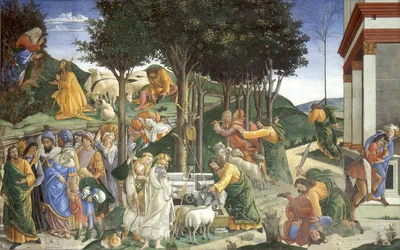
The title written above this fresco promises the Temptations of Christ. Yet if you look at the foreground first, you will find something else. The painting belongs to the fifteenth-century cycle on the chapel walls, made between 1480 and 1482, long before the famous ceiling. Its painter was the Florentine Sandro Botticelli, working with many assistants.
The three temptations told in the Gospel of Matthew take place in the background, in three small scenes along the top. On the upper left, the devil, disguised as a hermit, asks Jesus to turn stones into bread. In the centre, the two stand on the roof of a temple, and the devil dares Jesus to throw himself down. On the upper right, Jesus sends the devil tumbling from a cliff, while angels come to serve him.
The large scene in front is a sacrifice at the temple. It is usually read as the offering made by a leper after Christ had healed him. A young man brings a basin of water, and two women bring a pair of birds and some cedar wood, the ingredients of the ancient rite of cleansing. Some scholars see a deeper meaning here: the high priest stands for Moses, who gave the Law, and the young man for Christ, who will redeem humankind with his own blood.
This matters because the whole wall answers the one facing it. Here Christ brings the new law of the Gospel. Opposite, the life of Moses shows the old law, written on tablets. Together they told every visitor that the popes were the heirs of both.
The work
The fresco is about three and a half metres high and five and a half metres wide. Like every panel in this cycle, it has a title in the frieze above, written in Latin. It calls Jesus Christ the bringer of the Gospel law, and it names only the temptations, even though they are the smallest part of the picture.
The story unfolds in several moments, placed side by side. The first temptation is on the upper left. Jesus has been fasting, and a figure in a hermit's habit comes to him. It is the devil, and he asks for a miracle: turn these stones into bread.
The second temptation is in the upper centre. The devil has carried Jesus to the top of the temple of Jerusalem and dares him to jump, since God has promised that his angels will protect him. The building is not an ancient temple at all. It recalls the hospital of Santo Spirito, near the Vatican, whose construction Pope Sixtus IV had promoted.
The third temptation is on the upper right. From a high mountain, the devil shows Jesus the beauties of the earth and promises him power over them, if only he will bow down. Jesus refuses. The devil, now naked, falls from the rocks, and angels arrive to serve Christ.
In the foreground, a crowd gathers in front of the temple for a rite of cleansing. The high priest stands at the centre. A man healed of leprosy presents himself, so that he may be declared clean. A young man carries a basin of water with a branch of hyssop. One woman brings two birds for the sacrifice, another brings cedar wood.
As in all the wall frescoes, the painters added gold finishing, so that the scenes would shine in the light of torches and candles.
Context
The chapel takes its name from Pope Sixtus IV, of the della Rovere family, who had the old great chapel of the palace rebuilt. Its walls were painted by a team made up at first of Pietro Perugino, Sandro Botticelli, Domenico Ghirlandaio and Cosimo Rosselli, each helped by his own workshop. The Vatican Museums give 1481 and 1482 as the years of the work.
The Florentine painters travelled together. On 27 October 1480 they left for Rome. Their journey was part of a reconciliation between the Pope and Lorenzo de' Medici, the real ruler of Florence, and the painters served as ambassadors of their city's culture. By the spring of 1481 they were at work in the chapel, alongside Perugino, who was already there.
The programme set the life of Moses against the life of Christ, the Old Testament against the New. Moses received the divine law on the tablets. Christ brought the message of the Gospel, and then chose Peter as his successor. Peter was the first bishop of Rome, so the message for anyone entering the chapel was clear: the power of the popes came down through this chain.
In this light the foreground makes sense. The healed leper completes the rite laid down by the old law, in front of the priest. If the priest is Moses and the young man is Christ, old and new meet in a single scene.
The painter, helped by numerous assistants, painted three scenes in the chapel. On 17 February 1482 his contract was renewed for further panels. Only three days later his father died. He went back to Florence, and he never returned to the chapel.
On 15 August 1483, Sixtus IV consecrated the new chapel and dedicated it to the Virgin of the Assumption.
Details
Start by taking in the whole fresco. It works like a stage in two layers. In front stands a large, crowded ceremony. Behind it rise a temple and a landscape, and along the top run three small episodes that are easy to miss. In each of them, look for Christ, the same figure repeated three times.
Now look up to the upper left. Christ meets a figure in the brown habit of a hermit. This is the devil in disguise. He is tempting the fasting Jesus to prove himself with a miracle, by turning stones into bread.
Next, move to the top of the temple in the centre. Two small figures stand on the pediment, high above the square. The devil is urging Christ to throw himself into the void and be saved by angels. The building deserves a look of its own. Its front recalls the hospital of Santo Spirito, a foundation promoted by the same Pope who built this chapel.
Then look to the upper right. Here the tempter is finally unmasked. After Christ has refused to rule the world, the devil is thrown down from a rock, and angels gather to serve Christ.
Finally, come back down to the foreground. At the centre, in front of an altar where a fire burns, the high priest receives a basin from a young man in white. In it is a branch of hyssop. Further back on the left, a woman carries a bowl with the birds on her head. On the right, another woman strides in with a bundle of cedar wood. Water with hyssop, birds and cedar were the three ingredients of the ancient ritual for cleansing a leper. Notice also the many lively faces in the crowd. Critics who find the story hard to follow still admire the vigour of these portraits.
Details up close
Legacy
Above you is the famous ceiling, but this wall came first. It belongs to a great team project of the fifteenth century. The painters agreed on shared conventions so that the walls would look like one work: the same scale for the figures, the same rhythm, a similar landscape and a single range of colours.
Within this group, critics have not always been kind to the Sistine scenes by this painter. Compared with the masterpieces he made for the Medici, they can seem weaker and more scattered. Here the main subject, the temptations, is pushed into the background, and the picture becomes hard to read as a whole. One suggested explanation is that he felt out of place. He was working on a scale and on themes that did not suit him, far from his own city.
Other qualities are widely praised. The portraits in the crowd are vigorous, and the picture is rich in inventive images. Its careful formal order also strengthens the symbolic meaning of the events.
That meaning has been much discussed. The Vatican Museums note that some see the high priest as Moses and the young man as Christ, whose blood will redeem humankind. This fits a long habit of Christian thought, in which stories such as the healing of the leper were seen as pointing forward to the death and resurrection of Jesus.
The fresco also speaks to the one facing it, by the same painter, with the trials of Moses. In the official reading, Moses killing an Egyptian foreshadows Christ defeating the devil. Standing between the two walls, you are in the middle of the argument the chapel was built to make.
Like the rest of the chapel, the fresco was cleaned during the complete restoration carried out between 1979 and 1999.
- Image
- Wikimedia Commons · Public domain
- Official page
- www.museivaticani.va
Sources (12)
- Musei Vaticani – Tentazioni di Cristo · official
- Vatican Museums – Temptations of Christ · official
- Musei Vaticani – Storie di Cristo · official
- Musei Vaticani – Storia della Cappella Sistina · official
- Wikipedia (en) – Temptations of Christ (Botticelli) · academic
- Wikipedia (it) – Prove di Cristo · academic
- 维基百科(中文)– 基督在旷野受试探和洁净癞病人 · academic
- Wikipedia (en) – Sistine Chapel · academic
- Vatican Museums – History of the Sistine Chapel · official
- Vatican Museums – Stories of Christ · official
- Vatican Museums – Events in the life of Moses (pendant fresco) · official
- Musei Vaticani – Fatti della vita di Mosè (affresco di fronte) · official
In the same area
 Image failed to load
 Image failed to load
 Image failed to load
 Image failed to load
 Image failed to load
 Image failed to load
 Image failed to load
 Image failed to load
By the same artist
Personal, non-commercial site. Image: Wikimedia Commons · Public domain.
Pinch or scroll to zoom