The Trials of Moses
Prove di Mosè
Take a moment to look closer.
Sandro Botticelli · Vatican MuseumsSandro Botticelli · The Trials of Moses
Guide
This wall fresco tells the story of the young Moses, and it reads like a comic strip without frames. The same man appears again and again, and you can always recognise him by his golden yellow robe and his green cloak. It was painted in 1481 and 1482 by Sandro Botticelli and his workshop, about a quarter of a century before Michelangelo painted the ceiling above.
Start on the right. In front of a grand building, Moses kills an Egyptian who had ill-treated an Israelite, and then he flees into the desert. In the centre, he drives away the shepherds who wanted to stop the daughters of Jethro from watering their flock. Then he draws water for them himself. One of these young women, dressed in white, will become his wife, Zipporah.
Now look at the upper left. On the hillside, Moses takes off his sandals. A little further, he kneels before the burning bush, where God gives him his mission: go back to Egypt and free your people from slavery. At the lower left, he leads his people away.
Why is this story here? The walls of the chapel were planned as a parallel. This side shows the life of Moses, and the opposite wall shows the life of Christ. The Vatican Museums explain that when Moses kills the Egyptian, he prefigures Christ defeating the devil. So this panel answers the Temptations of Christ, also by Botticelli, directly across the chapel. Above, a Latin inscription in the frieze gives the title: the temptation of Moses, bearer of the written law.
The work
The fresco is about three and a half metres high and more than five and a half metres wide. It belongs to the middle tier of the chapel walls. Below it runs a painted curtain of silver and gold. Above it are portraits of popes.
The episodes come from the book of Exodus and are read from right to left. First, Moses kills the Egyptian and flees to the land of Midian. Second, at the well, he fights off the shepherds who were bullying the daughters of Jethro, among them his future wife Zipporah, and he waters their flock. Third, hearing the voice of God, he takes off his sandals and approaches the burning bush, where he receives the order to return to Egypt and free the Jews from slavery. The title in the upper frieze refers to this last episode. Finally, at the lower left, he leads his people towards the Promised Land.
The Vatican Museums give each episode a meaning. In killing the Egyptian, Moses is a figure of Christ defeating the devil. At the well he appears as a good shepherd. In the other episodes he is the appointed leader of the chosen people.
To hold all this together, the painter uses a landscape of trees, hills and a classical building. Of the three scenes he painted in the chapel, this is the most coordinated in the way it links its many episodes.
The strongest qualities of the fresco are the vigour of its portraits and its rich invention. Yet in places the whole feels fragmentary. Scholars suggest that the painter may have felt out of his depth, working at an unfamiliar scale, on unfamiliar subjects, far from home. Details were finished in gold, so that the painting would glitter in the light of torches and candles.
Context
The Sistine Chapel takes its name from Pope Sixtus IV, who had the old Great Chapel of the palace rebuilt between 1477 and 1480. The walls were then decorated by a team of painters: at first Pietro Perugino, Sandro Botticelli, Domenico Ghirlandaio and Cosimo Rosselli, each helped by his own workshop. The frescoes were begun in 1481 and finished in 1482. On 15 August 1483 the pope consecrated the chapel and dedicated it to the Virgin of the Assumption.
The Florentine painters had not come by chance. Botticelli left for Rome on 27 October 1480, together with other painters from Florence. Their journey was probably part of a reconciliation between the pope and Lorenzo de' Medici, the real ruler of Florence. The Florentines were at work in the chapel by the spring of 1481, next to Perugino, who was already there and may have supervised the project.
The programme was clear. The stories of Moses faced the stories of Christ, showing continuity between the Old and the New Testament, and between the law written on the tablets and the message of Jesus. Christ then chose Peter as his successor, and this legitimised the power of Peter's successors, the popes themselves. To keep the work consistent, the painters followed shared conventions: the same scale for the figures, a similar rhythm and a similar kind of landscape.
The Moses cycle originally had eight panels, beginning on the altar wall with a Finding of Moses by Perugino. That fresco was lost when Michelangelo painted the Last Judgement. So this panel is today the second of the cycle.
Botticelli painted three scenes in the chapel. On 17 February 1482 his contract was renewed for more work, but three days later his father died. He went home to Florence and never came back.
Details
Start by stepping back and taking in the whole wall. The scene is full of people, yet it is easy to follow if you look for one thing: the golden robe and green cloak of Moses. Your eye jumps from the building on the right, to the well in the centre, to the hill on the upper left, and down again.
Look first at the right. In front of a grand classical building, Moses strikes down the Egyptian, who falls backwards to the ground. Next to the building, a woman holds the Israelite who had been attacked. Just above, Moses runs away, looking back over his shoulder as he flees into the desert.
Now move to the centre, to the well. Two young women in white stand with their flock. They are the daughters of Jethro, and one of them is Zipporah, the future wife of Moses. Look at their long blond hair and the fine patterns of their dresses, typical of the painter. Moses bends over the trough and pours water for the sheep. Behind him, he drives away the shepherds with a stick.
Then look up at the upper left. On the green hill, Moses sits and takes off his sandals, because he is on holy ground. Close by, he kneels in wonder before the burning bush. Among the flames, God appears as an old man with a white beard and speaks to him.
Finally, come down to the lower left. Moses, now a leader, walks at the head of his people. Behind him come men in turbans, women carrying bundles and children, one of them holding a small dog. These lively faces may be portraits, and they show the painter at his best.
Details up close
Legacy
Today most visitors look up at Michelangelo, but these wall paintings are the oldest part of the decoration that survives. They show what the best painters of the late fifteenth century could do when they worked together on a single, coherent programme. Botticelli, Perugino, Ghirlandaio and Rosselli agreed on a common scale and rhythm, so that the walls read as one great book.
This panel is a fine example of the old way of telling stories in paint. Many episodes happen in one continuous landscape, and a single figure, marked by the same colours, guides us through time. The painter used this method with particular clarity here, and it remains one of the most readable scenes on the walls.
Its meaning is also important. The paired stories of Moses and Christ carried a strong message. The law given to Moses led to the message of Christ, and Christ entrusted his Church to Peter and his successors. On the walls of the pope's own chapel, this was a statement about the authority of the papacy. The link with the Temptations of Christ, directly opposite, makes the parallel visible.
The fresco also has a place in the life of its painter. It was one of only three scenes Botticelli painted in Rome, in a brief stay that ended with his father's death and his return to Florence. Scholars have noted both the vigour of its portraits and a certain uneasiness, as if he were working far from his usual world.
Finally, the chapel has never stopped being used. The first conclave held there, in 1492, elected Alexander VI, and popes are still elected beneath these walls. After the restoration of the chapel, completed in 1999, the colours and the gold can again be enjoyed as the painters intended.
- Image
- Wikimedia Commons · Public domain
- Official page
- www.museivaticani.va
Sources (10)
- Musei Vaticani – Fatti della vita di Mosè · official
- Vatican Museums – Events in the life of Moses · official
- Vatican Museums – Stories of Moses · official
- Musei Vaticani – Storia della Cappella Sistina · official
- Wikipedia (en) – Youth of Moses · academic
- Wikipedia (it) – Prove di Mosè · academic
- 维基百科(中文)– 梅瑟的生平 (波提切利) · academic
- Wikipedia (en) – Sistine Chapel · academic
- Vatican Museums – History of the Sistine Chapel · official
- Musei Vaticani – Storie di Mosè · official
In the same area
 Image failed to load
 Image failed to load
 Image failed to load
 Image failed to load
 Image failed to load
 Image failed to load
 Image failed to load
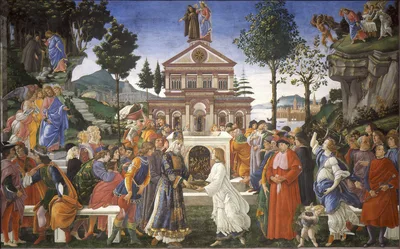 Image failed to load
Personal, non-commercial site. Image: Wikimedia Commons · Public domain.
Pinch or scroll to zoom