The Delivery of the Keys
Consegna delle chiavi
Take a moment to look closer.
Pietro Perugino · Vatican MuseumsPietro Perugino · The Delivery of the Keys
Guide
This is the fresco that explains why this chapel matters so much to the popes. In the centre, Christ hands a pair of keys to Peter, who kneels before him. They are the keys of the kingdom of heaven, a sign of sovereignty. With them, Christ gives his power on earth to Peter, his first vicar, and so to every pope after him.
The Vatican Museums consider it one of the high points of the wall cycle, and the masterpiece of its painter, Pietro Perugino. He and his assistants painted it in 1481 and 1482.
Look first at the foreground. The apostles stand in a long, calm row on either side, together with men in the clothes of the painter's own time. One of them, in a black cap with thick dark hair, is usually recognised as the painter himself.
Then let your eye travel back across the huge square, paved with large stones that draw you into the distance. At the far end stands the Temple of Jerusalem, imagined as a Renaissance building with eight sides and a dome. On each side of it rises a copy of the Arch of Constantine in Rome. In the middle distance, two small Gospel scenes play out: on the left the payment of the tribute money, on the right an attempt to stone Christ.
Finally, notice the landscape. Soft hills and slender trees fade into a bluish horizon. This sense of endless space was new, and it taught much to later painters, above all to the young Raphael.
The work
The fresco measures about three and a third metres by five and a half. It is organised in two horizontal bands. In front are the large figures. Behind them stretches an architectural backdrop, peopled with much smaller figures.
The main group sits well below the horizon, pressed close to the surface of the picture like a frieze. Christ holds out the keys, one gold and one silver, to the kneeling Peter. Peter is an old man dressed in blue and golden yellow. Around them stand the other apostles, recognisable by their haloes, and a group of the painter's contemporaries. Judas is among the apostles, the fifth figure to the left of Christ, shown from behind.
The poses follow a small number of basic attitudes, repeated in rhythm and often reversed from one side to the other. This suggests that the same drawing was reused. The result has been called musical: varied, yet orderly. The heavy, complex drapery follows the example of the Florentine sculptor Verrocchio.
The square is divided by coloured stones into large foreshortened rectangles. Their lines lead the eye to the centre of the background, to a domed temple with eight sides. Behind it, a real architect's design may have stood, but it is painted with the precision of a wooden model. On each side is a triumphal arch copied from the Arch of Constantine.
The inscription on the arches compares the Pope to Solomon, the builder of the first temple. It says that Sixtus, poorer in riches but greater in devotion, has consecrated this immense temple.
Look carefully and you will find mistakes of scale. The small figures in the middle band are as large as the people standing by the buildings, although these should be even smaller.
Context
The commission began in 1480. The painter was then working in Old Saint Peter's Basilica, decorating a chapel for Pope Sixtus IV. The Pope was so pleased that he asked him to decorate the new chapel he had rebuilt in the Vatican palace. Because the work was so large, a team of Florentine painters soon joined him. They were sent by Lorenzo de' Medici, and they included Sandro Botticelli and Domenico Ghirlandaio.
With many assistants, among them the young Pinturicchio, the painter made at least six scenes in the chapel. Only three survive today. The others were lost when the altar wall was repainted with the Last Judgment.
This scene is the fifth on its wall, counting from the altar, and it is the key to the whole programme. The wall paintings compare the life of Moses with the life of Christ. Christ, the new lawgiver, chooses Peter as his successor. The popes, as heirs of Peter, claim his supremacy. The fresco facing it, by Botticelli, makes the same point from the other side. It shows the Punishment of the Rebels, who dared to challenge the authority of Moses. One wall shows where papal power comes from. The other shows what happens to those who oppose it.
The timing was not by chance. Sixtus IV had recently restored the full powers of the papacy, after the end of the Great Schism and the abolition of the decrees of the Council of Constance.
While the fresco was being painted, a visit from Alfonso II of Naples led to his portrait being added at the far left of the foreground group. To balance the picture, an apostle was added above Saint Peter.
On 15 August 1483, the Pope consecrated the finished chapel to the Virgin of the Assumption.
Details
Start with the whole picture. The composition is built on symmetry. The lines of the pavement run towards the temple door, and the keys sit almost on the central axis, just below it. Your eye cannot miss the moment that matters.
Now look closer at the central group. Christ, in violet and blue, holds out the keys. Peter kneels, in blue and golden yellow. Around them, the apostles stand in a slow, rhythmic line. The graceful figure just to the right of Peter, with long flowing hair, is Saint John. Scholars see in him an echo of a bronze group by Verrocchio in Florence, showing Christ and Saint Thomas.
Next, lift your eyes to the temple. It has eight sides, porticoes and a dome. It stands for the Temple of Jerusalem, and also for the universal reach of papal power. Its perfect shape became a model. The painter reused it himself, and his followers took it up, above all Raphael, in his Marriage of the Virgin now in the Brera gallery.
Then move to the right-hand group in the foreground. Among the apostles stand men in the dress of the time. The one in a black cap with thick dark hair, turning towards us, is traditionally taken to be the painter's own self-portrait.
Finally, look to the left, at the triumphal arch and the space in front of it. There, in small scale, Christ and the apostles meet the tax collectors, in the story of the tribute money. On the other side of the square, a crowd tries to stone Christ. These tiny episodes are full of movement, while the large figures in front remain calm, almost like actors holding a pose.
Details up close
Legacy
This fresco is one of the most famous of the whole wall cycle, even from a purely artistic point of view. Its calm square, its perfect temple and its open sky became a picture of Renaissance ideals of classical perfection.
Its influence is easy to trace. The painter reused the temple in his own Marriage of the Virgin, now in Caen, and opened its central door onto the landscape. His pupil Pinturicchio took up the idea in the Bufalini Chapel in Rome. Above all, the young Raphael followed it in his celebrated Marriage of the Virgin in the Brera gallery. The vision even had an effect on real architecture: the Tempietto of San Pietro in Montorio, by Bramante.
The landscape was just as important. The feeling of an infinite world, stretching to the horizon with feathery trees and bluish hills, is stronger here than in almost any other work of the time. Later painters, Raphael especially, found it instructive.
Critics also point to limits. The small scenes in the background are lively, but the large figures have calm, similar expressions. Some see this as an inability to create drama, as if the figures were actors making gestures they did not really feel.
The meaning of the fresco reached far beyond art. It showed the source of papal authority in the very chapel where cardinals still meet to elect a new pope. It also gave rise to a superstition. The cardinal whose cell, drawn by lot during a conclave, lay beneath this fresco was said to be likely to be elected. Records indicate that at least three popes were housed beneath it during the conclaves that elected them: Julius II, Clement VII and Paul III.
- Image
- Wikimedia Commons · Public domain
- Official page
- www.museivaticani.va
Sources (10)
- Musei Vaticani – Consegna delle chiavi · official
- Vatican Museums – Delivery of the Keys · official
- Musei Vaticani – Storie di Cristo · official
- Musei Vaticani – Storia della Cappella Sistina · official
- Wikipedia (en) – Delivery of the Keys · academic
- Wikipedia (it) – Consegna delle chiavi (Perugino) · academic
- 维基百科(中文)– 交钥匙(佩鲁吉诺) · academic
- Wikipedia (en) – Sistine Chapel · academic
- Vatican Museums – History of the Sistine Chapel · official
- Vatican Museums – Stories of Christ · official
In the same area
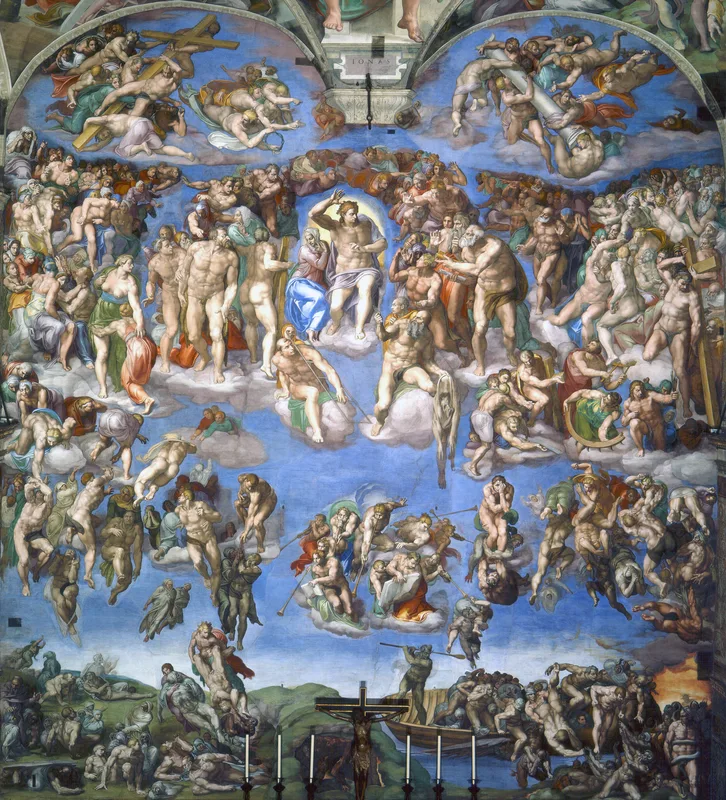 Image failed to load
 Image failed to load
 Image failed to load
 Image failed to load
 Image failed to load
 Image failed to load
 Image failed to load
 Image failed to load
Personal, non-commercial site. Image: Wikimedia Commons · Public domain.
Pinch or scroll to zoom