The Fall and Expulsion from Paradise
Peccato originale e Cacciata dal Paradiso terrestre
Take a moment to look closer.
Michelangelo · Vatican MuseumsMichelangelo · The Fall and Expulsion from Paradise
Guide
This panel tells two stories at once. Find the tree in the middle, with a serpent coiled around its trunk. It divides the scene into two halves, and each half shows a different moment from the third chapter of Genesis.
On the left is the Garden of Eden, green and leafy. Adam and Eve are still innocent. The serpent leans out of the branches and hands Eve the forbidden fruit. Look carefully: the tempter has the upper body of a woman, and below she becomes a long snake's tail wrapped around the tree. Eve turns to take the fruit, while Adam stretches into the branches to pick one for himself.
On the right, everything has changed. An angel in a red cloak, sword in hand, drives the couple out of Paradise. The landscape is suddenly bare and empty. Adam and Eve walk away, bent under the weight of remorse. Their faces are twisted with pain, and their bodies seem to have aged in a moment.
The Vatican Museums point out that in the Bible these two moments are clearly separate. By placing them side by side, Michelangelo shows cause and effect together: the sin and its consequence.
The fresco dates from around 1510. Before you move on, notice how the arm of the tempter and the arm of the angel mirror each other on either side of the tree. One offers, the other drives out. The whole human drama hangs on a single gesture, repeated twice.
The work
The panel is almost six metres wide and nearly three metres high, one of the larger fields in the central strip of the ceiling. It combines two passages from the third chapter of Genesis: the temptation and sin at the beginning, and the expulsion from the garden at the end.
The tree of the knowledge of good and evil stands more or less in the centre. One study notes that it is a fig tree, not the apple tree so common in Western Christian art. On the left, the space is closed by its branches and by a gentle diagonal of rocks, under a clear and luminous sky. Here the serpent is partly transformed into a woman. This develops an older tradition that usually gave the tempter a small human head. Some writers call this figure Lilith.
Adam and Eve are nude and extremely athletic. Even Eve, especially in her arms, has the masculine muscles typical of the women painted by this artist.
On the right, the landscape changes abruptly and becomes barren and desolate. The angel threatens the couple with his sword. Their bodies look suddenly shrunken and aged.
The fresco took thirteen giornate, the daily sections of fresh plaster. The painter began in the upper left corner, with the leaves of the tree, laid in with broad, fluid strokes.
The restoration was particularly effective on this scene. It brought back the contrast between warm and cool tones, and the changes in modelling. The modelling is soft and gentle for Eve before the sin, and hard and dense for the tempter, whose coiling tail shimmers with scales from yellow to green to red. The angel's red cloak rings out. The skin of the couple after the expulsion is built on a base of ochre, umber and white, with thin glazes of umber and black earth laid on top.
Context
Pope Julius II commissioned the ceiling, and Michelangelo signed the contract on 8 May 1508. The artist began above the entrance door, the one used for the solemn entry of the pope and his court, and moved towards the altar, painting the story of Genesis backwards. According to the Vatican Museums, he finished this first half, up to the Creation of Eve, in August 1510. This panel belongs to that first campaign, and most sources date it to around that year. One account places it after the long pause, so the exact sequence is debated.
The panel marks a turning point. The first three scenes, the stories of Noah, are crowded with small figures. At that stage the artist had assistants, but he was unhappy with their work and sent them away. In this scene and in the next, the Creation of Eve, the figures become larger, the composition simpler, and the gestures more essential and decisive.
For the expulsion, the painter looked back to Florence. As a student he had studied the great fresco painters of the early Renaissance, perhaps including Masaccio. Masaccio's figures of Adam and Eve driven out of Eden had changed the way painters used the nude body to express human feeling. Here that expressive power is developed on a much larger scale.
The scene also carried a meaning for the ceremonies held in the chapel. The Genesis stories can be read backwards as foreshadowing the events of Holy Week. In this reading the panel stands for the Crucifixion. The tree is placed at the centre on purpose, because according to tradition the wood of the True Cross came from it.
Below, the walls had been painted a generation earlier with the stories of Moses and of Christ. The ceiling was meant to complete that programme with the story of humanity from the very beginning.
Details
Begin with the whole panel. The tree stands at the centre like a hinge. To its left, the ground is green and the sky is clear. To its right, the land is bare and empty. The same two people appear twice, before and after.
Look up at the tempter, wrapped around the trunk. The upper body is that of a woman, and she leans out of the leaves to offer the fruit. Lower down, her body turns into a thick tail coiled around the tree. Look closer at the coils. Since the restoration, their scales shimmer again from yellow to green to red, with hard and dense modelling.
Now go down to Eve, reclining at the foot of the tree. She twists round and reaches up for the fruit. Her body is modelled softly, with gentle passages of light. Next to her, Adam stands and reaches up into the branches, eager to pick a fruit with his own hand. Both of them are powerful and athletic, full of life.
Then look at the angel on the right. He hovers above the couple in a bright red cloak and points his sword at Adam. Notice how his outstretched arm answers the arm of the tempter on the other side of the tree. The offer and the expulsion form one symmetrical design, with the tree as its axis.
Finally, follow Adam and Eve out of the garden. Adam raises his arms, as if to ward off the sword. Eve cowers beside him, arms drawn in. Their skin is darker, their backs are bent, and the ground under their feet is bare and dry. The contrast with the green garden is complete. In a few steps, the painter has shown the whole cost of the sin.
Details up close
Legacy
This panel is less famous than the Creation of Adam, yet it shows the ambitions of the ceiling just as clearly. Its first achievement is the way it tells the story. By joining two episodes that the Bible keeps apart, the painter turned a narrative into an argument about cause and effect. The tree at the centre and the matching gestures on either side make the idea readable even from the floor, far below.
Its second achievement is the body. On the left, the bodies are young and athletic. On the right, the same bodies look aged and broken. Nothing else is needed to show what the loss of Paradise means. The art historian Helen Gardner wrote that in the hands of this artist the body is simply the manifestation of the soul, or of a state of mind and character. This panel is a clear example. It carries forward the expressive tradition of Masaccio and raises it to a new, monumental scale.
The serpent is a bold invention too. Earlier images had usually given the tempter a small human head. Here it becomes a strong woman whose body flows into the coils of the snake, placed at the very centre of the composition.
Finally, the panel was one of the great revelations of the modern restoration, which the Vatican Museums date from 1979 to 1999 for the chapel as a whole. Over the centuries candle smoke and layers of varnish had muted the colours of the ceiling. The cleaning revealed colours much closer to those of the finished work: the warm and cool tones, the red of the angel's cloak, the shimmering tail. The restoration was praised, but it was also criticised. Some critics argue that details painted after the plaster had dried were lost with the dirt.
- Image
- Wikimedia Commons · Public domain
- Official page
- www.museivaticani.va
Sources (11)
- Musei Vaticani – Peccato originale e cacciata dal Paradiso terrestre · official
- Vatican Museums – Original Sin and Banishment from the Garden of Eden · official
- Musei Vaticani – La Volta · official
- Vatican Museums – History of the Sistine Chapel · official
- Wikipedia (it) – Peccato originale e cacciata dal Paradiso terrestre · academic
- 维基百科(中文)– 原罪和被赶出伊甸园 · academic
- Wikipedia (en) – Sistine Chapel ceiling · academic
- Wikipedia (it) – Storie della Genesi · academic
- Musei Vaticani – Storia della Cappella Sistina · guide
- Vatican Museums – The Vault · guide
- Wikipedia (it) – Volta della Cappella Sistina · academic
In the same area
 Image failed to load
 Image failed to load
 Image failed to load
 Image failed to load
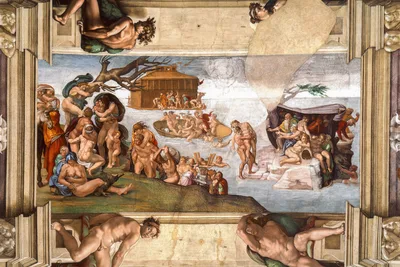 Image failed to load
 Image failed to load
 Image failed to load
 Image failed to load
Personal, non-commercial site. Image: Wikimedia Commons · Public domain.
Pinch or scroll to zoom