The Creation of the Sun, Moon and Plants
Creazione degli astri e delle piante
Take a moment to look closer.
Michelangelo · Vatican MuseumsMichelangelo · The Creation of the Sun, Moon and Plants
Guide
Look up, towards the altar end of the long central strip of the ceiling. This is the second panel of the story of Creation, counting from the altar. It tells two days of the Book of Genesis in a single picture. On the third day God created the plants, and on the fourth the sun, the moon and the stars.
So God appears twice. On the right, he rushes towards us, huge and frowning, his arms flung wide. With his right hand he points to a great golden sun, with his left to the pale moon. On the left, the same figure flies away from us, seen from behind, and stretches out a hand towards a small green bush in the corner. That bush stands for the whole world of plants.
Notice the wind. It fills the violet cloak of the Creator, blows his hair and beard, and gives both figures a tremendous speed. This is what is often called the terribilità of the artist, his awesome, overwhelming force.
The panel was painted around 1511 and 1512, in the second half of the work on the ceiling that Pope Julius II had commissioned. By then the artist had learned to simplify. Instead of crowds of small figures, he gives us only a few huge bodies and a few decisive gestures against an empty sky.
Take a moment to follow the movement from right to left. God comes towards us, creates the lights of heaven with one sweep of the arms, and turns away into the depth to bring life to the earth.
The work
The subject comes from the first chapter of Genesis. God said: let the earth put forth vegetation, plants yielding seed, and fruit trees. And there was evening and there was morning, a third day. Then God made the two great lights, the greater light to rule the day and the lesser light to rule the night, and he made the stars also. And there was evening and there was morning, a fourth day.
The painter shows both days at the same time. On the right, the Creator faces us. With a commanding gesture of both hands he points to the sun and the moon and divides them in the heavens. His face expresses the effort needed to create a home for living beings. The sun is a disc of burning gold. The moon, at the right edge, is a pearly sphere.
On the left, God is seen from behind, extending his right arm towards a bush that stands for the plant world. The two images are complementary, one seen from the front and one from behind, as if the camera had turned. The idea suggests the endless mobility of God, and also the multiple views of a sculpture.
Under the cloak of the figure on the right, a few small figures crowd together. Some scholars see in them an allusion to the four elements.
The colours are cool and pale: greys and very light blues, with the violet of the robe of the Creator. The one exception is the intense golden sun. Light and shadow are strong, and even the shadows are luminous.
The scene took seven days of fresco painting, starting from the upper right corner. The designs were transferred from the cartoons by direct incision into the plaster, while the discs of the sun and moon were drawn straight onto the wet surface with a compass.
Context
The ceiling was commissioned by Pope Julius II and painted between 1508 and 1512. Along its centre run nine scenes from the Book of Genesis, from the Separation of Light from Darkness above the altar to the Drunkenness of Noah near the entrance. They are framed by painted architecture, with seated nude youths holding garlands of oak leaves, a reference to the pope's family, the Della Rovere.
The painter did not work in the order of the story. He began near the entrance, the door used for the solemn processions of the pope and his court, with the last episodes, those of Noah, and moved towards the altar and the Creation. Halfway through, in 1510, the scaffolding was taken down in the first half of the chapel and rebuilt, by the autumn of 1511, in the other half. This panel belongs to the second block.
In these later scenes, the figures became larger and more monumental, the composition simpler and the gestures more essential and peremptory. Early on, the first scenes had been crowded with small figures, because the painter had misjudged the size of the ceiling. Here he corrected that.
The panel also breaks the order of the Bible. According to the text, the Separation of the Earth from the Waters, on the second day, should come next after the separation of light and darkness. Instead, the painter gave this scene of the third and fourth days a larger field, and placed the waters after it. Together these three panels form the group of the creation of the world.
The violet robe of the Creator, common to all three scenes, may also carry meaning. Violet is the colour of priestly vestments during Lent and Advent, two of the most important seasons celebrated by the papal court in this chapel.
Details
Start with the whole panel. Two great figures in violet fill almost all of it, set against an empty, pale sky. There is no landscape, no crowd, only a small bush in the lower left corner, the golden sun near the top and the edge of the moon at the far right.
Look first at the left. God flies away from us into the depth, seen from behind. His cloak swirls around him, and the soles of his bare feet face us. His right arm stretches down towards the corner, where a small green plant appears. It is one of the boldest images on the ceiling, the Creator shown from the back.
Now look up at the sun. It is a single disc of gold and orange, made of circular strokes. Its outline was traced directly onto the wet plaster with a compass. Next to it, the right hand of the Creator points with a sharp, commanding finger.
Then look closer at the space beneath his arm. Wrapped in the folds of his cloak, a few small figures ride along with him. One child stretches out an arm, another raises his hand to his head as if shielding himself from the light. Some scholars link them with the four elements.
Finally, look at the face of the Creator on the right. The brows are drawn together, the grey beard streams in the wind, and the eyes are fixed and intense. Both arms are flung out to the sides, the right towards the sun, the left towards the moon. The restoration, which removed centuries of candle soot and old retouching, revealed the brilliant colours of his cloak and the delicate changes of tone in its folds.
Details up close
Legacy
This panel is less famous than the Creation of Adam, further along the ceiling, yet it offers one of the most powerful images of God anywhere. It shows the Creator not as a calm old king on a throne, but as a force of nature, rushing through space.
Its most striking invention is the double view. By showing God twice, once from the front and once from behind, the painter created a kind of double snapshot. The effect is strongly dynamic, and it hints at the way a sculptor thinks, walking around a figure to see it from every side. The artist, after all, considered himself first of all a sculptor.
The figure seen from behind, with its bare soles turned towards the viewer, was bold for a sacred image. It shows how freely the artist treated even the most solemn subjects.
The scene also marks a stage in the artist's development. In the second half of the ceiling his figures became larger and fewer, and his gestures more peremptory. That growing power is visible here in the Creator's frown and in his wide arms. Italian has a word for this quality, terribilità, awe-inspiring force.
Before the restoration, the fresco was crossed by deep cracks and blackened by centuries of poor restorations, dirt and candle soot. The cleaning brought back its brilliant colours, especially in the Creator's cloak, and showed that even its shadows are full of light.
The image has travelled far beyond the chapel. It appeared on postage stamps of Vatican City in 1994 and of India in 1975.
- Image
- Wikimedia Commons · Public domain
- Official page
- www.museivaticani.va
Sources (7)
- Musei Vaticani – Creazione degli astri e delle piante · official
- Vatican Museums – The Creation of the Sun, Moon and Plants · official
- Wikipedia (en) – The Creation of the Sun, Moon and Plants · academic
- Wikipedia (it) – Creazione degli astri e delle piante · academic
- 维基百科(中文)– 创造日月星辰和植物 · academic
- Wikipedia (en) – Sistine Chapel ceiling · academic
- Wikipedia (it) – Volta della Cappella Sistina · academic
In the same area
 Image failed to load
 Image failed to load
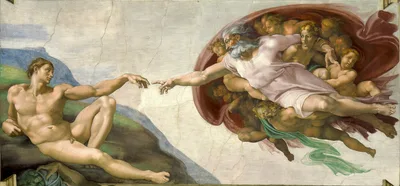 Image failed to load
 Image failed to load
 Image failed to load
 Image failed to load
 Image failed to load
 Image failed to load
Personal, non-commercial site. Image: Wikimedia Commons · Public domain.
Pinch or scroll to zoom