The Delphic Sibyl
Sibilla Delfica
Take a moment to look closer.
Michelangelo · Vatican MuseumsMichelangelo · The Delphic Sibyl
Guide
Look up at the young woman on the marble throne, with a blue hood over her head. She is the Delphic Sibyl, one of the prophetesses of the ancient pagan world, and a name written on the tablet below her identifies her: DELPHICA. Around the ceiling, twelve seers like her, seven prophets of Israel and five Sibyls, sit on painted thrones. They are the largest figures on the vault.
Why is a pagan prophetess in a papal chapel? The Vatican Museums explain that prophets and Sibyls were the first to sense the coming of the Redeemer. The prophets spoke to the people of Israel. The Sibyls, although they belonged to the pagan world, stand here for the rest of humanity. Together they show that the whole world was waiting for Christ.
Now look at her pose. She has been reading a scroll, and she still holds it open with her raised arm. But something has distracted her, perhaps a vision. Her body turns one way, while her head turns the other. Her eyes are wide and her lips slightly parted, as if she had just seen something astonishing. The rest of her body has not yet reacted.
The fresco was painted between 1508 and 1510, in the first half of the work, so she is one of the first seers Michelangelo created. Enjoy the colours: the blue mantle lined with orange, and the pale green tunic. The Vatican Museums note that she was among the most admired of all the Sibyls, for her physical and ideal beauty.
The work
The Delphic Sibyl belongs to the series of the seers, placed on wide architectural thrones in the spaces between the windows of the chapel. Like the others, she sits on a great marble seat between two plinths. On each plinth, pairs of putti imitate marble sculpture in high relief. Beside the Delphic Sibyl they strain to hold up the cornice, even leaning out of the space given to them. Below the platform of the throne, a tablet carries her name, and a putto holds it up.
She is unrolling a scroll. Her body is turned in that direction and her arm is raised, but her face is turned towards us, half in light and half in shadow. Her eyes look the other way with an expression of surprise. One reading sees here the coming of the Lord, which confirms her prophecy. The official text of the Vatican Museums describes a sudden emotion before a new event, which the rest of her body still resists, as if blocked in its former calm.
The effect of movement comes from this twist, and it is amplified by the swirling blue mantle with its hood, lined with orange, and by the folds of her light green tunic. On her face you can still see the straight lines incised into the plaster. The painter used them to mark out the oval of the head and the height of the eyes.
Behind her, two young assistants look on. One reads a book, the other holds it. According to the Vatican Museums, the two young people share her former state of calm, as if they have not yet noticed what she has seen.
The figure has kept its colours well. After the modern restoration, the blue, orange and green of her clothes shine again, bright enough to read clearly from the floor far below.
Context
Pope Julius II commissioned the ceiling, and Michelangelo signed the contract on 8 May 1508. The first plan was modest: twelve apostles in the spaces between the windows, and ornament elsewhere. The artist called it a poor thing. The pope then let him design the whole programme, probably with the help of theologians from the papal court. In place of the apostles came the twelve seers.
The painter began above the entrance used for the solemn entry of the pope, and worked towards the altar. The Delphic Sibyl sits in the first bay from that door, so she belongs to the first block of work, completed in 1510. Next to her, above the door itself, sits the prophet Zechariah. The seers grow larger and more agitated as they approach the altar. They begin with the calm meditation of Zechariah and end with the prophetic fury of Jonah. The Delphic Sibyl, close to the start, still has a measured, classical calm.
Who were the Sibyls? In the ancient world, they were prophetic women linked to shrines and temples. Delphi, in Greece, was one of the most famous. Legend has it that the Delphic Sibyl lived before the Trojan War. The Greek writer Pausanias said that she survived nine generations of humans.
Christian writers used the Sibyls to support their faith. The early Christian author Lactantius quoted a Sibyl who proclaimed a single God. In the Middle Ages the Sibyls even appeared in the Latin hymn Dies Irae. In Renaissance theology they were believed to share in divine revelation, as far as God had wished. The Delphic Sibyl was also linked to a prophecy of a saviour who would be mocked and crowned with thorns. Nobody knows exactly why the painter chose these five Sibyls out of ten possible ones.
Details
Start with the whole figure and its setting. She sits inside a painted architecture that looks like real stone: a throne, two plinths with pairs of carved children, and a cornice above. At the bottom, a putto holds up her nameplate. Everything is framed and stable, and against this calm frame her twisting body stands out.
Look first at her face. It is turned straight towards us, one side lit and the other in shadow. The eyes swing sharply to one side, and the mouth is just open. This is the instant of surprise. Look closer and imagine the painter at work: he marked the oval of the head and the level of the eyes with straight lines scratched into the wet plaster, and some of them are still visible.
Now follow her arm to the scroll. She holds it out, still unrolled, as if she had been reading a moment ago. Behind her, two young assistants share a book. One reads it, the other holds it. They are still absorbed and calm. They have not seen what she has seen.
Then enjoy the colours of her clothes. The blue mantle swirls around her shoulders and over her head as a hood. Its orange lining flashes on her lap. Underneath, the light green tunic falls in soft folds. These strong, clear colours were chosen so that each part could be read from far below.
Finally, look down at the nameplate. The letters spell DELPHICA, her name in Latin. The putto who holds it up is one of many small figures that fill the painted architecture. They are decorative, but the painter gave every one of them a lively pose, so that even the frame seems to move.
Details up close
Legacy
The Vatican Museums call her among the most admired of the Sibyls, for her physical and ideal beauty. Her face, young and calm yet caught in a moment of alarm, has become one of the defining images of the Sistine Chapel.
Her importance goes beyond beauty. The seers are the largest figures on the vault, and they were the painter's great chance to show what the human body could express. With the Delphic Sibyl he found a simple, powerful formula: a body that turns one way, a head that turns the other, and eyes that move faster than both. The twist becomes a way of showing thought and emotion.
She also stands at the start of a remarkable progression. Near the entrance, the seers are calm and balanced. As the painter moved towards the altar, and gained confidence, they grew larger and more agitated, ending with the huge figure of Jonah above the altar. Seen in sequence, the seers show how the artist's style changed during the four years of work.
Their message matters too. By placing pagan prophetesses beside the prophets of Israel, the ceiling says that the expectation of salvation belonged to all humanity, not only to one people. This was a bold, learned idea, typical of a papal court that admired the culture of antiquity.
The figure has also had a public life of its own. On 16 June 1964, for the four hundredth anniversary of the death of Michelangelo, the Vatican postal service issued a thirty-lira stamp with her image. Today she still greets almost every visitor who looks up.
- Image
- Wikimedia Commons · Public domain
- Official page
- www.museivaticani.va
Sources (13)
- Musei Vaticani – Sibilla Delfica · official
- Vatican Museums – The Delphic Sibyl · official
- Musei Vaticani – Sibille e Profeti · official
- Musei Vaticani – La Volta · official
- Wikipedia (it) – Sibilla Delfica (Michelangelo) · academic
- 维基百科(中文)– 德尔菲卡 · academic
- Wikipedia (it) – Veggenti (Michelangelo) · academic
- Wikipedia (en) – Delphic Sibyl · academic
- Wikipedia (en) – Sistine Chapel ceiling · academic
- Musei Vaticani – Storia della Cappella Sistina · guide
- Vatican Museums – History of the Sistine Chapel · guide
- Vatican Museums – The Vault · guide
- Wikipedia (it) – Volta della Cappella Sistina · academic
In the same area
 Image failed to load
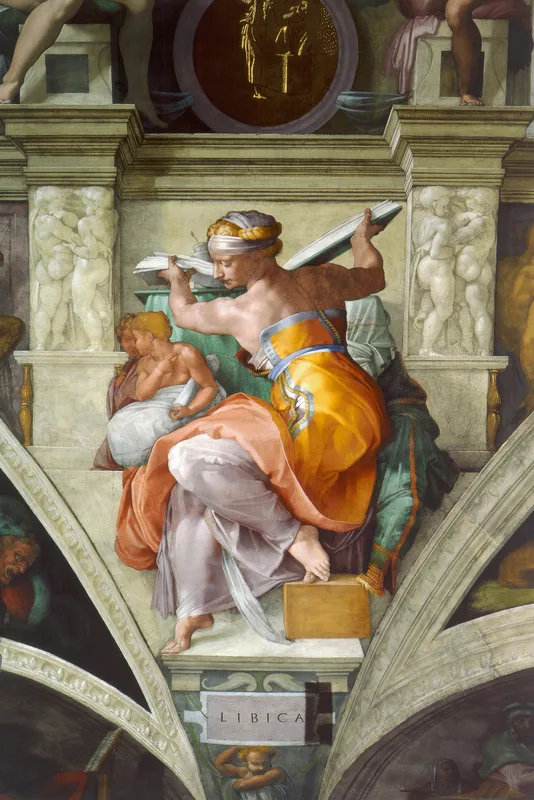 Image failed to load
 Image failed to load
 Image failed to load
 Image failed to load
 Image failed to load
 Image failed to load
 Image failed to load
Personal, non-commercial site. Image: Wikimedia Commons · Public domain.
Pinch or scroll to zoom