Birth of Venus
Nascita di Venere
The goddess of love, blown ashore by the winds.
Sandro Botticelli · Uffizi GallerySandro Botticelli · Birth of Venus · 1485 c.
Guide
This is one of the most famous images in Western art. It is usually called the Birth of Venus, but the moment shown comes just after the birth. The goddess of love has risen fully grown from the sea foam, and now she arrives on the shore of her island, Cyprus.
Look first at the centre. The goddess stands on a giant scallop shell, pure as a pearl. She covers herself with her hands and her long golden hair, in a pose borrowed from ancient statues. On the left, the west wind Zephyr blows her towards land. In his arms he holds a companion, perhaps the gentle breeze called Aura. Roses fall around them. On the right, a young woman waits with a cloak covered in flowers. She is probably one of the Hours, the goddesses of the seasons, and here she stands for spring.
The painting dates from the mid-1480s. It is painted on canvas, and real gold was added to make the hair and the leaves glitter. Nobody knows for certain who ordered it. A member of the Medici family is the most likely patron, and the orange trees on the right may be a family emblem.
What makes the picture so special is easy to see. For the first time since antiquity, a painter made a large nude goddess the whole subject of a painting. Take a moment to enjoy the calm sea, the soft light and the dance of the lines.
The work
The painting is large, almost three metres wide, and it tells one clear story. According to the ancient myth, the goddess of love rose fully grown from the foam of the waves. Here she stands on a scallop shell that is far too big to be real, gliding towards the shore.
Her pose is known as the modest Venus, or Venus Pudica. One hand covers her breast, the other presses her long hair against her body. Sculptors in ancient Greece and Rome used this pose for statues of the goddess, and the Uffizi owns a famous example, the Venus de' Medici. The painter clearly drew on works of this kind.
On the left fly two winged figures, wrapped in each other's arms. The strong one is Zephyr, the west wind. You can see his breath as fine lines coming from his mouth. The woman he holds is also blowing, but more gently. The sixteenth-century writer Giorgio Vasari called her Aura, the breeze. Other scholars see her as the nymph Chloris.
On the right, a young woman steps forward to welcome the goddess. She holds out a cloak embroidered with flowers, and the wind lifts it like a sail. The flowers on her dress suggest that she is the Hour of spring.
The picture was painted in tempera, a paint made with egg, laid on canvas in thin layers. This gives the surface a light, almost transparent look that recalls a fresco. Gold highlights shine on the hair, the wings, the shell and the landscape. Over the centuries the greens have darkened and the blues of the sea and sky have faded, so the colours were once brighter than they are today.
Context
The painting was made in Florence in the mid-1480s. Its painter was then one of the most admired artists in the city. A few years earlier he had worked in Rome, on the walls of the Sistine Chapel.
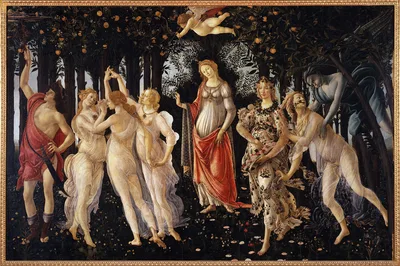
There is no document about the commission. The first person to describe the picture is Giorgio Vasari, the painter and biographer. Around the middle of the sixteenth century he saw it in the Medici villa of Castello, outside Florence, together with the Primavera. That villa belonged to a younger branch of the family, the branch of Lorenzo di Pierfrancesco de' Medici. For a long time, scholars believed that he had ordered both pictures.
Today this is less certain. An inventory of that branch of the family, drawn up in 1499, lists the Primavera but not this painting. So the patron may have been someone else, although a member of the Medici circle remains the most likely. The orange trees on the right point the same way. At the time these fruits were known as mala medica, a play on the family name.
The subject also belongs to the learned world of the Medici court. The poet Agnolo Poliziano described a very similar scene in verse, and he may have suggested the theme. Behind his poem stood an older source, an ancient Greek hymn to the goddess. It tells how the wet breath of Zephyr carried her over the waves to Cyprus, where the Hours welcomed her and dressed her in heavenly clothes.
The picture was probably meant for a country villa, a place of leisure rather than display. This helps to explain why it was painted on canvas, a lighter and cheaper support than the wooden panel used for the Primavera.
Details
Start by taking in the whole picture. Almost everything moves from left to right. The winds, the flowers, the shell and the hair all flow towards the shore. Only the young woman on the right moves the other way, to meet the goddess. The scene is framed by the sea and by the dark trees, so our eyes go straight to the centre.
Now look at the flying couple in the upper left. Their bodies are twisted together, their cloaks ripple, and pink roses tumble around them. The art historian Kenneth Clark called them perhaps the most beautiful example of ecstatic movement in the whole of painting.
Next, come closer to the face of the goddess. Her gaze is calm and a little distant, as if her thoughts were far away. Look at her hair: the golden locks are picked out with real gold, so they once shimmered in the light. Notice also her long neck and the gentle slope of her shoulders. Her body is not anatomically correct, and she could not really stand like this. The painter cared more about graceful lines than about realistic weight. None of the figures even casts a shadow.
Then look down at the shell and the sea. The waves are drawn as small, regular V shapes, almost like a decorative pattern. The ribs of the shell are touched with gold, and her feet barely rest on its edge. Near the lower left corner, clumps of bulrushes grow out of the water, a freshwater plant that has no real place by the sea.
Finally, turn to the right. The young woman wears a white dress sprinkled with small blue flowers and a wreath of leaves around her neck. The trees behind her and the grass below them glow with touches of gold.
Details up close
Legacy
Few paintings have become as famous as this one. Yet for a long time it was seen by very few people. It stayed in the villa of Castello until 1815, when it moved to the Uffizi. Even its title, the Birth of Venus, was only given in the nineteenth century.
Its importance lies first in what it dared to do. A large standing female nude as the main subject of a painting had no precedent in the West since antiquity. Together with the Primavera, it showed that stories from classical mythology could be painted on a grand scale, with the seriousness once reserved for religious subjects.
Contemporaries also saw its painter as a new Apelles, the most celebrated painter of ancient Greece. The humanist Ugolino Verino made exactly this comparison. According to the Roman writer Pliny, Apelles had painted a famous Venus rising from the sea, which was later lost. By treating the same subject, the Florentine painter seemed to bring that lost masterpiece back to life.
Scholars have read the painting in many ways. Some see it through the ideas of the Neoplatonic thinkers around the Medici, for whom earthly beauty could lift the mind towards divine love. Others read it as a picture about love and marriage. Most agree, however, that its meaning is simple and its appeal immediate, which is one reason for its huge popularity.
A popular story links the face of the goddess to Simonetta Vespucci, a young Florentine woman famous for her beauty. This is a legend, and there is no evidence that she posed for the painting.
Today the face of Venus appears on the Italian ten-cent euro coin, and the image has been copied endlessly in art, fashion and advertising.
- Date
- 1485 c.
- Technique
- Tempera su tela
- Size
- 172,5 x 278,5 cm
- Inventory
- 1890 n. 878
- Image
- Wikimedia Commons · Public domain
- Official page
- www.uffizi.it
Sources (6)
- Gallerie degli Uffizi – Nascita di Venere · official
- Uffizi Galleries – Birth of Venus · official
- Google Arts & Culture – The Birth of Venus · guide
- Wikipedia (en) – The Birth of Venus · academic
- Wikipedia (it) – Nascita di Venere · academic
- 维基百科(中文)– 维纳斯的诞生 · academic
In the same room
By the same artist
Personal, non-commercial site. Image: Wikimedia Commons · Public domain.
Pinch or scroll to zoom