Calumny of Apelles
Allegoria della calunnia
Take a moment to look closer.
Sandro Botticelli · Uffizi GallerySandro Botticelli · Calumny of Apelles · 1495c.
Guide
This small, crowded picture is a courtroom drama about a lie. Its subject is calumny, the false accusation that destroys an innocent person. The painter took it from a famous work by Apelles, a celebrated painter of ancient Greece. That painting was lost long ago, but a Greek writer called Lucian had described it in words.
Read the scene from right to left. On the throne sits a king with the ears of a donkey, the mark of a bad judge. Two women, Ignorance and Suspicion, whisper into those ears. Before him, a hooded man in rags, Rancour, leads a beautiful woman in white and blue. She is Calumny. In one hand she holds a torch, and with the other she drags a half-naked young man across the floor by his hair. He joins his hands in prayer. Two young women, Fraud and Deceit, are busy dressing her hair.
Further left, an old woman in black turns round. She is Penitence. She looks at the last figure, Truth, a naked young woman who points to the sky. Nobody else pays her any attention.
The painting dates from about 1495, a dark time for Florence. The preacher Girolamo Savonarola was then attacking the culture of the city, and the age of Lorenzo the Magnificent had ended. This is the last painting with an allegorical and mythological subject by the artist.
Notice how the figures rush and twist inside a cold, perfect hall of marble and gold. The contrast is part of the message: in this splendid palace, justice is missing.
The work
The panel is small, about sixty centimetres high and ninety wide, and it is painted in tempera. It holds nine living figures, and many more painted statues. It is far smaller than the great mythologies of the same artist, but it is packed with detail.
Each figure stands for a vice, a virtue, or a role. The king and the victim represent the powerful and the powerless. The others follow the ancient description very closely, down to the donkey's ears. In the myth, the god Apollo gave such ears to King Midas for judging a contest badly. The king stretches out his hand towards Calumny, but his eyes look down, so he cannot really see what is happening. Rancour raises a hand in front of him, as if to block his view.
The victim lies almost naked on the floor. His ankles are crossed, as if he were being crucified, and he raises his hands in prayer. The torch held by Calumny has been read as a torch that gives no light, a symbol of ignorance.
The setting is not in the ancient text. The painter invented it: a great hall with arches, pillars and niches, open towards a calm sea. Every surface is covered with gilded reliefs and statues. They show figures from mythology, from the Bible and from medieval literature, and their meaning in this context is still debated.
The space itself is unsettling. Most of the architecture points to one vanishing point, near the head of Fraud, but the central vaults use a lower one. The action races across the picture while the perspective pulls the eye deep into the hall. The figures are thin and elongated, as if swept by a violent wind.
Context
The story behind the picture begins in antiquity. According to Lucian, Apelles painted his Calumny after he himself had been falsely accused. A rival artist told the Egyptian king Ptolemy that Apelles had joined a conspiracy. The king almost had him executed, until a prisoner confirmed his innocence. Historians note a problem with this tale: Apelles probably lived about a century before that conspiracy.
In the fifteenth century the subject became popular in Italy. In 1435 the writer Leon Battista Alberti praised it in his treatise On Painting, De pictura, and recommended it to artists. Translations of Lucian into Latin and Italian spread the text further.
The painting was made around 1495. For Florence these were troubled years. Lorenzo the Magnificent had died in 1492. The friar Girolamo Savonarola preached against luxury and pagan culture, and his followers organised bonfires of the vanities in 1497 and 1498. He was executed on 23 May 1498.
Who was the picture for? The sources are uncertain. Some scholars think the painter first made it for himself. Others wonder whether he had a real victim of slander in mind, perhaps himself, perhaps Savonarola. In 1502, some years later, an anonymous denunciation accused the painter of sodomy.
In the middle of the sixteenth century, according to Giorgio Vasari, the picture belonged to Fabio Segni. He had probably inherited it from his father Antonio, and Vasari says it had been a gift from the painter. Sources give different details about this father, who remains little known. Later the panel entered the Medici collection in the Pitti Palace, and it was in the Uffizi by 1773.
Details
First, take in the whole stage. The hall is calm, symmetrical and gleaming with gold. The figures, by contrast, move like a gust of wind from right to left, and only Truth stands still. Look closer and you will see that the living people are painted in a different style from the statues around them.
Begin with the king on the right. He sits high on his throne, dressed in red and green. Look at his long donkey's ears. Ignorance and Suspicion lean over him and hold them as they whisper. His hand reaches out, but his gaze is lowered.
Now move to the centre, the heart of the action. The hooded man in black rags is Rancour. Beside him walks Calumny in white and blue, carrying her torch. Behind her, two young women arrange her hair with their hands. At her feet the victim is dragged along the floor, his hands joined in prayer, his ankles crossed.
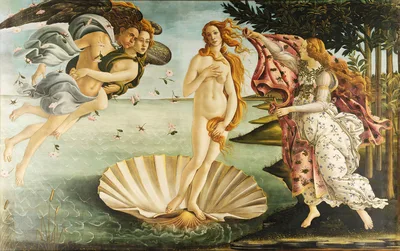
Next, look to the far left. The old woman wrapped in black is Penitence. Her black robe over white has reminded some scholars of the habit of the Dominican order, to which Savonarola belonged. She turns back towards Truth, who stands naked and points to heaven. Her pose clearly echoes the Venus in the Birth of Venus by the same painter.
Finally, look up at the central niche. A knight in armour stands there with a sword. Some scholars see him as King David. Others note that he recalls a figure of Saint George painted by Andrea del Castagno. Around him, gilded reliefs tell other stories. Below the throne, one scene shows a family of centaurs, another lost ancient painting described by Lucian. Some scholars think a collaborator, Bartolomeo di Giovanni, may have helped with these reliefs.
Details up close
Legacy
This panel marks a turning point in the career of its painter. From the late 1480s his work began to change. The figures became more solid and more expressive, the shadows stronger, the mood more intense. Many see the Calumny as the dividing line between his earlier and later manner.
It is also probably his last surviving secular painting, and the museum calls it his last work with an allegorical and mythological subject. In the final phase of his career, his art turned towards an intense mysticism.
The picture shows the painter's long ambition to bring back the lost glories of ancient Greek painting. Several of his secular works borrow ideas from ancient descriptions of paintings. But only here did he try to recreate an ancient composition almost in full. He was neither the first nor the last artist of the Renaissance to take up this subject.
How should we read its dark mood? Opinions differ. One reading sees in the splendid hall a court of history, where justice is missing even in the world of classical wisdom. It would express a loss of confidence in the ideals of the fifteenth century, in a Florence shaken by the death of Lorenzo the Magnificent and by the sermons of Savonarola. The art historian Frederick Hartt was tempted to see it as a defence of the friar against his enemies. He noted that no one seems to date the painting as late as 1497 or 1498, and asked why not. These political readings remain hypotheses.
Today, in a world of fake news and quick judgement, the lesson of the picture is easy to grasp: listen to both sides before you judge, and do not let rumour speak louder than truth.
- Date
- 1495c.
- Technique
- Tempera su tavola
- Size
- 62 x 91 cm
- Inventory
- 1890 n. 1496
- Image
- Wikimedia Commons · Public domain
- Official page
- www.uffizi.it
Sources (4)
- Gallerie degli Uffizi – Allegoria della calunnia · official
- Uffizi Galleries – Calumny of Apelles · official
- Wikipedia (en) – Calumny of Apelles · academic
- Wikipedia (it) – Calunnia (Botticelli) · academic
In the same room
By the same artist
Personal, non-commercial site. Image: Wikimedia Commons · Public domain.
Pinch or scroll to zoom