Spring
La Primavera
A mythological garden painted with hundreds of flowers.
Sandro Botticelli · Uffizi GallerySandro Botticelli · Spring · 1480 c.
Guide
This is the Primavera, which means Spring in Italian. It is one of the most loved and most debated paintings in the world. Nine figures from ancient mythology move across a flowering meadow, in a dark grove of orange trees heavy with golden fruit.
Read the picture from right to left, the way it moves. On the far right, the blue-green wind Zephyr bursts through the trees and seizes the nymph Chloris. Flowers are already spilling from her mouth. Next to her stands the same nymph after her transformation into Flora, the goddess of flowering, in a dress covered with blossoms. In the centre, set slightly back, is Venus, the goddess of love, modestly dressed. Above her flies her son Cupid, blindfolded, shooting his arrow. On the left, the three Graces dance in a circle in transparent veils. At the far left, the messenger god Mercury, with helmet and winged sandals, raises his staff to touch a cloud.
The painting was made in Florence around 1480, in tempera on a large poplar panel. Towards the end of the fifteenth century it hung in the city house of a younger branch of the Medici family.
No ancient story brings all these figures together, and the full meaning of the scene is still a mystery. According to the museum, the painting celebrates love, peace and prosperity, and most scholars see in it the rich growth of spring. Take a moment for the meadow: dozens of real plants and flowers can be recognised, painted with great care.
The work
The panel is huge, over two metres high and more than three metres wide. Nine figures stand across the front of the picture, six women, two men and a winged child. One writer compared them to pearls on a string. Behind them rises a wall of dark trees, mostly orange trees, with laurel among them.
The figures hardly interact. Zephyr and Chloris look at each other. Flora and Venus look out of the picture, and Venus seems to meet our gaze. Cupid cannot see at all, and Mercury has turned his back on everyone to look up at the clouds. Flora's broad smile was very unusual in painting at that time.
The ground rises gently towards the back. This is why the feet of Venus are higher than those of the others: she stands behind them. Above her, the trees open into a broken arch that draws the eye to her.
The technique is remarkably careful. Several large boards were joined to form the support. The painter then laid a different ground in different areas: a light beige under the figures, and black under the vegetation. Over this he built up the tempera in thin, successive layers. That is how the veils of the Graces and of Chloris became so light that we can see the bodies through them. Gold was added in places with the brush, and on the mantle of Venus as gold leaf.
The painting has darkened considerably over time. The trees and the meadow look almost black today, partly because the original green pigment has changed with age. At first the foliage was brighter, and the figures stood out less sharply than they do now.
Context
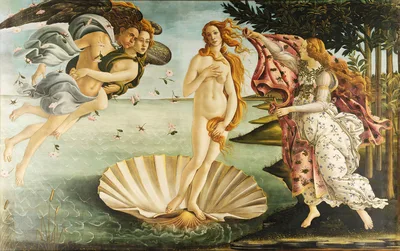
For a long time the story of this painting seemed simple. Around the middle of the sixteenth century the biographer Giorgio Vasari saw it in the Medici villa of Castello, outside Florence, together with the Birth of Venus. He described a Venus whom the Graces adorn with flowers, signifying spring, and that is where the title comes from.
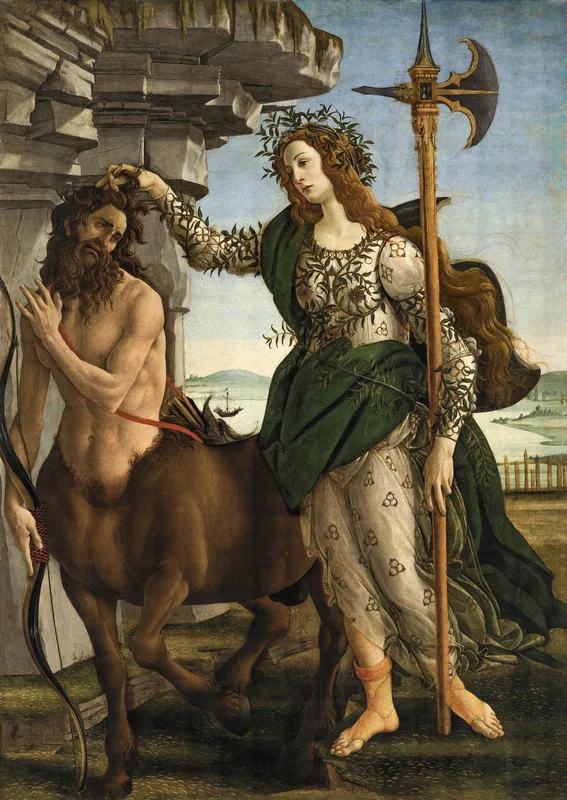
Then, in 1975, scholars published a family inventory of the late 1490s. The museum and some writers date it to 1498, others to 1499. It shows that the picture first hung in the Medici house in Via Larga, in the city. It belonged to Lorenzo di Pierfrancesco de' Medici and his brother Giovanni, younger cousins of Lorenzo the Magnificent. The painting hung above a lettuccio, a large chest with a high back, so its lower edge was roughly at eye level. In the same room hung Pallas and the Centaur, another mythology by the same painter.
The exact date is still debated. Proposals run from the late 1470s to the mid-1480s. Many scholars now link the picture to the wedding of Lorenzo di Pierfrancesco with Semiramide Appiani in July 1482, just after the painter came back from Rome, where he had worked in the Sistine Chapel.
The learned subject was probably suggested by an adviser. The poet Poliziano is the name most often proposed, and the philosopher Marsilio Ficino is also mentioned. The clearest source is the Roman poet Ovid. In his Fasti, the nymph Chloris tells how Zephyr took her, and how she became Flora.
The picture stayed at Castello until 1815. It later moved to the Galleria dell'Accademia, and it has hung in the Uffizi since 1919.
Details
Before looking at the single figures, step back once more. The scene is set out almost like a frieze, and the rhythm runs from right to left. There is no single source of light and hardly any shadow on the grass. Light falls only on skin, on thin fabrics and on the flowers.
Start on the right with Zephyr. His cheeks are puffed out, and the trees bend as he forces his way in. His skin is a cold blue-green. Chloris twists away from him, and a stream of flowers comes out of her mouth. This is the moment of her change, told by the poet Ovid.
Now look at Flora, the same nymph after her transformation. Her white dress is printed with flowers, she wears a wreath around her neck, and she holds roses in her lap, ready to scatter them. Notice her calm, confident smile.
Next, move to the centre. Venus stands in front of a dark myrtle bush, a plant sacred to her. Her hair is covered, as married women were expected to appear in public. Her raised hand seems to welcome us. Some scholars compare the gesture to that of the Virgin Mary in paintings of the Annunciation. Above her, Cupid aims a burning arrow at the middle Grace.
Finally, look at the three Graces. Their veils are almost transparent, and their fingers interlace high above their heads. The art historian Edgar Wind called them Pleasure, Chastity and Beauty, but many writers prefer not to name them. Just beyond them, Mercury stands guard, his sword at his side, pushing away the last clouds from the garden.
Details up close
Legacy
Few pictures have been written about as much as this one. It has been called one of the most controversial paintings in the world, and also one of the most popular in Western art. Together with the Birth of Venus, it showed something almost unknown since antiquity: subjects from classical mythology painted on a very large scale.
The two works are not a pair, as was once thought, but they are always discussed together. Both stayed at Castello until the nineteenth century, and they have remained side by side ever since.
Its style looks both new and old. The figures have the grace of the new art of Florence, yet the dark background covered with flowers recalls the Flemish tapestries called millefleur, which decorated palaces at the time.
The meaning is where opinions really divide. The basic names of the figures, first set out in the late nineteenth century, are now widely accepted, and the art historian Aby Warburg traced the literary sources in 1893. Beyond that, readings multiply. One sees the passage of spring from right to left, with Venus as the goddess of April and Mercury as the god of May. Another follows the Neoplatonic ideas of the Medici circle, in which earthly love rises towards divine love. A third reads it as a wedding picture. Some have tried to find real people of the time in the faces, but these identifications remain guesses, and theories about figures who died by 1478 depend on a very early date.
The painting also survived real dangers. During the Second World War it was taken to Montegufoni Castle, outside Florence, to protect it from the bombing. Today it is one of the great images of the Renaissance.
- Date
- 1480 c.
- Technique
- Tempera grassa su tavola
- Size
- 207 x 319 cm
- Inventory
- 1890 n. 8360
- Image
- Wikimedia Commons · Public domain
- Official page
- www.uffizi.it
Sources (6)
- Gallerie degli Uffizi – La Primavera · official
- Uffizi Galleries – Spring · official
- Google Arts & Culture – La Primavera (Spring) · guide
- Wikipedia (en) – Primavera (Botticelli) · academic
- Wikipedia (it) – Primavera (Botticelli) · academic
- 维基百科(中文)– 春 (波提切利) · academic
In the same room
By the same artist
Personal, non-commercial site. Image: Wikimedia Commons · Public domain.
Pinch or scroll to zoom