Pallas and the Centaur
Pallade e il centauro
Take a moment to look closer.
Sandro Botticelli · Uffizi GallerySandro Botticelli · Pallas and the Centaur · 1480-1485 c.
Guide
A tall young woman holds a centaur by the hair. In her other hand she grips a great halberd, a long ceremonial axe. The centaur, half man and half horse, carries a bow and a quiver of arrows, but he seems to give in. His face is full of distress, while hers stays calm and a little sad.
Who is she? That is the first puzzle. The oldest inventory that mentions the painting calls her Camilla, a warrior maiden from Roman poetry, famous for her chastity. A later inventory calls her Minerva, the Roman name for Pallas Athena, goddess of wisdom. Today Pallas is the usual name, but Camilla still has supporters.
Whatever her name, the general meaning is fairly clear. The museum explains that the centaur stands for the wild instincts of humanity. The woman is a virtue that restrains them: reason, or chastity, taming passion.
Now look at her dress. It is covered with a repeated pattern of three or four interlaced rings. This was an emblem of the Medici family. Olive branches wind around her head, her arms and her body. So the painting was almost certainly made for the Medici. It is often linked with the wedding in 1482 of Lorenzo di Pierfrancesco de' Medici, a cousin of Lorenzo the Magnificent.
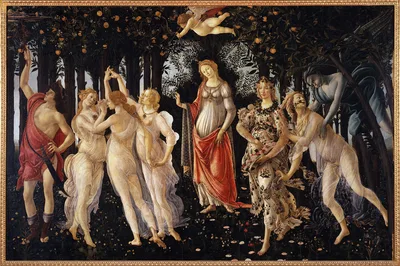
The painter is Sandro Botticelli. He painted this large canvas soon after returning from Rome, where he had worked on the walls of the Sistine Chapel. Like his Primavera, it is one of his great mythological pictures, and like them it keeps its secrets.
The work
The two figures are life-size, on a canvas more than two metres high. They stand in front of a great broken rock, like a stage wing, which opens on the right onto a wide landscape of calm water.
The centaur is on the left. His human body is muscular and his face is lined with pain. He was evidently about to shoot, for he still holds his bow, and arrows stick out of the quiver on his back. The woman steps towards him from the right. With her right hand she takes hold of his hair, and the centaur seems to grow calm at her gesture.
Her clothes are rich and light at the same time. Over a transparent white dress she wears a green cloak. The fabric is sprinkled with the ring emblem of the Medici, and olive sprays, held together by diamond rings, wind around her head, arms, breasts and hips. Some see laurel instead of olive, a plant also linked to the Medici. The museum suggests olive, sacred to Pallas, or myrtle, a plant associated with Camilla.
Her weapon is strange. A halberd is not the traditional attribute of either goddess or heroine. It was a ceremonial weapon for guards. This detail matters for one of the interpretations.
The picture is painted in tempera on canvas. It has perhaps been transferred from a wooden panel. It has been retouched in many places, and these retouchings have faded with time. In 1955 it was restored because of tears along the sides. The colours are clear and contrasting, and the lines are elegant rather than dramatic, typical of the painter.
Context
The painting is usually dated to about 1482 or 1483, on grounds of style. Botticelli had just come back from Rome. There, together with Perugino and Luca Signorelli, he had painted frescoes in the Sistine Chapel. Echoes of that experience appear here. The face of the centaur is close to that of Moses in one of his Roman frescoes, and the landscape recalls those of his colleagues.
The Medici emblem on the dress points to a Medici patron, but which one? The museum says the painting belonged to Lorenzo di Pierfrancesco de' Medici, cousin of Lorenzo the Magnificent, and may have been commissioned for his marriage to Semiramide Appiani in 1482. Another view is that the Magnificent himself ordered it as a wedding gift for his cousin. Lorenzo di Pierfrancesco and his brother had grown up as his wards after their father's early death.
The inventories disagree on details. The earliest record is dated 1498 in some sources and 1499 in others. It lists the painting near the Primavera. One source places them in the town palace of Lorenzo di Pierfrancesco, another in the Medici palace on Via Larga, above the door to an antechamber. In that first record the woman is called Camilla. In 1516 she is Minerva.
Its later journey is long. In the late sixteenth century it hung in Palazzo Vecchio. In 1638 it was at the Medici villa of Castello, together with the Primavera. By about 1830 it was in Palazzo Pitti. At that time the painter was out of fashion, and the canvas was forgotten. In 1895 the English artist William Blundell Spence noticed it in an anteroom of the palace. It has been in the Uffizi since 1922.
Details
Begin with the whole canvas. The composition is a play of full and empty spaces. On the left, the two bodies and the heavy rock fill the picture. On the right, the sky and the water open out. The halberd rises like a vertical line that holds the two halves together.
Look closer at the face of the woman. Her eyes are lowered towards the centaur, without fear, and her expression is gentle, almost melancholy. Her long red-gold hair falls down her back. Around her head is a wreath of olive leaves. The same sprays twist around her arms and across her breast.
Now turn to the centaur. His brow is furrowed, his mouth turned down. With one hand he clutches at his chest, as if in pain or surprise. Notice the contrast between his rough, tangled hair and beard and her smooth, flowing locks. The figure has been compared to reliefs on Roman sarcophagi, which the painter could have studied in Rome.
Next, study the dress. Its fine white fabric is scattered with small groups of interlaced rings, each set with a diamond. This was a personal device of the Medici. The motto that went with it, Deo amante, had been used by Cosimo the Elder and later by his grandson Lorenzo.
Finally, look at the background on the right. A calm bay opens beyond the rocks, with a ship sailing across it and gentle hills on the far shore. In front, notice the wooden fence. One scholar, Ronald Lightbown, reads it together with the halberd. For him, the woman is a guard who has caught the centaur trespassing on forbidden land.
Details up close
Legacy
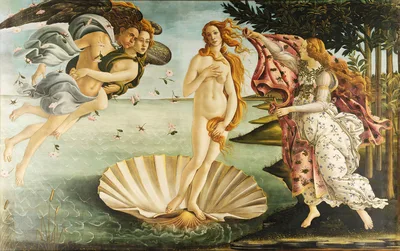
Like the Primavera and the Birth of Venus, this painting has been read in many ways, and none of them is final. The museum stresses the moral meaning: a virtue that restrains the bad-tempered, passionate side of human nature. Other scholars have spoken of chastity against lust, humility against pride, reason against instinct.
A philosophical reading links it to Marsilio Ficino, the leading thinker of the Medici circle. For him the soul was part animal and part human. The centaur's lower, horse half would be the beast in us, and his upper, human half our reason, tamed by wisdom. Modern writers have even compared the scene to the idea of the unconscious.
A political reading sees Florence itself in the woman. In those years Lorenzo the Magnificent negotiated a separate peace with the kingdom of Naples, to keep it out of a league against Florence. In this view the centaur is the enemy, tamed by wise diplomacy, and the olive branches stand for peace. A family reading, finally, sees the couple of the Medici wedding in the two figures. The name of Pallas even recalls palle, the balls on the Medici coat of arms.
Some recent scholars group the four great mythological works of the painter, this one included, as parts of a single cycle. That too remains a hypothesis.
For a long time the picture was almost unknown. After its rediscovery in 1895 it slowly returned to view. Since then it has travelled to major exhibitions, such as the one in Berlin and London in 2015, and even inspired a novel.
- Date
- 1480-1485 c.
- Technique
- Tempera su tela
- Size
- 207 x 148 cm
- Inventory
- Oggetti d'arte Pitti 1911 n. 752; Depositi n. 29
- Image
- Wikimedia Commons · Public domain
- Official page
- www.uffizi.it
Sources (5)
In the same room
By the same artist
Personal, non-commercial site. Image: Wikimedia Commons · Public domain.
Pinch or scroll to zoom