Santa Trinita Maestà
Maestà di Santa Trinita
Take a moment to look closer.
Cimabue · Uffizi GalleryCimabue · Santa Trinita Maestà · 1290-1300 c.
Guide
This huge golden panel is almost four metres tall. It shows the Virgin Mary enthroned like a queen, with the Christ Child on her lap. A painting of this kind is called a Maestà, Italian for majesty. It was made in Florence, probably in the last years of the thirteenth century, by the most important Florentine painter of that age, Cimabue.
Start with the Virgin. With her right hand she points to her son. This gesture comes from a Byzantine icon type called the Hodegetria, she who shows the way. The Child is dressed like an ancient philosopher. He blesses with one hand and holds a rolled scroll in the other. Thin lines of gold shimmer on their clothes.
Now let your eyes travel around the throne. Eight angels with wings of many colours hold it gently. The throne itself is built like a piece of architecture, and it is seen from the front, with real depth. Beneath it, under three arches, four prophets of the Old Testament look out as if from windows. Their scrolls announce the coming of Christ and the virginity of his mother.
Why does this painting matter? It still speaks the golden language of Byzantine art. Yet the faces are softer, with a hint of a smile, and the space feels more solid. Here, at the close of the thirteenth century, you can watch Florentine painting begin to change. The Sienese painter Duccio, and above all Giotto, the pupil of this master, would soon carry that change much further.
The work
The panel is painted in tempera on wood, on a background of gold. It is about three metres eighty high and more than two metres wide. Its pointed top is typical of the Maestà, a type of large upright altarpiece that spread across central Italy in the second half of the thirteenth century.
The Virgin sits on a grand ivory throne. She is turned three quarters towards us and presents her son. The Child is turned towards his mother, one leg bent so that we see the sole of his right foot, a pose typical of this image type. The scroll in his hand may be the scroll of the Law.
Eight angels surround the throne, four on each side. They are placed around it rather than simply stacked one above the other, and this helps to create a sense of depth. Their heads tilt in turn, inwards and outwards.
Below, the throne opens into three arches. Here we find four prophets, shown half-length. From left to right they are Jeremiah, Abraham, David and Isaiah. Each holds a scroll with a verse from the Old Testament.
The technique is rich and careful. The gold ground and the halos were decorated with punches and with geometric patterns engraved into the gold. The fine golden lines on the robes use a traditional Byzantine technique, known in Italian as agemina.
The panel has not come down to us unchanged. At some unknown date it was cut into a rectangle, and two side pieces with painted angels were added. In 1890 a restorer removed these additions and gave back the pointed shape. The original monumental frame was lost in the nineteenth century and replaced by a painted and gilded moulding. Further restorations followed in 1947 and 1948, and again in 1993.
Context
The panel comes from Santa Trinita, a church in Florence run by the Vallombrosan monks. According to sixteenth-century sources, including the biographer Giorgio Vasari, it stood on the main altar. Nobody knows who ordered it. It may have been the monks themselves, or a religious brotherhood that first meant it for another place.
Its painter was the leading Florentine artist of the thirteenth century. Besides Tuscany, he also worked in Rome, Assisi and Bologna. No document records the date of this work, and scholars have long disagreed. One Uffizi text places it in the 1280s. Most recent critics, and the main Uffizi entry, prefer the years around 1290 to 1300. That would put it after his frescoes in the upper basilica of Saint Francis at Assisi, late in his career.
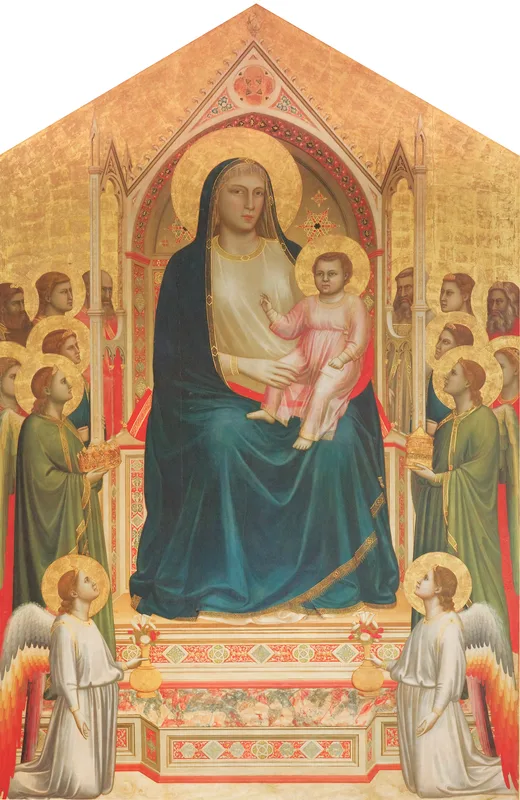
This was a time of great change. Younger painters, above all the Sienese master Duccio and the painter's own pupil Giotto, were bringing a new naturalism into art. The Uffizi sees echoes of their ideas in the soft faces, the falling drapery and the deep throne. Other scholars stress how much the older master still held on to his own habits.
The later history of the painting mirrors changing taste. Vasari reports that in 1471 it was replaced on the high altar by a Trinity by Alesso Baldovinetti, a more modern work, and moved to a side chapel. Later it ended up in the infirmary of the monastery, and from 1765 in the sacristy. In 1810, after the French suppressed the religious orders, it went to the Galleria dell'Accademia in Florence. Only in 1919, as early Italian painting was being rediscovered, did it come to the Uffizi.
Details
First, step back and take in the whole panel. It is built like a tall pyramid of figures. At the top is the face of the Virgin, framed by her halo. Around her the angels rise in two columns of colour. At the bottom, the throne rests on arches, and the prophets sit within them like a foundation. The Old Testament quite literally supports the New.
Now look closer at the Virgin and Child. Her face is long and calm, turned three quarters towards us. Notice the small mouth, almost smiling, and the soft shading on the cheeks. Scholars point to small touches, such as the cut of the nostril, that are new in the work of this painter. On her dark blue mantle and on the robe of the Child, fine lines of gold catch the light. They follow the folds and suggest how light plays on the cloth.
Next, turn to the angels on the left. Their heads tilt in a gentle rhythm, and none is shown in strict profile. Look at their wings. The feathers pass from dark shades at the bottom to bright, lively colours higher up. The red and blue of their robes have been read as a sign of their nature, a fusion of fire and air.
Finally, look down at the four prophets. The two outer figures, Jeremiah and Isaiah, twist their heads to look up towards the Child. The two in the centre, Abraham and David, are calm and solemn. They recall the family line from which Christ was born. Behind them the gold seems to open into empty space, as if they were leaning out of windows or caves. On the scrolls you can still read Latin verses. The words of Isaiah announce that a virgin shall conceive.
Details up close
Legacy
This Maestà marks a turning point in Italian painting. It still belongs to the world of Byzantine icons, with its gold ground, its fixed types and the golden lines on the robes. But its painter was breaking free of that rigid tradition. The faces are gentle, the figures broader and heavier, and the drapery falls in loose folds rather than in tight curves.
Its most admired novelty is the throne. For the first time in his work, the painter showed it straight from the front, with a deep hollow at the centre and both inner sides visible. It becomes a true architectural mass. This central viewpoint was soon taken up by Giotto, Duccio and other painters of the fourteenth century.
Giorgio Vasari, writing in 1568, praised the work for its invention and for the fine arrangement of the Virgin among her angels. For him, this painter was the first to move beyond the old Greek manner, as he called the Byzantine style.
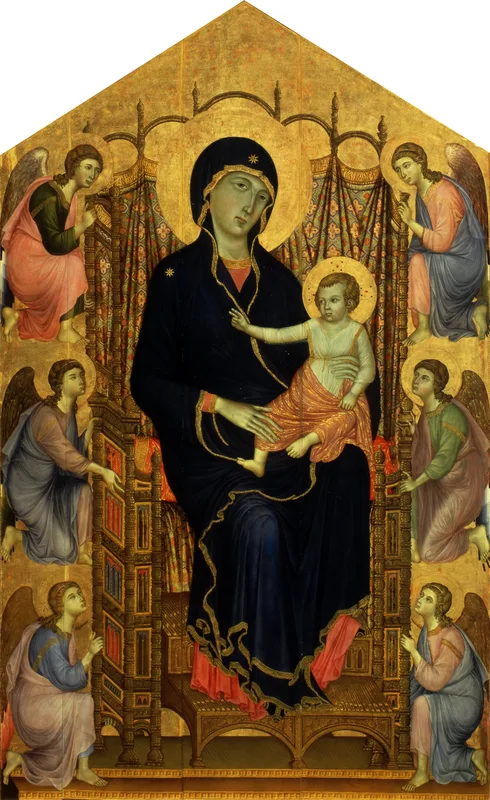
Modern scholars give a more mixed picture. Compared with the Rucellai Madonna by Duccio, painted in the 1280s, this panel seems less refined. The light does not come from a single source, the gazes remain vague, and the range of colours is limited. In this view, the older master was holding on to the formulas that had made him famous, just as they began to look old fashioned.
That tension is what makes the painting so rewarding today. It stands on the border between two worlds. After long years in a side chapel, an infirmary and a sacristy, it is now a key work for anyone who wants to understand how Florentine art moved from medieval tradition towards the naturalism of Giotto.
- Date
- 1290-1300 c.
- Technique
- Tempera su tavola, fondo oro
- Size
- 384 x 223 cm
- Inventory
- 1890 n. 8343
- Image
- Wikimedia Commons · Public domain
- Official page
- www.uffizi.it
Sources (8)
- Gallerie degli Uffizi – Maestà di Santa Trinita · official
- Uffizi Galleries – Santa Trinita Maestà · official
- Google Arts & Culture – Maestà of Santa Trinita · guide
- Google Arts & Culture – The Santa Trinita Maestà, Cimabue · guide
- Wikipedia (en) – Santa Trinita Maestà · academic
- Wikipedia (it) – Maestà di Santa Trinita · academic
- Google Arts & Culture – Maestà of Santa Trinita (testo delle Gallerie degli Uffizi) · guide
- Google Arts & Culture – The Santa Trinita Maestà, Cimabue (Uffizi Gallery) · guide
In the same room
Personal, non-commercial site. Image: Wikimedia Commons · Public domain.
Pinch or scroll to zoom