Rucellai Madonna
Madonna Rucellai
Take a moment to look closer.
Duccio di Buoninsegna · Uffizi GalleryDuccio di Buoninsegna · Rucellai Madonna · 1285 c.
Guide
This is the largest painting on wood to survive from the thirteenth century. It is four and a half metres tall. The Virgin sits on a carved wooden throne, holding the Christ Child on her knee. Six angels kneel, three on each side, as if floating in the golden air.
The painter was Duccio di Buoninsegna, a young artist from Siena. In 1285 a Florentine brotherhood called the Compagnia dei Laudesi ordered it for their chapel in the church of Santa Maria Novella. Its members met there to sing hymns in praise of the Virgin. The picture was the focus of their prayers.
Look first at the face of Mary. It is long and gentle, and she seems about to smile. Then follow the thin golden border of her dark mantle. It winds from her chest down to her feet in a restless, wavy line. This graceful line is a sign of Gothic taste, while the gold background and the types of the faces still follow Byzantine tradition.
Notice also how the angels hold the throne. They do not stand on any floor. They seem suspended in space, so that the whole vision appears to rise up suddenly before the faithful.
The name Rucellai Madonna comes from a family chapel in the same church, where the painting was moved in the late sixteenth century. For centuries it was even credited to another painter, Cimabue. Only in the nineteenth century did scholars give it back to Duccio.
The work
The painting shows the Virgin and Child enthroned, surrounded by angels. A picture of this kind is often called a Maestà. It is painted in egg tempera on a panel of poplar wood made of five pieces, and it measures about four and a half metres by nearly three.
Mary sits a little sideways on the throne. A precious cloth hangs over its back and covers her shoulders, a sign of her honour and rank. The Child sits on her knee. He wears an ancient robe, and a rich red cloth woven with gold is wrapped around his hips. Both the angled throne and the slight turn of the Virgin were ways in which painters of the time suggested depth.
The six angels kneel one above the other, three on each side. They are almost perfectly symmetrical. Some scholars think they were painted with the help of cut-out patterns. They seem to hang in the gold, with no sense of layers in depth.
The original frame is part of the work. It is partly gilded and partly painted, and it contains small round portraits of prophets and saints. At the bottom you can recognise Dominican friars by their black and white habits. They include the founder of their order and Saint Peter Martyr, who had founded the Laudesi.
The contract asked for costly ultramarine blue for the robe of the Virgin. Yet when the panel was restored in 1989, conservators found that the painter had used a cheaper blue, azurite. Over the centuries the blues had darkened, and the green underlayer of the flesh had begun to show through. Restoration has brought back much of the harmony and subtle naturalism of the colours.
Context
The commission is unusually well documented. On the fifteenth of April 1285 the rectors of the Compagnia dei Laudesi signed a contract with the painter. This lay brotherhood, devoted to the Virgin, met in a chapel of the new Dominican church of Santa Maria Novella in Florence. The contract is the oldest Italian document of its kind to survive. It promised a fee of 150 lire. It also asked the painter to accept no other work until he had finished, and to paint everything himself. The brotherhood supplied the panel and kept the right to refuse the result.
The choice of artist is striking. Florence and Siena were rival republics, and Siena honoured the Virgin as the queen of the city. Sienese painters had become specialists in images of Mary. Duccio, who was probably working alongside the Florentine master Cimabue in the early 1280s, took up a model that Cimabue had used a few years before. But he gave it a new, more Gothic sensitivity, perhaps inspired by enamels, miniatures and ivories from France.
Later the painting was moved within the church. The sources disagree on the date. One account gives 1591, another the end of the sixteenth century, and one Uffizi text the late seventeenth century. It went to the chapel of the Rucellai family, which gave it its modern name.
Its authorship was forgotten early. A fourteenth-century commentator on the Divina Commedia already credited it to Cimabue, and Giorgio Vasari repeated the error. Only at the end of the nineteenth century did the art historian Franz Wickhoff restore it to Duccio. The painting left the church in 1937 for an exhibition on Giotto, and in 1948 it came to the Uffizi. It is still on loan from Santa Maria Novella.
Details
Before looking at the details, take in the whole. The throne is set at an angle, and the Virgin turns slightly with it. Behind her hangs a patterned silk cloth. The angels line the two edges of the picture like a guard of honour, and between them the dark mass of the mantle fills the centre. The only strong accents are gold, red and the pale pink and blue of the angels.
Now come closer to the face of Mary. It is long and pale, with a small mouth and narrow eyes that look past us. The expression is still a little enigmatic, yet much softer than in earlier images of Mary. Notice the small gold star on the veil above her forehead, and another on her shoulder.
Next, look at the Child. He sits upright on his mother's knee, with a serious, grown-up face. Around his hips is the red cloth, streaked with fine threads of gold. Byzantine painters used gold lettering and lines like these, and the painter keeps them here.
Then follow the golden hem of the mantle. It starts at her chest and runs all the way to her feet, curling and folding back on itself. It is a nervous, almost capricious line, far from the stiff zigzag folds of Byzantine painting. This rhythm of line is one of the clearest signs of Gothic taste in the work.
Finally, turn to the angels on the right. Each kneels on nothing but gold. Their robes are in delicate shades, rose, pale blue and green, that set each other off. With their hands they touch the throne, as if lifting it towards us.
Details up close
Legacy
This painting is one of the earliest and best known works of Duccio. It is also the earlier of only two works by him that are documented in writing. The other is the great Maestà for the cathedral of Siena, painted many years later.
For a long time, however, its fame belonged to someone else. Because Vasari gave it to Cimabue, the painting became a symbol of the birth of Florentine art. Vasari even told a story about it. Legend has it that when Charles of Anjou visited Florence, he went to see the unfinished panel in the workshop of Cimabue. The neighbours were so delighted that the district took the name Borgo Allegri, the joyful quarter. The story rests on the wrong attribution. In the nineteenth century the painter Frederic Leighton still showed the Madonna of Cimabue carried in procession through the streets.
Once Duccio was recognised as its author, the painting took on a different meaning. It became evidence of the exchange between Siena and Florence at the end of the thirteenth century. It also showed the early rise of the Sienese school, with its rich colours and elegant line.
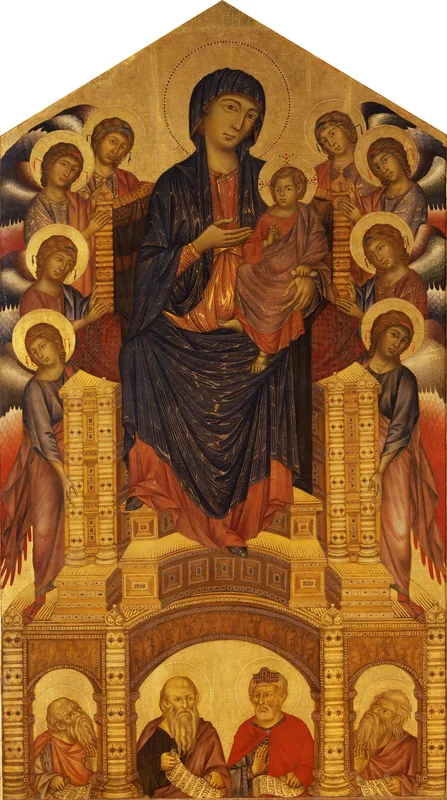
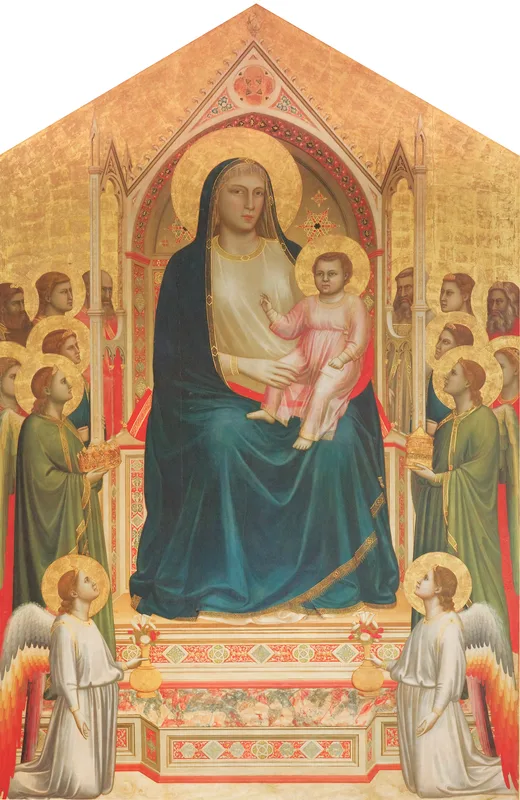
Today the Uffizi displays it together with the great Maestà panels by Cimabue and Giotto, from the churches of Santa Trinita and Ognissanti. This follows Vasari, who saw in these artists the first light of Italian painting. Some scholars warn that such a story can mislead. They argue that the painting has less in common with the naturalism of later centuries than with the refined, otherworldly icons of the Byzantine world. Both readings are worth keeping in mind as you look.
- Date
- 1285 c.
- Technique
- Tempera su tavola, fondo oro
- Size
- 450 x 290 cm
- Image
- Wikimedia Commons · Public domain
- Official page
- www.uffizi.it
Sources (6)
- Gallerie degli Uffizi – Madonna Rucellai · official
- Uffizi Galleries – Rucellai Madonna · official
- Google Arts & Culture – The Rucellai Madonna · guide
- Wikipedia (en) – Rucellai Madonna · academic
- Wikipedia (it) – Madonna Rucellai · academic
- Google Arts & Culture – The Rucellai Madonna (testo delle Gallerie degli Uffizi) · guide
In the same room
Personal, non-commercial site. Image: Wikimedia Commons · Public domain.
Pinch or scroll to zoom