Ognissanti Madonna
Maestà di Ognissanti
Take a moment to look closer.
Giotto · Uffizi GalleryGiotto · Ognissanti Madonna · 1300-1305 c.
Guide
Here the Virgin Mary sits on a throne like a queen, holding the Christ Child on her lap. Angels and saints crowd around her. This royal scene gives the painting its name, Maestà, or majesty. It was painted by Giotto for the church of Ognissanti in Florence, which means All Saints. By then he was already one of the most famous and sought-after painters in Italy.
Look first at the figures of Mary and her son. They are not flat shapes decorated with gold lines. They are solid, heavy bodies, shaped by light and shadow. You can sense her knees under the blue mantle and her breast beneath the pale robe. Look at her mouth. Her lips are slightly parted, and you can just see her white teeth.
Then look at the throne. It is a slender Gothic structure of coloured marble, with a pointed roof. It seems to stand in real space. Some saints are half hidden behind it, and we see them only through its openings. This is a new way of making depth believable on a golden background.
Below, angels kneel with vases of lilies and roses, while others offer a crown and a precious box.
Why is this painting so important? It is often called the first painting of the Italian Renaissance, because of its new naturalism. That label is a simplification, since the gold ground and the large size of the Virgin still follow old rules. But for more than a century, Florentine painters took this composition as their model.
The work
The panel is painted in tempera and gold on wood. It is more than three metres high and about two metres wide. The subject is the traditional Maestà: the Virgin enthroned with her son, surrounded by a court of angels and saints.
The Child blesses with his right hand. In his left he holds a rolled scroll, a symbol of knowledge. He is turned three quarters and looks towards our left. The Virgin is a strong, matronly figure. She is much larger than everyone around her. This scale of importance is an old convention, and it may also have helped to fit as many figures as possible around her.
Her throne is a pointed tabernacle inlaid with marble of different colours. It recalls the Gothic architecture fashionable in the fourteenth century. Its thin, delicate forms make the bodies seem even heavier.
Around the throne, the angels and saints no longer float one above the other. They stand in rows, one behind the other, each with a different face. Two kneeling angels offer vases of roses and lilies, signs of purity and charity. Two more hold out a crown and a small precious container. The Uffizi suggests it may be a pyx, which could refer to the Passion of Christ.
Decoration on the clothes is kept to a minimum. Instead of lines of gold, the painter used light, shadow and colour to build up the folds. The colours are refined. Notice the pearly white of her robe, the blue of her mantle and the deep red of its lining. The shading is smooth and even, far from the hatched strokes of the century before. Unusually for this painter, the light comes from the right.
Context
The painting was made for the church of Ognissanti in Florence. The church belonged to the Humiliati, a small religious order. The painter continued to work for them during his career and made at least two more works for the same church.
Its date is debated. The main Uffizi entry gives the years around 1300 to 1305. Another Uffizi text gives 1306 to 1310, and many scholars simply say around 1310. Some even place it around 1314 or 1315. By then the painter had completed his frescoes in the Scrovegni Chapel in Padua. He was so famous that Dante wrote, in the Divina Commedia, that the glory of Giotto had now eclipsed that of his master Cimabue.
Where the painting first stood is not certain. One source says the high altar. The Uffizi thinks of a side altar, or of the partition wall that separated the choir of the friars from the space of the lay faithful. A document of 1418 mentions it on the last altar on the right. The Child is turned towards the left, and this fits a place on the right side of the partition.
The oldest written reference to the painter as its author comes from the artist Lorenzo Ghiberti. In his Commentari, he described a very large panel of the Virgin seated on a chair, with many angels around her.
By the end of the seventeenth century at the latest, the painting had moved into the convent. In 1810, after the French suppressed the religious houses, it went to the Galleria dell'Accademia. It has been in the Uffizi since 1919.
Details
First, take in the whole scene. Everything is arranged symmetrically around the Virgin. The throne rises like a small Gothic chapel, and the figures on either side stand in ordered rows. All the angels turn their eyes towards the centre, so your gaze is drawn there too.
Now look closer at the face of Mary. It is broad and calm, with heavy eyelids. Her lips are just parted, showing a glimpse of white teeth. This is something quite new, almost the start of a smile. The soft shading makes her face look round and real.
Next, look at the Child. He is not a baby but a small, sturdy boy, dressed in a pink robe. He raises his right hand in blessing and holds the scroll in his left. Notice how his body has real weight, and how his mother's hand supports him from below.
Then turn to the saints on the right. They stand behind the throne and are partly hidden by its columns and by one another's halos. We see them through the openings, as if through the side panels of a half-closed triptych. The halos overlapping one another suggest a real space. The crowd of saints may also evoke the name of the church, All Saints.
Finally, look down at the angels on the left. One holds up a golden crown for the queen of heaven. Below, another kneels and offers a golden vase of lilies and roses. Some angels are shown in pure profile, a view that Byzantine art reserved for negative figures. These vases of flowers are among the earliest examples of still life in medieval painting.
Details up close
Legacy
This panel is often celebrated as the first painting of the Italian Renaissance. The reason is its new naturalism and its escape from the conventions of Byzantine and Gothic art. The figures are weighty, like sculptures, and they occupy a space that we can believe in.
The story is more complex than that label suggests. The painter still used a flat gold ground and still made the Virgin far larger than the saints. He learned from many sources. From his master Cimabue he took the symmetrical composition and his concern for volume. The calm, statue-like figures recall the Roman painter Pietro Cavallini. The drama of the sculptors Nicola and Giovanni Pisano also left its mark.
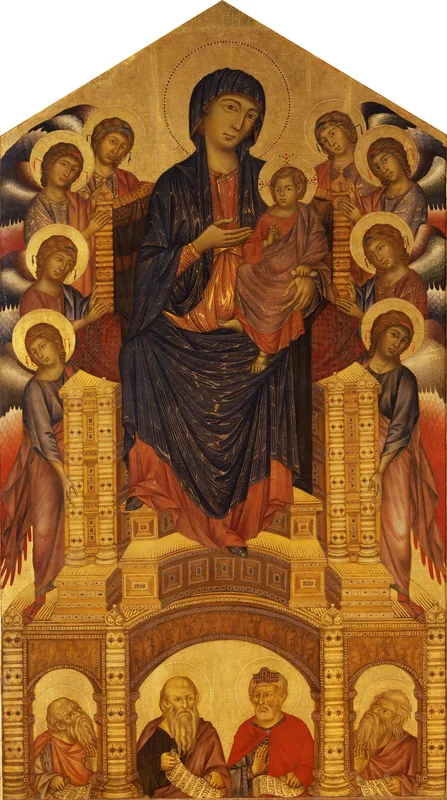
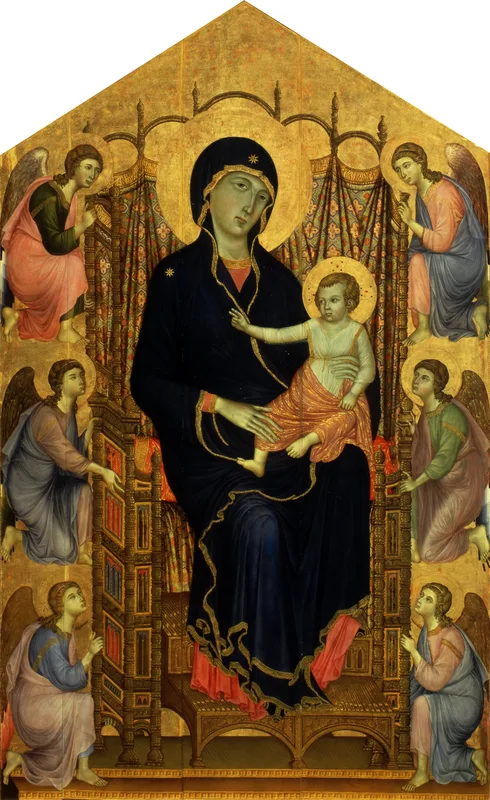
The comparison with the two other great Maestà panels in the Uffizi, by Cimabue for Santa Trinita and by Duccio for the Rucellai chapel, shows the change most clearly. In the older works, gold lines trace the folds of the cloth. Here, light and shadow do the work. The angels and saints no longer float but stand. The throne becomes a piece of architecture in space.
The painting was admired from the start. Ghiberti described it in the fifteenth century, and the Uffizi notes that for over a century its composition inspired Florentine painters. Scholars see in its sense of volume, its sculptural forms and its simplified shapes the starting point for the research of Masaccio, a century later.
For modern visitors it remains a powerful meeting. A queen of heaven sits before us, yet she has the weight, the gaze and even the teeth of a real woman.
- Date
- 1300-1305 c.
- Technique
- Tempera su tavola, fondo oro
- Size
- 325 x 204 cm
- Inventory
- 1890 n. 8344
- Image
- Wikimedia Commons · Public domain
- Official page
- www.uffizi.it
Sources (6)
- Gallerie degli Uffizi – Maestà di Ognissanti · official
- Uffizi Galleries – Ognissanti Maestà · official
- Google Arts & Culture – The Ognissanti Madonna · guide
- Wikipedia (en) – Ognissanti Madonna · academic
- Wikipedia (it) – Maestà di Ognissanti · academic
- Google Arts & Culture – The Ognissanti Madonna (testo delle Gallerie degli Uffizi) · guide
In the same room
Personal, non-commercial site. Image: Wikimedia Commons · Public domain.
Pinch or scroll to zoom