The Baptism of Christ
Battesimo di Cristo
Take a moment to look closer.
Andrea del Verrocchio and Leonardo da Vinci · Uffizi GalleryAndrea del Verrocchio and Leonardo da Vinci · The Baptism of Christ · 1470 - 1475 c.
Guide
Here is a painting made by a master and his pupils, and one of those pupils would become the most famous artist of all. The scene is the baptism of Jesus. He stands in the river Jordan with his hands joined in prayer. On the right, John the Baptist pours water on his head from a small bowl. Above, the hands of God release the dove of the Holy Spirit.
The panel came from the workshop of Andrea del Verrocchio, then one of the busiest in Florence. He was above all a sculptor and goldsmith, and you can see it in the hard, wiry bodies of Christ and John.
Now look at the two angels kneeling on the left. The one furthest to the left, seen in profile, was painted by the young Leonardo da Vinci. In the sixteenth century Giorgio Vasari wrote that this angel was so beautiful that the master was upset to be outdone by his pupil. Compare the two faces. The other angel stares blankly. Leonardo's turns with a gentle, living gaze, and his robe falls in soft, natural folds.
Today experts think the young painter did more than the angel. The museum credits him with much of the misty landscape along the river and with the soft modelling of the body of Christ. He worked in oil on top of the older tempera, and his glazes tie the picture together.
So this is not one artist's work, but a record of a workshop in action. Take a moment to find the different hands, from the stiff palm tree on the left to the glowing valley behind the angels.
The work
The subject comes from the Gospels. On the banks of the Jordan, John baptises Jesus. Christ stands in the exact centre, his legs set in a gentle contrapposto, his head bowed. John leans forward, balanced on one foot on a stone. In his left hand he holds a slender staff with a golden cross. A scroll hangs from it with the words Ecce Agnus Dei, Behold the Lamb of God.
Above them, two hands reach down from an opening heaven and send the dove, surrounded by golden rays. So God, the Holy Spirit and Christ are stacked on one vertical line. This sacred axis divides the picture into two equal halves.
On the left kneel two angels. One holds the garment of Christ, the other folds his hands. Behind them rises a palm tree, a symbol of the victory of Christ over death. On the right, a bird of prey swoops towards a small wood on the rocks. It has been read as a symbol of evil, in contrast to the dove.
The panel is large, nearly one metre eighty high. It is painted in tempera and oil, and the two techniques tell two stories. Verrocchio still used tempera, the traditional paint of Florentine workshops. Oil painting was then arriving in the city, partly through works by Dutch and Flemish painters. Leonardo mastered the new medium, and his parts are painted in oil over a tempera base. X-rays taken in 1954 confirmed this, and showed that he also retouched the skin of Christ and parts of the landscape. The painting was restored in 1998.
Context
The painting was made for the church of San Salvi in Florence, which belonged to the Vallombrosan monks. According to an early source, Antonio Billi, it was ordered by the head of that monastery, Don Simone, who was Verrocchio's own brother. Recent technical studies suggest that the master began it around 1468, set it aside, and that the young Leonardo reworked parts of it in the 1470s. The dates proposed vary. The museum gives about 1470 to 1475, while other scholars prefer 1475 to 1478.
Workshops of the time were run like teams. The head of the studio designed the picture and left secondary parts to pupils and assistants. Verrocchio trained many young artists, among them Perugino, Lorenzo di Credi and Leonardo himself. His own fame rested mainly on sculpture, and very few paintings are given to his hand.
Here several hands can be traced. The master laid out the composition and painted much of Christ and John. The museum suggests that an older painter did less developed details, such as the hands of God and the dove. Another assistant, less gifted, is credited with the schematic palm tree and the rocks on the right. Some scholars think the frontal angel may be by the young Botticelli, but this is only a suggestion. Leonardo came last, and his task was to bring it all together.
The later history is well documented, although sources give different dates for the last step. The panel moved from San Salvi to another Vallombrosan convent, Santa Verdiana. In 1810 it entered the Florentine state collections. The museum says it has been in the Uffizi since 1919; other sources give 1914 or 1959.
Details
Stand back first and follow the lines. Christ forms the axis of a triangle, with John and the angels at its base. The heavy figures in the foreground are drawn sharply, while the landscape behind them opens into a soft, deep valley. The contrast between hard and soft, tempera and oil, runs through the whole picture.
Now look closer at the two angels. The one on the left, by Leonardo, twists in a surprising way. His back turns away from us, while his face swings to the right, as if he had just looked round at Christ. A blue ribbon flutters in his fluffy golden hair. His robe clings to the arm, the hips and the kneeling legs beneath. Next to him, the other angel looks out of the picture, distracted, with a flatter and more linear face.
Then look at the landscape above their heads. A river winds through a wide valley towards distant mountains, and everything dissolves in a golden haze. These veiled layers, painted in oil, are among the first signs of the atmospheric effects that the painter would later perfect.
Next, lower your eyes to the water around the feet of Christ. It is green and transparent, with gentle reflections. The left foot of Christ was deliberately left unfinished, so that it seems to shimmer under the surface. This too is thought to be by Leonardo.
Finally, look up to the top of the panel. The two hands of God and the dove are simpler and more schematic than the rest. The museum believes they were painted by another, older member of the workshop. To the right, look for the bird of prey diving towards the trees, the dark opposite of the dove.
Details up close
Legacy
This panel has become famous above all as the place where Leonardo first appears. The story of the angel has attracted so much comment and myth that the value of the picture as a whole, and its place in the work of Verrocchio, is often overlooked.
The story is old. Giorgio Vasari told it in his lives of both artists. The young pupil painted an angel so perfect that his master, ashamed to be surpassed, never touched a brush again. The story is probably not true. Vasari did not know Leonardo personally. Still, it is striking that Verrocchio's painted output seems to stop quite suddenly. His last known painting, a Virgin and Child with two angels, was finished by his assistant Lorenzo di Credi.
For historians, the panel is precious for other reasons. It shows how a great Florentine workshop really functioned, with a master and several assistants sharing one surface. It also captures a moment of technical change, when the new oil painting began to transform the old tempera tradition. The angel's languid gaze, the soft skin and the veiled distance point directly to the painter's later work.
Some scholars have also looked again at the second angel. One historian has suggested that the master added it after Leonardo's angel, to balance the composition on the right. Most Italian paintings of this subject in the fourteenth and fifteenth centuries include two or more angels.
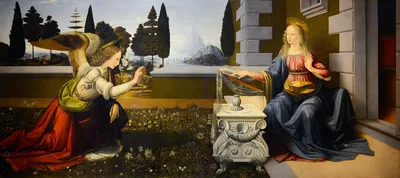
Together with the Annunciation, also in the Uffizi, this panel lets us follow his first steps, from pupil in the workshop to independent master.
- Date
- 1470 - 1475 c.
- Technique
- Tempera e olio su tavola
- Size
- 177 x 151 cm
- Inventory
- 1890 n. 8358
- Image
- Wikimedia Commons · Public domain
- Official page
- www.uffizi.it
Sources (6)
- Gallerie degli Uffizi – Battesimo di Cristo · official
- Uffizi Galleries – Baptism of Christ · official
- Google Arts & Culture – Baptism of Christ · guide
- Wikipedia (en) – The Baptism of Christ (Verrocchio and Leonardo) · academic
- Wikipedia (it) – Battesimo di Cristo (Verrocchio e Leonardo) · academic
- 维基百科(中文)– 基督受洗 (韦罗基奥) · academic
In the same room
Personal, non-commercial site. Image: Wikimedia Commons · Public domain.
Pinch or scroll to zoom