Annunciation
Annunciazione
A young Leonardo, barely twenty, tests his powers.
Leonardo da Vinci · Uffizi GalleryLeonardo da Vinci · Annunciation · 1472 c.
Guide
An angel has just landed in a garden. He kneels on the grass, raises his right hand in blessing and holds out a white lily. On the right, a young woman looks up from her book. This is the Annunciation: the angel Gabriel tells Mary that she will bear the Son of God. It was one of the best-loved subjects in fifteenth-century Florence.
Look first at the angel. He does not float like a vision. He has real weight, and he casts a shadow on the lawn. His wings are modelled on those of a powerful bird of prey. Then follow the lily across the garden to the Virgin. She sits with calm dignity behind a carved marble lectern, one hand on the page, the other raised in reply.
Between them opens a wide landscape. Dark cypresses stand against a pale distance of water, boats and misty mountains. The colours soften as they recede, an effect the painter would explore for the rest of his life.
The panel is generally considered one of the earliest surviving works of Leonardo da Vinci. It dates from around 1472, when he was about twenty and still worked in the studio of his master, Andrea del Verrocchio. Nobody knows who ordered it or where it first hung. It came to the Uffizi in 1867 from a small church just outside Florence.
Some things look strange. The Virgin's right arm seems too long. The museum suggests a reason: the panel was probably designed to be seen from below and from the right, perhaps above a side altar.
The work
The scene takes place outdoors, which was unusual. Earlier painters often set the Annunciation in a loggia or in Mary's bedroom. Here the meeting happens in a garden in front of a Renaissance palace, closed off by a low wall. It recalls the hortus conclusus, the enclosed garden that stood for the purity of Mary. The traditional order is kept, however. The angel is on the left and the Virgin on the right, as in several works by Fra Angelico.
The angel has just touched down. His robe has already settled on the grass and shows its weight. His right hand blesses, and his left holds the lily, a symbol of Mary's virginity and also of the city of Florence. The Virgin answers with her left hand raised. Her right hand rests on the open book, as if to keep the pages from turning. Under the book lies a thin, almost transparent veil. Her wide blue mantle spreads over her legs and over the seat.
The picture is painted on a large poplar panel, more than two metres wide. The museum describes the technique as oil; other studies speak of oil and tempera. Two preparatory drawings by the artist survive. One studies the angel's sleeve and is now in Oxford. The other studies the drapery over the Virgin's legs and is in the Louvre.
Not everything we see is original. The wings were once shorter. Later, another painter lengthened them, and so hid the young artist's careful study of a bird folding its wings. The head of the Virgin has also been repainted. A restoration in 2000 brought back much of the brightness. It also made the building on the right and the misty landscape easier to read.
Context
Very little is known for certain about the origins of this painting. There is no record of the commission, and no early writer describes it. Even Giorgio Vasari does not mention it, although a friend among the monks had told him in detail about the art in their monastery.
In the nineteenth century the panel hung in the church of San Bartolomeo a Monteoliveto, on the hills just outside the San Frediano gate of Florence. The church belonged to the Olivetan monks. Some scholars suggest that the monks ordered the painting for their sacristy after the church was renovated in 1472. This remains a hypothesis. The panel entered the Uffizi in 1867.
At first it was given to Domenico Ghirlandaio, who had also trained with Verrocchio. In 1869 the connoisseur Karl Eduard von Liphart recognised it as an early work by Leonardo. Doubts lasted a long time. Some critics proposed the son of Ghirlandaio, Ridolfo, or Lorenzo di Credi working with Leonardo. The two drawings in Oxford and Paris have now almost settled the question. Most scholars see the painting as Leonardo's, made inside the workshop of Verrocchio. One scholar has even proposed a later date, 1481, and a different main author, Antonio del Pollaiolo. That view has few followers.
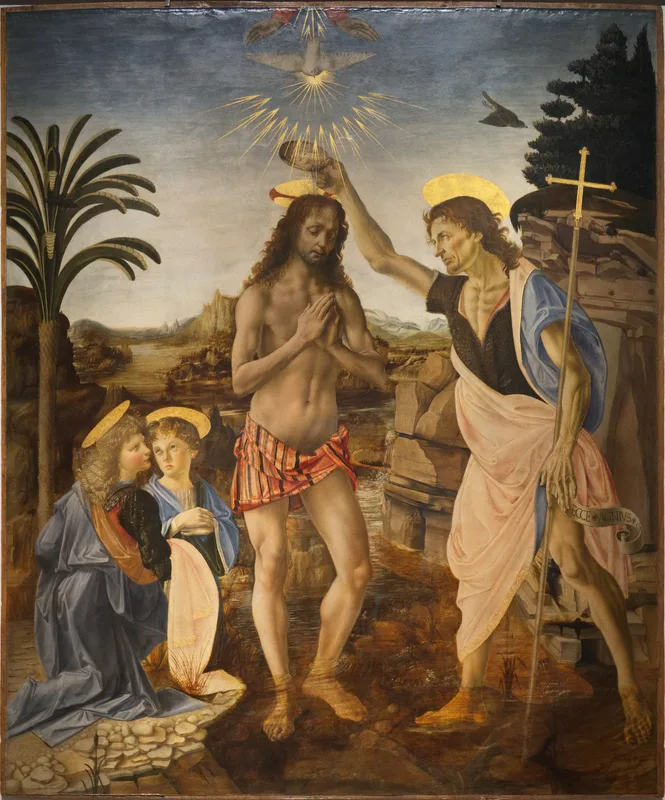
The dating is debated too. Most proposals fall in the years up to 1475, before the angel that Leonardo painted in the Baptism of Christ, which also hangs in the Uffizi.
The workshop is visible in the lectern. It repeats a design by Verrocchio himself, the tomb of Piero and Giovanni de' Medici in the church of San Lorenzo. The lion's paw feet, the scrolls and the garland of leaves and fruit all come from that monument.
Details
Start with the whole panel. The painter built the space in two ways. The palace, the paving and the lectern follow geometric perspective, with the vanishing point in the centre. The landscape, instead, fades gently into haze. This is aerial perspective: distant things grow paler, as if seen through layers of air.
Look closer at the angel. His profile is sharp, and his hair forms a compact mass of curls. Some scholars find this face flatter than the artist's usual faces and think a workshop companion may have helped. Now look at the wing. It is a real bird's wing, not the peacock wing of older paintings. Its long tip, however, is a later addition.
Next, the view between the trees. A river winds past a harbour full of boats, and pale mountains rise behind, dotted with towers. The nearest trees are crisp, and the jump to the soft distance is abrupt. Scholars read this as a sign of youth. The smooth transitions of the later works are not there yet.
Now the lectern. At the top, a shell sits between fluttering ribbons, perhaps a sign of Mary as a new Venus. Under the book the veil stands for the prophecies of the Old Testament. Very close up, in the leaves of the garland, there are fingerprints: the young painter sometimes blended colour with his fingertips.
Finally, the Virgin. Her right arm looks too long, and her legs seem short for her body. The letters in her book are real Latin characters, but they spell nothing. For some scholars the errors of proportion are simply mistakes. Others, including Antonio Natali, a director of the Uffizi, think they were intended, and that seen from the right they correct themselves.
Details up close
Legacy
This is the earliest major painting by Leonardo to survive, and one of the best-known images of the Annunciation in Christian art. It matters because it shows a great artist at the very start. Several ideas that would define his later work are already here.
The first is his close study of nature. The flowers in the meadow seem observed one by one, with almost botanical precision. The wings were based on real birds. The drapery was studied from life. Giorgio Vasari tells us that the artist sometimes made clay figures, wrapped them in soft cloth soaked in plaster, and then patiently drew the folds.
The second is his interest in light and air. The soft modelling of the figures and the hazy distance point towards the blurred transitions later called sfumato. Even the time of day is open to debate. The museum describes the light as the light of dusk, while other writers find it clear, like morning. Either way, it binds the whole scene together.
The third is his interest in how we see. If the distortions of the Virgin were intended, the young painter was already experimenting with viewpoint, as Donatello and Filippo Lippi had done before him.
The painting has rarely left Florence. Before 2007 it had travelled only three times: to exhibitions in Paris and Milan in the 1930s, and to safety during the Second World War. That year it was lent to the Tokyo National Museum. About three hundred politicians and art experts wrote to the culture minister to stop the loan. It went ahead under strict security, and the panel then came home to the Uffizi.
- Date
- 1472 c.
- Technique
- Olio su tavola
- Size
- 90 x 222 cm
- Inventory
- 1890 n. 1618
- Image
- Wikimedia Commons · Public domain
- Official page
- www.uffizi.it
Sources (6)
- Gallerie degli Uffizi – Annunciazione · official
- Uffizi Galleries – Annunciation · official
- Google Arts & Culture – Annunciation · guide
- Wikipedia (en) – Annunciation (Leonardo) · academic
- Wikipedia (it) – Annunciazione (Leonardo) · academic
- 维基百科(中文)– 圣母领报 (达芬奇) · academic
In the same room
Personal, non-commercial site. Image: Wikimedia Commons · Public domain.
Pinch or scroll to zoom