Coronation of the Virgin
Incoronazione della Vergine
Take a moment to look closer.
Lorenzo Monaco · Uffizi GalleryLorenzo Monaco · Coronation of the Virgin · 1414
Guide
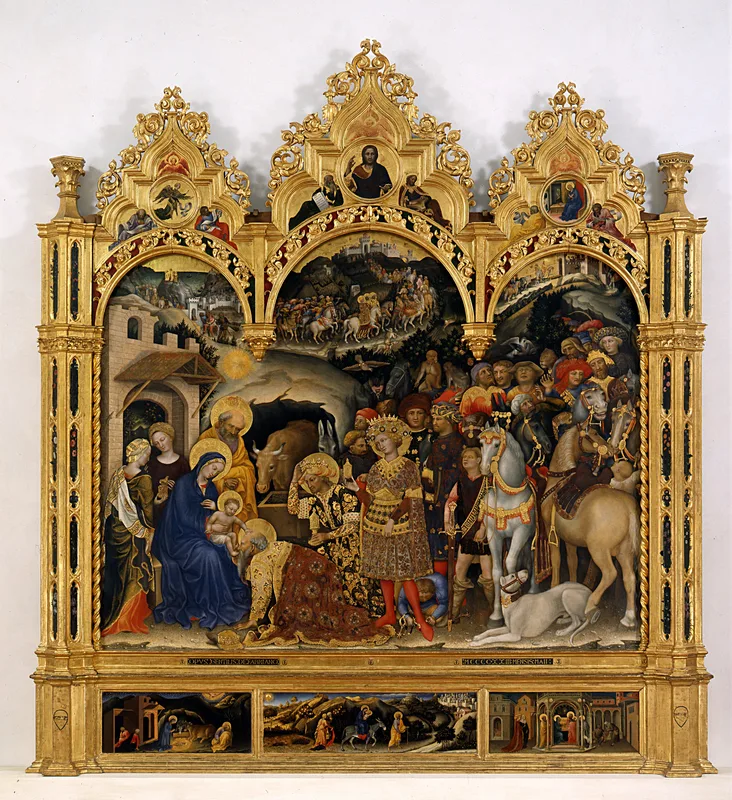
This towering altarpiece shows the Coronation of the Virgin. In heaven, Christ places a crown on the head of his mother, Mary. Around them gather angels and crowds of saints. The work was painted in Florence and completed in 1414. Its author was a monk, Don Lorenzo, known as Lorenzo Monaco, which simply means Lorenzo the Monk.
Look first at the centre. Christ and the Virgin sit together on a single throne under a Gothic canopy. Christ, in a deep blue mantle, leans forward to set the crown on her head. Mary, dressed in white, bows and crosses her hands on her breast in humility.
Now look down. The throne rests on curved bands of blue, scattered with gold stars. They stand for the heavenly spheres that formed the universe in medieval cosmology. In front, three angels kneel and swing censers.
On each side, the saints kneel in rows. In the front row stand out two monks in white robes. These are the colours of the Camaldolese monks, the order to which the painter belonged, and for whose church the altarpiece was made.
Although the frame divides the picture into three arches, the scene is one single, continuous vision. Notice the colours: cool, bright blues and pinks, with shimmering changes of tone, set against the gold.
The painter was also a famous illuminator of manuscripts. You can feel it in the long, slender bodies and in the sweeping, graceful folds. It is one of the most representative works of late Gothic painting in Florence.
The work
This is a large polyptych, painted in tempera and gold on wood. With its huge carved and gilded frame it is more than four metres high. The frame works almost like a stage set. It has three pointed tops over projecting brackets, and twisted columns along the sides.
In the three small panels at the top, the Annunciation is shown in two parts. On the left is the angel, on the right the Virgin who receives the message. Between them, in the centre, is God the Father, or Christ blessing among cherubim, as other sources describe him. Small figures of prophets appear in the side pillars.
The main panel is divided by the arches like a triptych, but the scene runs across without a break. Christ and Mary share a throne under a canopy. Angels crowd behind it, beside it and in front of it. Three angels in front swing censers. The saints on both sides are arranged in three rows. Among them you can recognise Peter, John the Baptist and many others.
Everything rests on bands of blue sprinkled with stars. The Uffizi reads them as a starry rainbow, the celestial spheres of medieval cosmology. Another reading sees in them the seven heavens of paradise.
Below runs the predella, with small scenes in frames of mixed curved and straight lines. In the centre are the Nativity and the Adoration of the Magi. At the sides are stories of Saint Benedict, and according to some sources also of Saint Bernard of Clairvaux. Here the painter left out the gold ground and painted intense, imaginative figures.
The inscription at the bottom was partly restored in the nineteenth century. A restoration in 1990 brought back the brilliance of the colours, including a very costly blue made from lapis lazuli.
Context
The inscription at the bottom tells us a great deal. It says that the altarpiece was commissioned by Zanobi di Cecco del Frasca for the high altar of the church of Santa Maria degli Angeli in Florence. This was an abbey of the Camaldolese monks. The inscription also names the painter, Don Lorenzo, a monk who lived in the abbey.
The date reads February 1413. That may seem to contradict the usual date of 1414, but it does not. Until the eighteenth century, the Florentine year began on the twenty-fifth of March, the feast of the Annunciation. So February 1413 in Florence corresponds to February 1414 in our calendar.
The Camaldolese were a congregation of the Benedictine family. This explains the presence of Saint Benedict, the founder of Western monasticism, among the saints and in the predella. The Uffizi identifies the second white-robed monk as Saint Romuald, founder of the Camaldolese order. Another source names Saint Bernard of Clairvaux instead. The painter placed his personal style at the service of the spirituality of his order.
An early writer, Antonio Billi, admired the work and described it as made with great ornament. But taste changed. In 1593 the altarpiece was replaced on the high altar by a large canvas by Alessandro Allori, now in the Galleria dell'Accademia. The old panel was sent to the abbey of San Pietro at Cerreto, near Certaldo.
There it was found in the nineteenth century in very poor condition. Water had damaged much of the original woodwork. In 1872 a restorer of the Uffizi rebuilt the frame, and the Uffizi has held the painting since 1864, as one Uffizi text states.
Details
First, take in the whole scene. It is crowded, yet quite flat. There is little real perspective, and the figures are stacked one above another against the gold. What holds your eye is not depth but rhythm, colour and line.
Now come closer to the centre. Christ leans towards his mother, both arms raised, and lowers the crown onto her veil. Mary bows her head and folds her hands across her breast. Her white robe and his blue mantle form two great shapes side by side. Look at the long, curving folds. They fall like sickles, a sign of the hand of an artist trained in painting miniatures.
Next, turn to the saints on the left. In front kneels a monk in a white habit, holding an open book. Behind him you can pick out Saint Peter in yellow and blue, and next to him John the Baptist, with his rough, dark clothing. Their faces are intense and thoughtful, as if absorbed in the holy event.
Then look down at the bands of blue. They curve like a rainbow, sprinkled with golden stars. On them kneel three angels with multicoloured wings. They swing golden censers towards the throne, and you can almost imagine the smoke of incense rising.
Finally, look at the saints on the right. Here too, in front, kneels a bearded monk in white, leaning on a staff. The Uffizi identifies him as Saint Romuald, while another source names Saint Benedict on this side. Around him are bishops, apostles and a friar in a brown habit. Notice the cool, clear colours, pink, green and blue, that change tone as they catch the light.
Details up close
Legacy
This altarpiece is one of the most representative works of late Gothic painting in Florence. Its painter was a leading figure of that style, and he was also very well known as an illuminator of manuscripts. Both sides of his art meet here, on a monumental scale.
What makes the work original is not space. The composition remains largely flat, as in the paintings of the followers of Giotto. Its originality lies elsewhere. It shows in the long, stretched figures, in the sickle-like rhythm of the drapery and in the cold, ringing colours with their changing tones.
It also shows a particular Florentine character. Compared with other parts of Italy, Florentine painters of this time made almost no reference to the world of the courts. In this painter above all, deep religious feeling is always at the centre, and the persistent gold ground underlines it. The Uffizi stresses how his figurative language serves the spirituality of the Camaldolese. The intense, thoughtful faces of the saints, the slender bodies and the refined lines of the clothing all express a sense of transcendence.
The fate of the painting also tells a story about taste. At the end of the sixteenth century it was considered old-fashioned and was taken down from its altar. It spent almost three centuries in a country abbey. Only when interest in early painting revived in the nineteenth century was it rediscovered, repaired and brought to Florence.
Today its restored colours, including the precious blue of lapis lazuli, let us see it again as its first viewers did. It is a vision of paradise created by a monk for his own community.
- Date
- 1414
- Technique
- Tempera su tavola, fondo oro
- Size
- 450 x 350 cm
- Inventory
- 1890 n. 885
- Image
- Gallerie degli Uffizi · © Gallerie degli Uffizi
- Official page
- www.uffizi.it
Sources (6)
- Gallerie degli Uffizi – Incoronazione della Vergine · official
- Uffizi Galleries – Coronation of the Virgin · official
- Google Arts & Culture – Coronation of the Virgin · guide
- Wikipedia (en) – Coronation of the Virgin (Lorenzo Monaco) · academic
- Wikipedia (it) – Incoronazione della Vergine (Lorenzo Monaco) · academic
- Google Arts & Culture – Coronation of the Virgin (testo delle Gallerie degli Uffizi) · guide
In the same room
Personal, non-commercial site. Image: Gallerie degli Uffizi · © Gallerie degli Uffizi.
Pinch or scroll to zoom