Adoration of the Magi
Adorazione dei Magi
Take a moment to look closer.
Gentile da Fabriano · Uffizi GalleryGentile da Fabriano · Adoration of the Magi · 1423
Guide
This dazzling altarpiece tells the story of the three kings, the Magi, who follow a star to find the newborn Christ. It was painted by Gentile da Fabriano for the richest man in Florence, the banker Palla Strozzi. It is signed and dated May 1423, and it is often called the finest example of International Gothic painting in Italy.
Start at the lower left. The Virgin sits with the Child in front of a humble shelter, with Joseph behind her. The oldest king has already taken off his crown and kneels to kiss the foot of the Child. Behind him, a second king lifts off his crown, and the youngest is still waiting while a servant removes his spurs. The three kings stand for the three ages of man.
Now look at the crowd behind them. It fills the whole right side. There are horses, hunting dogs, a leopard, monkeys and even a dromedary. These exotic animals tell us that the travellers come from the distant East. The costumes glitter with real gold and silver. Some parts, like crowns and spurs, are raised in relief, so they catch the light like jewellery.
Then raise your eyes to the three arches at the top. Here the same journey is told from the beginning, in little scenes on a winding road through a rocky landscape.
The painting is like a fairy tale. It celebrates both the Christ Child and the wealth of the family who paid for it. Take your time. The more you look, the more details you will find.
The work
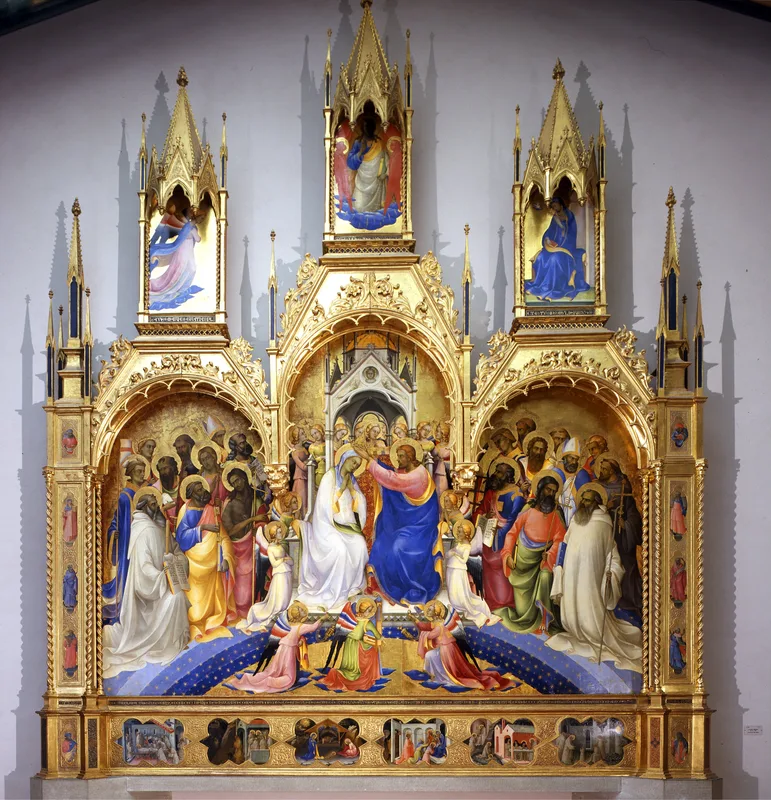
The altarpiece is painted in tempera on wood, and it keeps its elaborate carved and gilded frame, largely original. With the frame it is about three metres high and nearly three metres wide. The signature, OPUS GENTILIS DE FABRIANO, runs above the predella.
The main panel does not show a single moment. It tells the whole journey of the Magi. The story begins in the three arches at the top, and the Uffizi and other sources describe these small scenes a little differently. One reading sees the kings sighting the star, arriving at Jerusalem and finally entering the city. The Uffizi text speaks of the star, the stop at the palace of Herod and the return home. In any case the procession then winds down and fills the lower half of the picture, arriving at the stable on the left.
The frame has three pointed tops. In the central roundel Christ gives his blessing. On the left is the angel of the Annunciation, and on the right the Virgin who receives the message. Prophets recline beside them. On the side pillars the painter added bunches of flowers, all different, among them irises, lilies and crocuses.
Below runs the predella, with three scenes from the childhood of Christ, the Nativity, the Flight into Egypt and the Presentation in the Temple. The last is a modern copy. The original was taken to Paris in 1812 and is now in the Louvre.
The technique is extraordinary. Gold and silver leaf were engraved, punched, or covered with thin glazes. In some places the painter built up relief with pastiglia, a paste of gesso and glue, then covered it with gold. The robe of Mary was painted with costly ultramarine. A restoration in 2004 brought back the original lakes and greens.
Context
The patron, Palla Strozzi, was a wealthy banker and a refined lover of art. In the Florentine tax survey of 1427 he appeared as the richest citizen of the city. He was also a learned humanist, who collected ancient manuscripts and studied Greek.
He commissioned the altarpiece in 1420, soon after the painter arrived in Florence. It was meant for the family chapel in the sacristy of the church of Santa Trinita, which Lorenzo Ghiberti was completing in those years. The painter finished it three years later, helped by assistants who had come with him. The sources give different figures for the price. One speaks of a total of 300 florins, another of a final payment of 150 gold florins. Either way, it was a considerable sum.
The subject suited a rich merchant well. The biblical kings had given their treasures to the Christ Child, and this offered an example of wealth used in a pious way. The more splendid the painting, the more visible the generosity of the patron.
Scholars have long discussed why such a cultivated man chose this courtly style, rather than the new art of Masaccio and Brunelleschi, which was already known in Florence. The answer seems to be that different tastes lived side by side in the city, and the change from one style to another was not immediate.
The painting stayed in Santa Trinita for almost four centuries. During the Napoleonic suppressions it was moved to a store in 1806. In 1810 it went to the Galleria dell'Accademia, to help train young artists. In 1812 it lost the Presentation panel of the predella to the Louvre. Since 1919 it has been in the Uffizi, with a copy in place of the missing scene.
Details
Before looking at the details, take in the whole picture. There is no strict perspective here. The figures overlap in a crowded, festive way, and the space feels unreal, like a fairy tale. Your eye is meant to wander from one small episode to the next, as if reading a story.
Start at the lower left, with the Holy Family. The Virgin, in deep blue, holds the Child on her lap. Joseph stands behind, and two maidservants on the far left already hold the gift of the first king. The old king kneels on the ground. His crown lies at the feet of the Child, who blesses him.
Next, move to the right. The middle-aged king bends down, lifting his crown with one hand and holding a golden cup in the other. The young king stands upright in a robe of gold brocade. At his feet a servant is still taking off his golden spurs. These spurs may be a reference to the Order of the Golden Spur, to which the patron belonged.
Now look up at the central arch. Here, in miniature, the procession of riders winds along a road towards a walled city on a hill. The landscape is full of fields and small woods, and you can pick out tiny figures and horses.
Finally, come back down to the lower right. A group of horses shies and turns. Beneath them lies a white hunting dog with a golden collar, painted in relief. It stretches out between the hooves and stares at a horse. Look closer at the harness, the sword hilts and the belts. They glitter with raised gold, one of the most admired effects of the painting.
Details up close
Legacy
This altarpiece is considered the masterpiece of Gentile da Fabriano and one of the high points of International Gothic art. It is one of the most refined expressions of late Gothic culture, filled with the ideals of the courts. The Uffizi calls it the most important example of that style in Italy.
Yet it also looks forward. The painter observed the natural world with great care. Faces have varied expressions. Fur, leaves, fabrics and shadows are painted with a light, soft touch. In the predella, blue skies replace the traditional gold ground. The Nativity is set at night, lit by the glow of the newborn Child. For the Uffizi, this interest in nature points towards the ideals that would flourish in the Renaissance.
Its detailed views of nature and its complex compositions strongly influenced Florentine painting. The frame was also important. It is the first known altarpiece in which the panels and the frame were made as two separate pieces, an idea that shaped the later role of frames.
The painting also reflects the wider world. The rich textiles recall silks and brocades imported from the East. In the haloes of Mary and Joseph, the painter placed golden letters that imitate Arabic script. They show how trade with the East brought new forms to Florence.
Scholars still debate who is portrayed in the crowd. The man with the falcon, dressed more richly than anyone but the kings, is usually taken to be Palla Strozzi himself. Other views place him elsewhere. Giorgio Vasari saw a self-portrait of the painter nearby, but this seems unlikely today.
- Date
- 1423
- Technique
- Tempera su tavola
- Size
- 300 x 282 cm
- Inventory
- 1890 n. 8364
- Image
- Wikimedia Commons · Public domain
- Official page
- www.uffizi.it
Sources (6)
- Gallerie degli Uffizi – Adorazione dei Magi · official
- Uffizi Galleries – Adoration of the Magi · official
- Google Arts & Culture – Adoration of the Magi · guide
- Wikipedia (en) – Adoration of the Magi (Gentile da Fabriano) · academic
- Wikipedia (it) – Adorazione dei Magi (Gentile da Fabriano) · academic
- Google Arts & Culture – Adoration of the Magi (testo delle Gallerie degli Uffizi) · guide
In the same room
Personal, non-commercial site. Image: Wikimedia Commons · Public domain.
Pinch or scroll to zoom