Flora
Flora
Take a moment to look closer.
Titian · Uffizi GalleryTitian · Flora · 1517 c.
Guide
A young woman steps out of a dark background and seems about to offer us a handful of flowers. The painting is by Titian, the great Venetian master, and it dates from around 1515 to 1517. The sources give slightly different years. For centuries it has been known as Flora, after the goddess of spring and flowering plants.
Look first at her face. Her skin is pale and luminous, her cheeks are pink, and long copper-blonde hair falls over her shoulders. This warm colour is so typical of the painter's women that it gave its name to a shade, Titian red. She tilts her head gently and looks away, past us, out of the picture.
Then follow her arms. In her right hand she holds a small bunch of spring flowers: rosebuds, violets and jasmine. With her left hand she gathers a pink mantle. Her loose white robe, cut in an ancient style, slides off one shoulder and lets us glimpse her breast.
Who is she? Nobody really knows. The name Flora goes back to a writer of the seventeenth century, and the museum itself says the image does not point clearly to the goddess. Some see a courtesan, others a bride. Most of all she is an ideal of female beauty, which Venetian painters of the time loved to paint. The museum sees in her a balance of modesty and sensual pleasure. Take a moment to enjoy how soft and warm the painter makes the skin, the hair and the silk.
The work
The picture is fairly small, about eighty centimetres high and sixty-four wide. It is painted in oil on canvas. We see a woman of ideal beauty, shown to just below the waist, set against a plain brown background. There is no landscape and no story, only the figure.
She wears a wide pleated shirt of bright white. It is not a bridal dress but a classical tunic, as the Renaissance imagined it. The shirt slips down from one shoulder, leaving the breast almost bare. With one hand she holds a pink mantle, which makes the bare skin above it look even warmer. In the other hand she holds her flowers and leaves.
The face follows the rules of beauty of the time. Her features are delicate, the skin is fair and luminous, and the cheeks are touched with pink. Her hair is blonde with a copper glow, partly gathered and partly falling in loose, crinkled waves.
The same blonde woman appears in a whole series of paintings by the artist from these years. Among them are the Woman at the Mirror in the Louvre, a Salome and a Vanity, and she resembles the clothed figure in Sacred and Profane Love. The workshop often created similar works with small variations from the same studies.
The style shows what Italian writers call the painter's chromatic classicism. The colours are soft and sumptuous at the same time. The pose is not rigidly frontal. Instead, the hands, the shoulders and the slightly tilted head suggest a gentle circular movement, which makes the full figure feel alive.
Context
The painting was made in Venice in the second decade of the sixteenth century, when the painter was still young. We do not know who ordered it. It belongs to a new kind of picture that had appeared in Venice a few years earlier: the half-length image of a beautiful woman. The model was the Laura by Giorgione, dated 1506 and now in Vienna. Pictures of this kind came to be known simply as the Belle, the Beauties.
Its later history is only partly clear. The picture seems to have changed hands several times on the art markets of Brussels and Vienna. In the seventeenth century it belonged to Alfonso López, a Spanish ambassador and businessman in Amsterdam, who also worked as an agent for Cardinal Richelieu. There, around 1635, it was seen by the writer Joachim von Sandrart. He made an engraving of it with the title Flora, and the name has stayed ever since.
The painting was then sold to Archduke Leopold Wilhelm of Austria and ended up in the imperial collections in Vienna. For a while it was even believed to be a work of Palma the Elder, another Venetian painter.
It came to Florence in 1793 through an exchange between the imperial gallery in Vienna and the grand dukes of Tuscany, whose ruling houses were related. Vienna was rich in Venetian paintings, which were scarce in Florence, but poor in Tuscan ones. The exchange brought works by Dürer, Giorgione, Bellini and Titian to the Uffizi.
The name comes from ancient myth. Flora was a nymph, the bride of Zephyr, the west wind, and her story was told by the Roman poet Ovid.
Details
Start by stepping back. The figure fills almost the whole canvas. Her body turns one way and her head the other, while her arms reach out to both sides. Against the dark, empty background, the bright white shirt and the warm skin seem to glow.
Now come closer to the face. The features are soft and delicate, with no hard outlines. Her eyes look away to the side, as if something outside the frame had caught her attention. Look at the hair. Part of it is twisted and pinned up, and the rest falls in crinkled golden waves, lit with copper tones. This is the colour the world now calls Titian red.
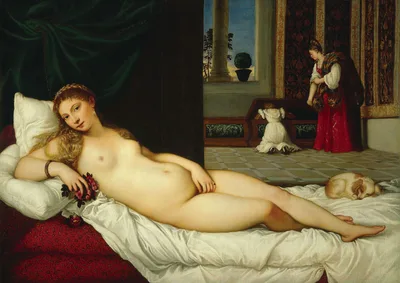
Next, look at her right hand, low on the left side of the picture. The small bunch of flowers is made of rosebuds, violets and jasmine, all flowers of spring. They explain the name Flora. Flowers were also an attribute of Venus, and a similar gesture appears in the Venus of Urbino, painted some twenty years later. Look closer and you will see a ring on one of her fingers. Some scholars read it as an engagement ring.
Finally, turn to her left hand, resting on the pink mantle. Notice how the painter plays with textures here. The heavy silk has a pattern woven into it, the white shirt is fine and crumpled, and the skin is smooth. The fingers are spread apart. One reading sees fingers opened like scissors as the sign of a promised bride. Together with the one covered and one uncovered breast, this would suggest the union of chastity and sensuality expected of a bride. Like every reading of this picture, it remains a hypothesis.
Details up close
Legacy
The painting was admired from the very start. Already in the sixteenth century it was reproduced in many engravings, a sign of how famous it had become. Engravings let an image travel far beyond the room where it hung.
In the seventeenth century, while it was in Amsterdam, it caught the eye of Rembrandt. The great Dutch painter quoted it in his Saskia as Flora, now in London, and in two portraits now in Dresden and New York. So this Venetian beauty found an echo in the work of a great painter of the north.
At the Uffizi it became extremely popular. In 1824 so many artists wanted to copy it that the director had to make a rule. No more than four copyists could work in front of it at the same time, and the waiting list stretched for months.
Its meaning has been debated for a long time. Some scholars, pointing to inscriptions on old engravings, see a courtesan. The art historian Panofsky saw instead a symbol of married love. Others read the flowers as the sign of Flora, or of a goddess of spring and vegetation. Later scholars Crowe and Cavalcaselle simply saw something classical that recalls ancient art. The museum's own view is that the picture is less about a particular goddess than about female beauty itself, able to combine modesty and desire.
Its legacy also lives on in a word. The phrase Titian red, used for a warm copper-blonde, comes from women like this one. And the type of the single beautiful woman, painted for pleasure, became one of the great themes of Venetian painting.
- Date
- 1517 c.
- Technique
- Olio su tela
- Size
- 79,7 x 63,5 cm
- Inventory
- 1890 n. 1462
- Image
- Wikimedia Commons · Public domain
- Official page
- www.uffizi.it
Sources (6)
- Gallerie degli Uffizi – Flora · official
- Uffizi Galleries – Flora · official
- Google Arts & Culture – Flora · guide
- Wikipedia (en) – Flora (Titian) · academic
- Wikipedia (it) – Flora (Tiziano) · academic
- 维基百科(中文)– 花神 (提香) · academic
In the same room
By the same artist
Personal, non-commercial site. Image: Wikimedia Commons · Public domain.
Pinch or scroll to zoom