David with the Head of Goliath
David con la testa di Golia
Take a moment to look closer.
Guido Reni · Uffizi GalleryGuido Reni · David with the Head of Goliath · 1605 c.
Guide
A young man stands with his legs crossed, leaning on an ancient column. He wears a red hat with a great feather, and a cloak trimmed with fur that barely covers his body. Beside him, on a stone pillar, rests an enormous severed head. This is David, the young shepherd of the Bible, with the head of the giant Goliath.
The story comes from the Book of Samuel. Goliath, the champion of the Philistines, challenged the Israelites to single combat, and only the young David accepted. He struck the giant on the forehead with a stone from his sling. Then he cut off his head with the giant's own sword.
Look first at the face of David. He is not celebrating. He looks at the head calmly, almost thoughtfully. The action is over, and the drama has melted into meditation. Then look at the head itself, heavy and pale, with the wound still visible on the forehead.
The painter is Guido Reni, from Bologna. In the first years of the seventeenth century he worked in Rome, where he saw the paintings of Caravaggio. For a short time he borrowed their strong contrasts of light and their taste for bloody subjects. But he kept his own ideal of calm, elegant beauty. The Uffizi dates this canvas to around 1605.
The composition was a great success. Versions of it exist in the Louvre, in Orléans and in several other museums in Europe. Scholars still discuss how much of this canvas in Florence was painted by the master himself, and how much by his workshop.
The work
The subject is one of the best known stories of the Bible. In the first Book of Samuel, the Israelites face the Philistines, and every day the giant Goliath comes out to challenge them. King Saul is afraid. The young shepherd David refuses armour and takes only his staff, his sling and five stones. The stone hits Goliath in the centre of his forehead, the giant falls, and David cuts off his head.
The painter does not show the fight. He shows what comes after. David is shown full length, on a canvas more than two metres high. He poses almost like a dandy. His weight rests on one leg, the other crosses in front, and he leans against the column behind him. In his lowered hand he still holds the sling. With the other hand he holds the head of the giant by the hair, on top of a stone pillar.
His clothes are not those of a shepherd. The red hat with its feather and the rich cloak edged with fur belong to a young gentleman. A blue drape falls over the column. The heavy sword of Goliath lies on the ground at his feet.
The light is cool, almost moonlike. It softly shapes the body of David and leaves the background in deep shadow. This recalls the dramatic light of Caravaggio, but the effect is very different. The figure keeps a certain icy coldness and a melancholy elegance.
The painting is in oil on canvas and measures two hundred and twenty-two by one hundred and forty-seven centimetres. In this version the head of Goliath is turned inwards, towards David. Specialists use this detail to tell apart the different groups of versions of the composition.
Context
The painter was born in Bologna in 1575, into a family of musicians. At the age of nine he was apprenticed to the painter Denis Calvaert. Around the age of twenty he joined the Accademia degli Incamminati, the famous school founded by Annibale Carracci with his brother Agostino and his cousin Ludovico. The school looked back to the great masters of the sixteenth century, above all Raphael, and put great weight on anatomy and drawing from life. This training shaped his taste for harmony and clear design.
By late 1601 he had moved to Rome, to work with the team of Annibale Carracci on the frescoes of the Farnese Palace. At that time two new currents were emerging in Rome. On one side stood Caravaggio, with his raw realism and harsh light. On the other stood the Carracci, with their luminous, harmonious approach inspired by the Renaissance.
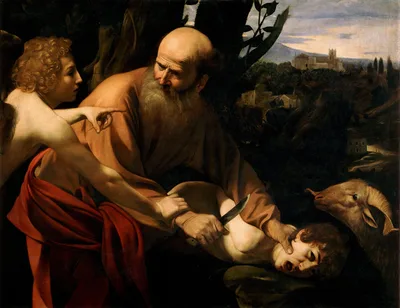
The subject of David and Goliath was typical of the followers of Caravaggio. At the very time Reni painted his first version, around 1605 or 1606, Caravaggio was working on his own David with the head of Goliath. In that painting, now in the Borghese Gallery, he gave the severed head his own features.
Reni took something from this example: the strong contrast of light and dark and the realism of the severed head. But he set himself apart through his search for ideal beauty, balanced composition and soft light. His David is not a triumphant hero but a thoughtful youth, poised between gentleness and violence.
We know less about this particular canvas. The sources available to us do not say who ordered it, or when and how it came to Florence. The Uffizi dates it to around 1605 and presents it as his work. Other specialists consider it a copy made in his studio.
Details
Begin with the whole picture. It is tall and narrow, and David fills almost all of it. The column on the left and the stone pillar on the right frame him like the sides of a stage. His pale body stands out against a background that is almost black. Notice the long diagonal of his outstretched arm, which leads your eye from his face to the head of the giant.
Now look at the face of David under the red hat. It is smooth and young, turned towards Goliath. The expression is calm and absorbed. The great pale feather curls upwards like a flame, and it is the most decorative note in the whole picture.
Next, look at his body. The cloak, lined with thick fur, slips from his shoulder and leaves his chest bare. The light glides over his skin as if it were marble. Look closer at his lowered hand. He still holds the cords of the sling, the humble weapon that brought down the giant.
Then turn to the head of Goliath. It is huge, far bigger than the face of the boy. The eyes are closed, the mouth hangs open, and the skin has the grey tone of death. On the forehead you can see the wound made by the stone, with a trickle of blood. David holds the head by the hair, almost casually, as if it weighed nothing.
Finally, look down to the bottom right. The sword of Goliath lies on the ground, with its golden hilt catching the light, next to a few green leaves. It is the weapon with which David cut off the head. The painter places it quietly at the edge, as a last reminder of the violence that the elegant youth seems to have already forgotten.
Details up close
Legacy
In his lifetime the painter was so admired that for a long time he was called the sublime Guido. He was often seen as the opposite of the followers of Caravaggio. Where they sought darkness and drama, he offered light, composure and a classical ideal of beauty based on harmony of proportion and drawing.
This David shows both sides of his art at once. It borrows the dramatic subject and the contrasts of light of his great rival, but it turns them into something cool, elegant and reflective. For this reason it is often used to explain the rich tension between the two main currents of Italian painting in the seventeenth century.
The composition was copied and varied many times. Specialists divide the versions into two main types, depending on which way the head of Goliath is turned. The version in the Louvre was long considered the original. Recent research has shown that there were several versions by the master himself, including one in Orléans. Another was rediscovered and sold at auction in Paris in November 2025. According to the experts involved in that sale, the canvas in Florence, like those in Dresden and Osnabrück, is a workshop copy of the Orléans painting. The Uffizi, for its part, presents it as a work by the master. The question is still debated.
Copies were part of how his studio worked. In Bologna he ran two large workshops with nearly two hundred pupils. His biographer Carlo Cesare Malvasia even claimed that his gambling debts pushed him to produce many copies with the help of assistants.
The composition also inspired other painters. The Neapolitan painter Battistello Caracciolo, in a David now in the Borghese Gallery, took from it the full-length figure, the crossed legs, the plumed hat and the ancient fragments.
- Date
- 1605 c.
- Technique
- Olio su tela
- Size
- 222 x 147 cm
- Inventory
- 1890 n. 3830
- Image
- Wikimedia Commons · Public domain
- Official page
- www.uffizi.it
Sources (7)
- Gallerie degli Uffizi – David con la testa di Golia · official
- Uffizi Galleries – David with the Head of Goliath · official
- Galleria Borghese – Battistello, David with the Head of Goliath · official
- Artcurial – Guido Reni, David Contemplating the Head of Goliath (2025) · guide
- Wikipédia (fr) – David tenant la tête de Goliath · academic
- Wikipedia (en) – Guido Reni · academic
- Wikipedia (en) – Goliath · academic
In the same room
Personal, non-commercial site. Image: Wikimedia Commons · Public domain.
Pinch or scroll to zoom