Madonna of the Goldfinch
Madonna del Cardellino
Take a moment to look closer.
Raphael · Uffizi GalleryRaphael · Madonna of the Goldfinch · Entro febbraio 1506
Guide
This gentle picture is known as the Madonna of the Goldfinch. It shows Mary seated on a rock in a wide, calm landscape, with two small boys at her knees. The one on the right is the Christ Child. The curly-haired boy on the left is his cousin, the young John the Baptist.
Look first at the centre, between the two children. John holds a tiny bird, a goldfinch, and Jesus reaches out to stroke it. Mary has just looked up from the book in her hand and turns her eyes down towards them. Her glance, their hands and the little bird tie the three figures together. Together they form an almost perfect triangle, calm and stable, like a pyramid.
The painter was the young Raphael, then in his early twenties. He spent several years in Florence, studying the great masters of the city. According to the biographer Giorgio Vasari, this panel was made for the wedding of his friend Lorenzo Nasi, a rich cloth merchant, early in 1506.
The picture also has a dramatic story. Some forty years later, a landslide destroyed the Nasi house, and the panel broke into seventeen pieces. It was rescued and put back together. A long restoration, finished in 2008, brought back its original colours.
Why does it matter? Here Raphael takes lessons from Leonardo and Michelangelo and turns them into something of his own: an image of ideal, harmonious beauty that still feels warm, natural and alive.
The work
The painting is an oil on a wooden panel, a little over one metre high. Its subject is a quiet family scene with a sacred meaning. Mary sits on a rock and holds the Christ Child between her legs. With her other arm she embraces the young John the Baptist, who stands on the left.
The three figures are arranged in a simple pyramid. Their poses are natural, yet together they make an almost regular triangle. The scholars who wrote about the painting note that this simplified scheme makes the group look larger and more solid, helped by a stronger play of light and shade.
The colours carry meaning too. Mary wears a red dress and a blue cloak. Red was linked with the Passion of Christ, blue with the Church. The book in her hand is a sign of her faith. It also hints at the prophecies about her son's future sacrifice. The little goldfinch points the same way: a fragile, innocent creature that was a traditional symbol of the Passion.
The painter used the soft shading called sfumato, learned from Leonardo. You can see it in the faces of the two children and in the far landscape, which melts into a hazy distance.
The state of the panel is a story in itself. When it broke into seventeen pieces, the fragments were joined with nails and the gaps were filled with new paint. Over the centuries, dirt and later repainting dulled the surface. A restoration of about ten years, completed in 2008, used X-rays and infrared images to study the panel. The restorers removed the old overpainting and filled the losses in a way that can easily be undone in the future.
Context
The painting belongs to the years that Raphael spent in Florence, from about 1504 to 1508. He arrived with the experience he had gained in Urbino. In Florence he studied the great masters, and the works of Perugino, Fra’ Bartolomeo and Leonardo. He also worked for important merchant families.
The biographer Giorgio Vasari tells us who ordered this picture. It was made for the marriage of Lorenzo Nasi, a wealthy wool merchant and a friend of the painter, to Sandra di Matteo Canigiani. The wedding was celebrated on 23 February 1506, so the panel was finished by then.
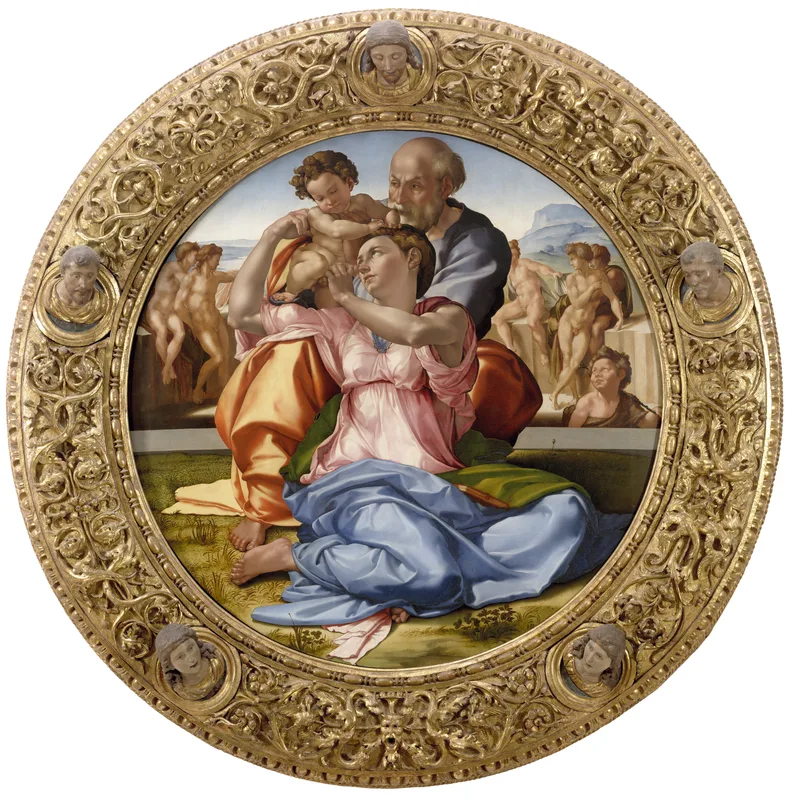
The young painter was learning fast. The pyramid of figures reflects a famous lost cartoon by Leonardo, the Virgin and Child with Saint Anne. It was shown at that time in the church of the Santissima Annunziata, and it made a deep impression on him. Another model was a marble Madonna by Michelangelo, now in Bruges, carved around the same years. Raphael painted several variations on this group of Mary, Jesus and John. Two of the best known are the Madonna of the Meadow in Vienna and the Belle Jardinière in the Louvre.
The couple lived on the steep hillside of Costa San Giorgio. In 1547, according to the museum, a landslide brought the house down. Some accounts give a later date. The panel was found in the rubble and was probably restored by a Florentine painter, Michele di Ridolfo del Ghirlandaio.
After that its history is unknown for about a century. It reappears in the collection of Cardinal Giovan Carlo de' Medici. The museum dates this to around 1646, while other sources give 1666. In the inventory made at his death it was valued at six hundred scudi, one of the highest prices of all.
Details
Start by taking in the whole panel. The three figures fill the lower half, and their heads rise in steps towards the face of Mary. Behind them, a wide landscape opens out, with slender trees on both sides that frame the group. The brown ground at their feet is dotted with plants, each one studied with care.
Now look at the centre, where the two boys meet. John holds the goldfinch against his chest, and Jesus lays his small hand on its head. Look closer at the bird: its red face is just a few strokes of paint. Notice also the way the two children look at each other, so serious and so tender.
Next, move to the right, to the book in Mary's hand. She holds it open, as if she had just stopped reading to watch the children. Some sources read it as the book of prophecies about her son's fate. Others link it with a title of Mary, Seat of Wisdom, and see the rock beneath her as her natural throne.
Then look to the far left, at the landscape. A small arched bridge crosses the river among the rocks. Infrared images made during the restoration show that the painter invented this bridge directly, without tracing it from his drawing. On the right, he had first planned a tower and a round building, but in the end he left an open view instead.
Finally, look down at the feet. The Christ Child sets his little foot on his mother's foot, sheltering between her knees. Some scholars see here an echo of the marble Madonna by Michelangelo. Around them grow small white flowers.
Details up close
Legacy
Raphael is counted among the great masters of the High Renaissance, together with Leonardo and Michelangelo. He was born in 1483 and died in 1520, at only thirty-seven. In 1508 he left Florence for Rome, where many of his commissions came from the Vatican. The Madonnas he painted in Florence mark the moment when his own style reached maturity.
This panel shows what he learned and what he changed. The pyramid comes from Leonardo, but the mood is different. Leonardo's groups are full of mystery. Here there is serene sweetness, calm spirituality and simple family affection, much easier for the viewer to share. Even the traditional sadness of Mary, who foresees her son's death, has almost faded away.
The picture was admired from the start. Vasari praised it at length. It is the only work of the painter's Florentine years that he described in such detail. Later it became one of the treasures of the Medici. In 1704 or 1705, the sources differ, it was on show in the Tribuna of the Uffizi.
Its fame kept growing. By the middle of the nineteenth century it was one of the most admired and most copied paintings in the gallery. Many old copies survive, for example in the Victoria and Albert Museum and in the sacristy of the abbey of Vallombrosa. Preparatory drawings by Raphael are kept at the Ashmolean Museum.
The restoration completed in 2008 gave the picture a second life. It was celebrated with an exhibition in the Palazzo Medici Riccardi in Florence. Today visitors can once again see the fresh colours and the clear light that so impressed Raphael's contemporaries.
- Date
- Entro febbraio 1506
- Technique
- Olio su tavola
- Size
- 107 x 77,2 cm
- Inventory
- 1890 n. 1447
- Image
- Wikimedia Commons · CC BY-SA 4.0
- Official page
- www.uffizi.it
Sources (6)
- Gallerie degli Uffizi – Madonna del Cardellino · official
- Uffizi Galleries – Madonna of the Goldfinch · official
- Google Arts & Culture – Madonna of the Goldfinch · guide
- Wikipedia (en) – Madonna del Cardellino · academic
- Wikipedia (it) – Madonna del Cardellino · academic
- 维基百科(中文)– 金翅雀圣母 · academic
In the same room
By the same artist
Personal, non-commercial site. Image: Wikimedia Commons · CC BY-SA 4.0.
Pinch or scroll to zoom